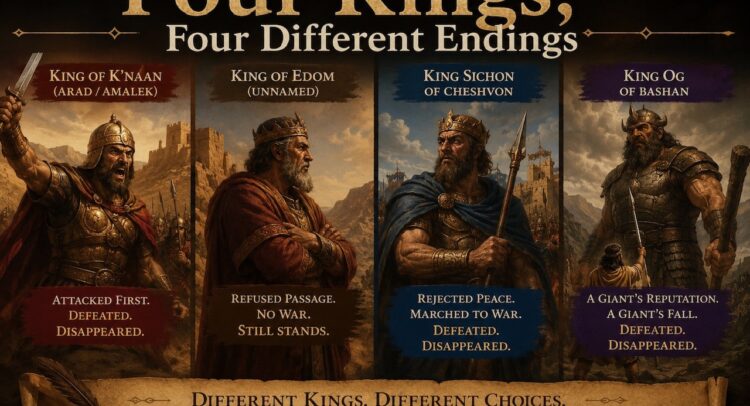
Four Kings, Four Different Endings
But before we get to the kings, let’s shout out one amazing queen. This past Sunday, we had the great pleasure of wishing Mrs. Shirley Schachter a very happy 100th birthday, continued blessings, and good health. Surrounded by family and generations of children, grandchildren, great, great, and even greater, along with friends, the celebration began with a shiur by Rabbi Shay Schachter tailored to the occasion. I have the great pleasure of seeing and schmoozing with Shirley every so often. Sharper than a tac, she is always a pleasure to converse with and is truly a one-of-a kind matriarch to the five generations she has nurtured. May the RBSO continue to shower this special woman with continued good health. Mazel tov!

As these words are being written, Israel finds itself fighting a war against Iran and its proxies while simultaneously navigating pressure, advice, warnings, demands, and occasional support from allies near and far. Every television pundit, retired general, podcaster, taxi driver, and Kiddush Club foreign policy expert seems to have an opinion. Attack. Don’t attack. Negotiate. Don’t negotiate. Show restraint. Show strength. Escalate. De-escalate.
Sound familiar? It should because three thousand years ago, Moishe Rabbaynu faced remarkably similar questions. Not every enemy was treated the same. Not every provocation led to war. Not every war was avoided. One king attacked and was destroyed. Another threatened and was ignored. A third rejected diplomacy and lost his kingdom. A fourth was a giant who believed himself invincible until history proved otherwise. The challenge then was the same as it is today. Not deciding whether war is always right or always wrong. The challenge was figuring out who was standing on the other side of the border. Sound familiar? It should. Because the enemies Moishe faced all appear in this week’s parsha. Four kings. Four confrontations. Four very different responses.
Shoin, it’s kimat the end of June and time is mamish flying by. Tishe Be’ov is not far off and neither are the big ones, Rosh Hashono and Yom Kippur. And just like that, we’re at Parshas Chukas, where the Heylige Toirah’s clock doesn’t spring forward one hour—it jumps ahead thirty-eight years in the span of a few pisukim.
Aside from the first nineteen pisukim devoted to the Poro Adumah —a red cow whose ashes somehow purify the impure while simultaneously contaminating those performing the purification process—the parsha reads like a Hollywood action movie. Miriam dies. The miraculous well disappears. The nation complains. Moishe loses his temper. A rock is struck. Water gushes forth. Moishe and Aharon receive the devastating news that neither will enter Eretz Yisroel. Aharon dies. The Canaanites attack. Snakes invade the camp. An image of a copper snake will heal them. And before the parsha concludes, the Yiddin will find themselves engaged in major military confrontations. I need a nap.
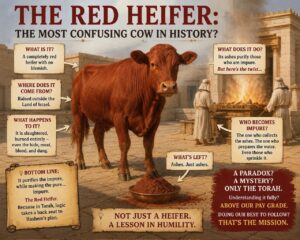
That all said, over the past sixteen years of Heylige Ois parsha posts, we’ve discussed Miriam’s well, Moishe’s striking of the rock, the sin at Mei Merivah, Aharon’s passing, the copper snake, and just about every other headline event in the parsha. Just about but not quite every one, and this year for the first time, the heylige Ois will focus on several barely-discussed characters who suddenly emerge from the shadows and play starring roles in the final chapters of Chukas. It’s mamish relevant.
I’m referring to four kings. Not kings of Persia. Not kings of Babylon. And not the kings or other top leaders currently making headlines on CNN, Fox News, Newsmax, X, Truth Social, or whatever source of aggravation you prefer. I’m talking about kings of K’anan, Edom, Sichoin, and Oig. Four rulers and several encounters with the Yiddin at a critical time -mamish weeks before they will finally be poised to enter the promised land. And four very different outcomes. Hidden within their stories lies one of the Heylige Toirah’s most fascinating lessons about diplomacy, restraint, war, and knowing when to walk away from a fight. Is this history relevant today as Israel again finds itself at war with the usual suspects and under immense pressure from its friend? Let’s meet the players.
At first glance, the four kings appear to be little more than supporting actors in the drama unfolding around the Yiddin. Read the pisukim quickly and one can easily miss what is really happening. But slow down for a moment and a fascinating pattern emerges. Four kings enter the story. Two of them go nameless; why, ver veyst? One attacks first, no reason given. One refuses passage. One rejects a peace proposal and marches to war. One is a giant whose reputation alone could terrify an army. Three will disappear from history. One will survive. Three kingdoms will fall. One kingdom will remain standing. And that’s where the questions begin.
Why was the King of K’nan attacked and defeated? Why was Sichoin attacked and defeated? Why was Oig attacked and defeated? And perhaps most puzzling of all, why was Edom spared? As an aside, if you’re wondering where all this can be found and why you never heard of these wars before, it’s likely the case that you were already tuned out, or at the kiddish club in past years when this parsha was read, but the kings and the wars are all detailed in the parsha.
The first king to enter our story is the King of K’naan. Or perhaps not. Already in the opening pasuk we encounter a mystery. The Toirah tells us: “וישמע הכנעני מלך ערד”
“The Canaanite King of Arad heard that the Yiddin were approaching.”
He launches a surprise attack and succeeds in taking captives. Hostages. Sound familar? And just like that, before the Yiddin have even crossed the Yarden, before they have entered the land, before they have settled a single city, they find themselves at war. Who exactly was this king? The heylige Toirah tells us he was the ruler of Arad, a city in the southern region of Canaan. Ober, Rashi, citing Chazal, throws a wrench into the story. According to Chazal, this was not really a Canaanite king at all. It was Amolake. He was back for more! Knowing that the Yiddin had been commanded to wage war against Amolake, they allegedly disguised themselves as Canaanites and attempted to confuse the Jews. In other words, the very first king in our story may not even be the nation the Toirah appears to identify. Trust the Toirah to begin with a plot twist. Whatever his identity, the attack itself is significant because this king attacks first. No negotiations. No peace proposal. No diplomatic outreach. No summit meeting. No ceasefire discussions. No mediator flying in from a neutral country. He attacks. More troubling still is this: The Toirah records that he succeeded in taking captives. According to Chazal, the number of captives was extremely small, perhaps even a single maidservant. Yet the message was unmistakable. The enemy had struck first.
How do the Yiddin respond? Not with panic. Not with surrender. And interestingly, not immediately with military force. First, they turn to the RBSO. The Toirah records that the Yiddin made the following neder (vow).
“If You deliver this nation into our hands, we will dedicate their cities to destruction.”
Only after prayer comes battle. Only after dependence on the RBSO comes military action. The result was decisive. The king was defeated. His cities were destroyed. And the place was renamed Chormah. Exactly where that’s located today is the subject of much controversy. Want more information? Try Google or one of the AI options. As an aside, the heylige Toirah is silent on the hostage; we assume he/she or they were rescued. What’s fascinating is that the heylige Toirah spends more words describing the capture than the rescue. The hostage is introduced. The hostage disappears. No follow-up. No interview on CNN. No memoir. No hostage-release ceremony. Nothing. Almost as if the Toirah’s interest is not in the captive but in the reaction of the Yiddin. The moment a Jew is taken, the nation mobilizes. The neder is made. The war is fought. The enemy is defeated. Mission accomplished. The bottom line. The first military episode in Chukas begins not with a territorial dispute, not with a border crossing, and not with an invasion. It begins with a hostage. One Jew. One captive. And the nation’s response is immediate. And the lesson? It seems obvious. When an enemy attacks first, takes captives, and seeks destruction, there is little room for diplomacy. The response is war.
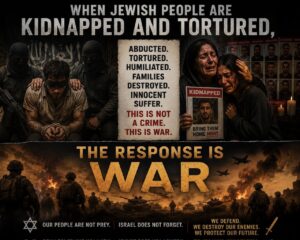
To wit: Since October 7, the IDF and Shin Bet have eliminated 2,555 terrorists who took part in the massacre. And the job isn’t finished yet. Until the last one. According to security assessments, approximately 6,000 terrorists participated in the October 7 terrorist attack, including around 3,800 Hamas Nukhba commandos. These forces crossed the border fence, infiltrated Israeli communities and military positions, and took an active part in the massacre and invasion of Israeli territory.
The next king to enter our story is the unnamed King of Edom. The Heylige Toirah never tells us his name. Think about that for a moment. It names Sichoin. The Heylige Toirah also names Oig. Soon it will name Bolok and Bilam. Yet the ruler of an entire nation, one important enough that the RBSO specifically commands the Yiddin not to provoke, remains anonymous? What’s pshat? He is simply referred to as “Melech Edom”—the King of Edom. No first name. No family name. No biography. Gornisht! Might we kler that he goes unnamed because the individual king was irrelevant? The story was never about him; it was bigger than him? The story was perhaps about the nation of Edom. About a conflict that began centuries earlier between Yaakov and Eisav and continued long after both brothers had left this world? The king was merely the latest actor cast in a role written generations before he was born. What went down?
Moishe dispatches messengers to this unnamed king with what may be the most respectful diplomatic communication found anywhere in Tanach. He begins not with demands, threats, or military boasts. He begins with family. “Ko amar achicha Yisroel”—Thus says your brother Israel. Your brother. Not your neighbor. Not your ally. Not your trading partner. Your brother.
Moishe then recounts the history of the Yiddin’s suffering in Mitzrayim and their miraculous redemption. He explains that the nation now finds itself at Edom’s border and requests permission to pass through the country. The request could hardly have been more accommodating. We will not enter your fields. We will not enter your vineyards. We will not drink your well water. We will remain on the King’s Highway. If we consume anything, we will pay for it. Avada Moishe knew that Yiddin -even when but crossing through- must stop -at least for kiddish to eat and drink. In modern language, Moishe was offering a fully insured, all-expenses-paid transit agreement. The response? Absolutely not. Not only does Edom reject the request, but he mobilizes an army and marches out to confront the Yiddin. At this point, one would expect war. After all, this was no small band of travelers. The Yiddin (even after the RBSO thinned out the population greatly over the past 40 years) were still formidable and numbered in the millions. Yet something astonishing happened. Moishe walked away. No battle. No retaliation. No military response whatsoever. The Heylige Toirah (Bamidbar 20:21) simply tells us:
וַיְמָאֵן אֱדוֹם נְתֹן אֶת־יִשְׂרָאֵל עֲבֹר בִּגְבֻלוֹ וַיֵּצֵא אֱדוֹם לִקְרָאתוֹ בְּעַם כָּבֵד וּבְיָד חֲזָקָה׃
וַיְמָאֵן אֱדוֹם נְתֹן אֶת־יִשְׂרָאֵל עֲבֹר בִּגְבֻלוֹ וַיֵּט יִשְׂרָאֵל מֵעָלָיו׃
“So Edom refused to allow Israel passage through its border, and Israel turned away from him.”
It’s a remarkably understated ending. After all the diplomatic effort, the military threat, and the expectation of war, the Torah concludes the entire episode in just four Hebrew words. No battle. No retaliation. No further discussion. Just… Israel turned away. That brevity itself is striking. Wow! And that raises what may be the some very important questions.
Yet perhaps the real question is not why Edom said no. The real question is why Moishe asked. Did Moishe really believe the descendants of Eisav would suddenly welcome the descendants of Yaakov? Or was the request itself the lesson? Before there is war, there must first be an attempt at peace. Before there is confrontation, there must first be conversation.
Before we can understand the encounter with Edom, we need to understand something even more fundamental. Why was Edom there in the first place? Why did the descendants of Eisav possess an established homeland while the Yiddin were still wandering through the wilderness? The answer is both simple and astonishing. Because the RBSO gave it to them. Case closed! In Sefer Devorim, Moishe reminds the nation that the RBSO specifically prohibited any confrontation with Edom.
“Al tisgaru bam.” Do not provoke them. And why not? “Ki yerusha l’Eisav nasati es Har Se’ir.”
“Because I have given Har Se’ir to Eisav as an inheritance.”

Read those words carefully. Har Se’ir was not seized by Eisav. It was not stolen by Eisav. It was not conquered by Eisav. It was granted to Eisav by the RBSO Himself. And that raises an uncomfortable question: If Eisav was the villain many of us imagine him to be, why would the RBSO grant his descendants a permanent homeland? Let me ask a shayla. When was the last time the RBSO awarded permanent real estate to a nation He despised? If Eisav was merely a cartoon villain, why does the Toirah repeatedly protect his inheritance? More troubling still, why would the RBSO protect that homeland centuries later and forbid the Yiddin from taking even a small piece of it? Apparently, the story of Eisav is far more complicated than the children’s version many of us learned in elementary school. In fact, the Ois has -on several occasions over these past sixteen years- questioned why our sages paint him so ugly when the RBSO seemingly had much warmer feelings for him. Shoin.
Yes, Eisav made terrible choices. Yes, Chazal are sharply critical of much of his conduct. But yet, the RBSO had some warm feelings for Eisav. Eisav honored his father to an extraordinary degree. Our sages describe his kibbud av as virtually unparalleled. Could it be that Har Se’ir was, at least in part, the reward for that mitzvah? Could it be that the heylige Toirah is teaching us that the RBSO does not ignore even the merits of someone like Eisav? Is that why Moishe approached Edom as a brother and not as an enemy? Could well be! Because before there was an Edom, there was an Eisav. Before there was a geopolitical dispute, there was a family relationship. And before there was hostility, there was a brother who, despite all his flaws, had been granted a legacy by the RBSO Himself. Gishmak!
Then came Sichoin. And this is where the story becomes truly puzzling. A short time after the encounter with Edom, the Yiddin find themselves facing another king. This time the ruler is not anonymous. His name is recorded for all eternity. He is Sichoin, King of the Emori. What happens next should sound remarkably familiar. Moishe again dispatches messengers. Moishe again requests peaceful passage through the country. Moishe again promises that Klal Yisroel will remain on the designated route. Moishe again assures the king that no damage will be done. And once again, the answer is no. Not only no, but a military no. Sichoin gathers his forces and marches out to confront. At first glance, the two stories appear nearly identical. Moishe asks Edom for passage. Edom refuses. Moishe asks Sichoin for passage. Sichoin refuses. Edom mobilizes an army. Sichoin mobilizes an army. Yet the outcomes could not be more different. When Edom says no, Moishe turns around and takes the long route. When Sichoin says no, Moishe goes to war. Not merely a skirmish. Not a limited military operation. Not a symbolic show of force. An all-out war. The Heylige Toirah tells us that the Yiddin defeated Sichoin and captured his cities. An entire kingdom fell into Jewish hands.
The obvious question practically jumps off the page. What changed? The request was the same. The refusal was the same. The military threat was the same. So why was one king left alone while the other lost everything? The simple answer is that the RBSO had previously instructed the Yiddin not to provoke the descendants of Eisav. Edom’s land had been granted to Eisav, and no matter how unfairly Edom behaved, no matter how unreasonable its response may have been, Moishe’s hands were tied.
And then -mamish a few pisukim later- comes Og. Unlike the King of Edom, whose name we never learn, and unlike Sichoin, whose kingdom had only recently entered our story, Og arrives carrying centuries of baggage. Most people know Og as the giant. We spoke of him just a few weeks back. And indeed, later in the Heylige Toirah we are told of his enormous dimensions. Chazal fill in the picture even further, portraying him as a towering figure whose physical size was matched only by his ego. But Og was more than a giant. According to Chazal, he was a survivor from an earlier world. A very earlier world. The medrish identifies Og as the fugitive who informed Avrohom that Loit had been captured during the war of the four kings against the five kings. If true, Oig had personally known Avrohom Avinu.
Think about that for a moment. Avrohom was gone. Yitzchok was gone. Yaakov was gone. The Shvotim were gone. Entire civilizations had risen and fallen. Empires had come and gone. And somehow Oig was still around. He was the last living reminder of a world that had almost vanished from history. A few weeks back the heylige Ois mentioned that the RBSO -for reasons we aren’t necessarily supposed to chap- kept giants around. Oig is one such giant. Perhaps that explains why his appearance feels so different from the encounters with Edom and Sichoin. Edom represented the unfinished story of Yaakov and Eisav. Sichoin represented a present-day political obstacle. Oig represented the past. A relic. A holdover from a previous era. A man who had witnessed history but failed to learn from it. One might imagine that after living through generations of miracles, after witnessing the rise of Avrohom’s descendants, after seeing the Hand of Hashem guide Jewish history, Oig would have reached a simple conclusion. Don’t fight these people. Instead, he does exactly the opposite. He marches to war.
The medrish famously portrays Oig as so confident in his own strength that he viewed the Yiddin as little more than an annoyance to be eliminated. It is one of the great ironies in the Heylige Toirah. The man with the longest perspective possessed the shortest vision. He had seen more history than anyone alive. Yet he failed to understand where history was heading.
The bottom line: Not one of the four kings in our parsha was exactly what he appears to be. The first may not even be the nation the Toirah calls him. The second doesn’t have a name. The third loses a kingdom. The fourth is a giant from another era. So why does the heylige tells us about these kings? Perhaps that is why the four kings appear together in our parsha. Edom teaches that not every battle should be fought. Sichoin teaches that some battles must be fought. And Oig teaches that no matter how powerful a person may appear, eventually history catches up with everyone. Even giants. Especially giants.
And as these closing words are being written, pundits, politicians, generals and keyboard warriors all have opinions about Iran, Israel and what should happen next. There is no shortage of opinions about Israel, Iran, diplomacy, deterrence, restraint, and war. The heylige Toirah’s inclusion about the four kings reminds us that there is no single answer to every threat. Sometimes the response is K’naan. Sometimes it is Edoim. Sometimes it is Sichoin. And sometimes it is Oig. The difficult part is identifying which king is standing on the other side of the border before making the decision. Three thousand years later, that remains the hardest question in foreign policy.
A gittin Shabbis!
The Heylige Oisvorfer Ruv
Yitz Grossman
