Raboyseyee and Ladies,
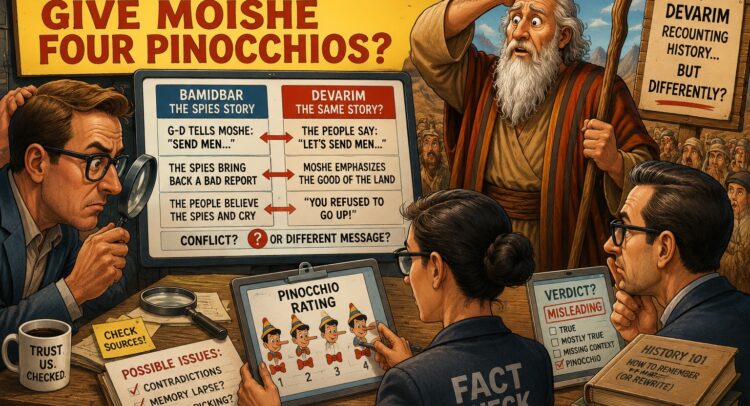
Would Today’s Fact-Checkers Give Moishe Four Pinocchios?
Say it isn’t so! Better yet, don’t even ask such a question. Questions like these can get a person thrown out of a yeshiva, disinvited from a few Shabbis tables, removed from at least two WhatsApp groups, and depending upon which neighborhood you live in, might also hurt your grandchildren’s shidduchim. Ober (but) if you’ve been reading the heylige Ois these past sixteen years, you already know that I have a knack for asking questions that make otherwise normal people slightly uncomfortable. Nu, somebody has to.
Let’s begin with a confession.
There are certain questions that, somewhere between second grade and adulthood, we simply learn never to ask. Not because they’re stupid. Not because they’re disrespectful. And certainly not because there aren’t answers. Rather, because they make us—and often our rabbeim—uncomfortable. We assume that if nobody in yeshiva ever mentioned the subject, the topic itself must somehow be treif. Better to keep quiet than risk sounding like the class apikores. Every yeshiva had one. Some had two. In one of the yeshivas my poor parents paid tuition to, I somehow managed to be both.
This week, however, I’m going to ask one anyway. Not because I enjoy getting comments from angry readers -although some of those are quite entertaining- but because the question itself jumps off the very first page of Sefer Devorim. Did Moishe rewrite the Toirah?
Relax! Don’t call the Vaad just yet; put down the phone. Nobody’s denying Heylige Toirah min HaShomayim. Farkert and Chas v’sholom! By the time we’re finished, you might just be a stronger believer than when you started reading. Or not! But first, let’s create a little confusion. It’s healthy. The heylige Gemora has been doing it to us for centuries. It’s also put more people to sleep during class and at bedtime than any drug!

Let’s go back for a moment. For nearly forty years Moishe was the busiest employee in Jewish history. No vacation days. No pension. No Human Resources department. Millions of complaints. One rebellion after another. The man was hired at eighty, is now one hundred and twenty, knows he has barely thirty-seven days left to live, and suddenly develops a desire to talk. Boy, does he talk. Ironically, this is the very same Moishe who once stood barefoot in front of a burning bush and tried convincing the RBSO that He had chosen the wrong man.
“לא איש דברים אנכי.” “I’m not a man of words.”
Really? Open Sefer Devorim. The man won’t stop talking. Three speeches. Thirty-seven days. An entire Chumish. Apparently, somewhere between the burning bush and the Plains of Moav he found his voice. Or perhaps his wife finally let him get a word in. Maybe that’s why he left her? Ver veyst? And what does he spend those final weeks talking about? Everything. The Eygel. The Meraglim. The judges. The wars. The complaints. The failures. The miracles. It’s almost as though, much like your own eishes chayil after twenty-five years of marriage, Moishe suddenly becomes historical. Does she not remember every questionable decision you’ve made since the day you met? Of course she does. Women possess a remarkable gift. Men remember stuff -even good stuff- poorly. Women remember arguments perfectly. When they do, they get angry again as if it just happened; yikes! Forty years later she can still quote you word for word. “That’s what you said or did -wrong- on this and that day back in 1997.” Amazing creatures. Shoin.

Ober, the question isn’t why Moishe reviewed history. Every leader does that. The question is something else entirely. Why does he tell some of the stories differently? Did he forget? Imagine today’s fact-checkers getting hold of Sefer Devorim. Within fifteen minutes there’d be twenty-seven Instagram reels titled: “Five Mistakes Moishe Made While Remembering the Exodus.” CNN would have one panel. Fox another. Reddit would already have a 600-comment thread. Some guy living in his mother’s basement would proudly announce that he had “debunked” the Toirah because Devorim tells the Meraglim story differently than Bamidbar. Ober, guess what? Chazal were discussing this little “problem” about 1,800 years before Wi-Fi was invented. It so happens that modern day scholars and others taka latched onto these differences; more on that later.
Did he forget? Or, did he stam azoy revise a number of stories for reasons only he knew? Now open your Chumish. Actually, open two. Keep one finger in Bamidbar. The other in Devorim. Because if you don’t compare them side by side, you’ll miss one of the most fascinating literary features in the entire heylige Toirah. One hundred and seventy-five times the heylige Toirah introduces the RBSO’s words with the now familiar formula: “וידבר ה’ אל משה לאמר.” Another sixty-seven times it begins: “ויאמר ה’ אל משה.”
The pattern is almost hypnotic. Hashem speaks. Moishe listens. Moishe writes. Again. Again. And again. Then, without warning, we arrive at Sefer Devorim. The formula disappears. Instead, we read: “אלה הדברים אשר דבר משה…”
“These are the words that Moishe spoke.” Nu? Did you chap what just happened?
For four Chumoshim we’ve been listening almost exclusively to the Voice of the RBSO. Suddenly the heylige Toirah hands the microphone to Moishe. Not once. Not twice. The entire Sefer. He’s reviewing. He’s rebuking. He’s interpreting. He’s explaining. He’s emphasizing certain details while racing past others. Sometimes he even tells familiar stories in ways that don’t quite sound like the versions we learned earlier. Wait a minute. Has history changed? Did the greatest Novee who ever lived suddenly begin suffering from memory loss during his final month? On the other hand, the man was 120! I forget why I walked into the kitchen. Moishe remembered conversations from thirty-eight years earlier; impressive. My wife remembers conversations from thirty-eight years earlier too. Which is both amazing…and terrifying. Could he have used a healthy dose of PREVAGEN? Or, is something much deeper happening?

Let’s investigate. Because once you notice it, you can’t unsee it. Take the very first example. Back in Parshas Yisroy, the story seems perfectly straightforward. Yisroy watches his son-in-law trying to judge every dispute among the Yiddin from sunrise until sunset. Concerned that Moishe will collapse before reaching retirement age -which, in Moishe’s case, turned out to be one hundred and twenty- the shver offers a brilliant piece of management advice. Delegate. Create judges. Build a court system. Everybody lives happily ever after. Case closed. Except…Open this week’s parsha. Suddenly Yisroy is almost nowhere to be found. Recalling the event, Moishe tells the people: “הבו לכם אנשים…” “Bring me capable men…” Nu? Whose idea was this? Yisroy’s? Or Moishe’s? Did Moishe just take credit for his father-in-law’s greatest consulting job? Can you imagine LinkedIn?
Leadership Tip #47: Always take credit for your father-in-law’s ideas.
So what’s pshat? Did Moishe suddenly forget who came up with the idea? Did forty years in the sunny and arid Midbar fry his memory? Did he wake up one morning and say, “You know what? Nobody remembers what happened anymore. Most are dead. I’ll improve the story.” Avada not! The great Novee didn’t suddenly become forgetful. Nor did he decide to rewrite the Toirah. So what exactly was he doing? Let’s keep digging because the next example is even stranger.
Back in Parshas Shelach, the story of the Meraglim appears crystal clear. The RBSO tells Moishe: שלח לך אנשים – “Send men.” Simple. Case closed. Except… Open this week’s parsha. Moishe suddenly tells the Yiddin: ותקרבון אלי כולכם ותאמרו נשלחה אנשים לפנינו – “You all came to me and said, ‘Let us send men ahead of us.'” Nu? Which was it? Did the RBSO initiate the mission? Or did the Yiddin? Did Moishe suddenly begin remembering things differently? Maybe after forty years the details became fuzzy. After all, he was now one hundred and twenty. Most of us can’t remember where we left the car keys yesterday. Moishe was expected to remember conversations that took place nearly four decades earlier? Ober, before we send him for neurological testing, let’s continue because things become even stranger.
Back in Bamidbar, the Meraglim return carrying grapes the size of watermelons, frightening everyone with stories about giants, fortified cities and certain death. The nation panics. Makes sense. Fear follows bad news. Except… Read Moishe’s version. He first reminds the people how wonderful the land was. Beautiful. Flowing with milk and honey. Then he says: ולא אביתם לעלות “You simply refused to go.” Is that what happened? Not! Wait a minute. That’s not the story we remember. Back in Bamidbar the spies seem to be the villains. They were the root cause of the 38-year midbar excursion extension. Here in Devorim…Moishe barely discusses them. Instead, he turns directly to the people and says: “You refused.” “You rebelled.” “You lacked faith.” Why? Did history change? What’s pshat?
Keep that question in your back pocket. We’re going to need it. Ready for another one? Ask any child in yeshiva why Moishe never entered Israel. S/he will answer before you finish the question. “He hit the rock.” Excellent. That’s exactly what we all learned. Open Bamidbar. There it is. Mei Merivah. Case closed. Except…Open Devorim. Moishe says something astonishing. גם בי התאנף ה’ בגללכם “The RBSO became angry with me because of you.” Because of YOU? Excuse me? I don’t remember anyone forcing Moishe to hit the rock. Did Moishe just blame the Yiddin for his own mistake? Imagine standing before the Heavenly Court. “Your Honor…my clients made me do it.” Really? Could that possibly be what he meant?
By now, if you’ve been following along and comparing the stories in Bamidbar with those in Devorim, you’ve probably noticed that something very strange is happening. The story of Yisroy suddenly emphasizes Moishe’s leadership instead of his father-in-law’s advice. The story of the Meraglim shifts the spotlight away from the spies and squarely onto the people who chose to believe them. Even Moishe’s own punishment is now presented from a completely different perspective. History hasn’t changed, but there’s no doubt that the emphasis most certainly has.
As mentioned above, long before professors, bloggers, YouTube influencers and every self-appointed Toirah expert with a podcast and a ring light “discovered” these differences, Chazal themselves had already noticed them. In fact, they discussed them nearly two thousand years ago. The heylige Gemora (Megillah 31b), while comparing the Toichocho (rebuke) in Parshas Bechukosai with the one found later in Sefer Devorim, casually makes what may be one of the most astonishing statements in all of Shas. Referring to the two sets of curses, it says: “הללו מפי הגבורה והללו מפי עצמו אמרן.” The first Toichocho was spoken directly by the RBSO. The second? Moishe said it “mipi atzmo”—from himself. Excuse me? Did the Gemora really just say that? If someone posted those four words on social media today without mentioning they came from the Gemora, there would probably be a petition demanding his expulsion from every shul in America before Mincha. Yet there it is, in black and white, right in the heylige Gemora. Moishe said it “from himself.” Read those words again and let them sink in.
At this point, every frum Yid should be asking the same question. If the heylige Gemora says מפי עצמו, doesn’t that contradict everything we’ve been taught since kindergarten? That every single word of the heylige Toirah came directly from the RBSO? It does! Enter the Rambam, who, like a seasoned defense attorney sensing the jury beginning to panic, immediately rises to object. In Hilchis Teshuvah, where he codifies the Thirteen Principles of Faith, he writes in unmistakable language that anyone who claims even a single posik of the heylige Toirah originated with Moishe rather than with the RBSO has denied one of the very foundations of Judaism. Not “made a mistake.” Not “misunderstood the sugya.” Rather, he has crossed one of the brightest red lines in Jewish belief. Take that! And now we’re really stuck. The Gemora says מפי עצמו. The Rambam says don’t even think such a thing. Which one are we supposed to believe?
The yeshiva velts (world) answer, is avada both. How? Ver veyst? Whenever it appears that Chazal and the Rambam disagree, it’s usually a safe bet that the only confused fellow in the room is the heylige Ois. The Rambam isn’t arguing with the Gemora. He’s explaining (attempting to) what the Gemora cannot possibly mean. Mipi atzmo never meant that Moishe invented a posik, improvised a speech, or decided to become an author during the final month of his life. Say it’s not so. Every single word of Sefer Devorim remains Toirah min HaShomayim exactly as much as Bereishis, Shmois, Vayikro and Bamidbar. What changed was not the source of the words, but the manner in which the RBSO chose to communicate them. For the first four holy books, we primarily hear the RBSO speaking to Moishe. In the fifth, He deliberately clothes His eternal message in the voice, personality, experience and rebuke of His prophet. The words are still the RBSO’s. The voice is unmistakably Moishe’s.
And, if that’s pshat, our contradictions begin to disappear. Yisroy wasn’t written out of the story; Moishe was emphasizing the responsibility that ultimately rested upon his own shoulders. Gishmak! The account of the Meraglim wasn’t rewritten; the lesson changed from the spies’ betrayal to the nation’s willingness to believe them. Even the episode of Mei Merivah is viewed through the eyes of a leader who understood that when a nation stumbles, its leader ultimately bears the consequences. History never changed. The audience did. Forty years earlier, Moishe was leading a nation of newly freed slaves who required miracles, direction and constant reassurance. Now he stood before their children, a generation preparing to cross the Jordan, conquer a land, establish a government, appoint judges and live without the man who had led them for four decades. They no longer needed a travel diary. They needed a farewell address. They no longer needed information. They needed interpretation. They no longer needed to know merely what happened. They needed to chap what it all meant.
Is that the greatest chiddush of Sefer Devorim? Could be! The RBSO did not ask Moishe to repeat the Toirah as though he were reading yesterday’s minutes from a board meeting. He asked him to teach it. Every rebbe does exactly the same thing. Every Rav does exactly the same thing. Every parent who tells the same family story differently to a six-year-old than to a thirty-six-year-old, is doing exactly the same thing. The facts haven’t changed. The listener has. The heylige Toirah is eternal, but every generation needs to hear that eternity in a language it can understand. That’s not rewriting the Toirah. That’s teaching the Toirah. And perhaps that’s why the fifth Chumish begins, not with the familiar words “וידבר ה’ אל משה לאמר,” but with “אלה הדברים אשר דבר משה.” These are the words that Moishe spoke—because these are the very words the RBSO wanted the nation to hear through the voice of His greatest servant.

The bottom line: If you think these questions about Moishe’s revisionist history first occurred to a few modern Bible professors sitting around a university seminar table sometime in the nineteenth century, think again. Long before Julius Wellhausen, long before documentary hypotheses, and long before people began making a very comfortable living “discovering” contradictions in the heylige Toirah, our sages themselves had already noticed that Sefer Devorim sounds different. Much different. They were the first to notice that after four Chumoshim of “וידבר ה’ אל משה לאמר,” the Toirah suddenly opens with “אלה הדברים אשר דבר משה.” They were the first to ask why the stories are retold differently. They were the first to grapple with the Gemora’s startling expression “מפי עצמו.” In other words, don’t let anyone tell you that asking these questions is somehow un-Jewish. The questions are as old as the Gemora itself. The only difference is that Chazal asked them מתוך אמונה (believers), while others asked them מתוך כפירה. They are the revisionists.
Nor did the discussion end with the Gemora. It continued through the centuries. The Ramban, Abarbanel, Ohr HaChaim, Netziv, Malbim and many others each struggled to define exactly what מפי עצמו means. Kabbalistic sources add still another dimension, seeing Sefer Devorim as the point where the voice of Heylige Toirah begins to merge with the perfected voice of Moishe, whatever that means. Even the famous discussion in Bava Basra concerning the final eight pisukim of the Heylige Toirah—whether they were written by Moishe with tears (writing about his pending demise) or completed by Yehoshua (Moishe already dead), demonstrates that Chazal were never afraid to explore difficult questions. They simply refused to reach conclusions that undermined the heylige Toirah’s Divine origin. For them, the discussion was never whether the heylige Toirah came from Heaven. That was never up for debate. The discussion was how Heaven chose to reveal it.
Non-believers and revisionists begin with the differences and conclude there must have been multiple authors. Chazal began with the same differences and concluded there must be a deeper understanding of prophecy. Same observations. Entirely different worldview. One approach sees contradictions, the other sees layers. One assumes human authorship, the other searches for Divine intention. Modern critics and Chazal noticed exactly the same phenomenon. The critic sees a problem. Our Sages saw a mystery. One tried to dismantle the heylige Toirah, the other tried to understand it more deeply.
A gittin Shabbis and an easy fast ahead!
The Heylige Oisvorfer Ruv
Yitz Grossman
