Raboyseyee and Ladies,
Breasts, Billionaires and Bitter Waters
For much of modern political discourse, especially of late and especially from those on the far left, attacking the wealthy has become almost irresistible theater. A politician can ignite a crowd simply by denouncing “millionaires,” “billionaires,” “the elites,” or “the oligarchs.” Blaming the rich has become a reliable applause line. Let’s tax them, punish them, humiliate them and make them miserable. And taka, at selected times, limoshol (by way of example), when some foreign national is funding far left hate groups or useful idiots to carry signs and make noise, society often does have reason to feel uneasy around enormous wealth. Money accumulates power; power accumulates influence; influence eventually begins bending politics, media, morality, and eventually even truth itself. Civilization has always carried a deep suspicion toward those who possess too much.

Ober is this some newfangled progressive invention? Not even close. Long before campaign rallies, social media mobs and cable news, the Heylige Toirah itself already grappled with society’s uneasy dependence upon the wealthy. Mamish azoy? Nowhere is that tension more quietly fascinating than in Parshas Nosi which, with its 176 pisukim, is mamish overflowing with controversial and difficult topics to include those with great wealth. Ober, given that this is my 16th annual Nosi post, many of the obvious battlegrounds have already been explored. The suspected Soita woman -suspected of being touched by another while married- could probably sustain another decade of columns and still leave material untouched, ober this year another question caught my attention first. One that almost nobody seems to ask.
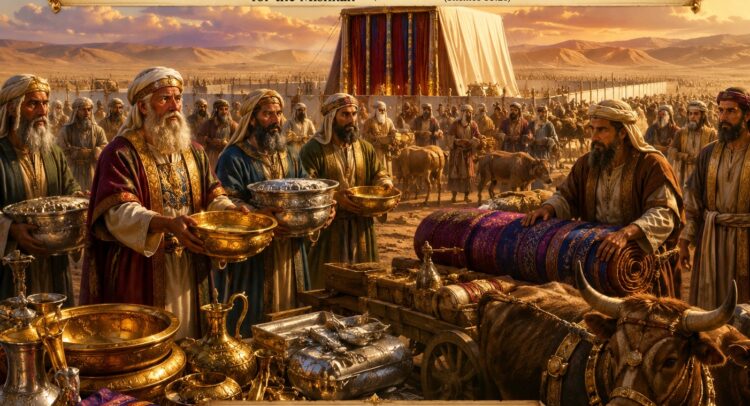
The Mishkan — the largest and holiest national project in Jewish history- did not emerge from some utopian socialist society of economic equality. Farkert. Quite the opposite. Suddenly, in the middle of the desert, a class of astonishingly wealthy leaders appears: The Nisim. They donate silver bowls, golden spoons, wagons, oxen, livestock and enormous public offerings. The Heylige Toirah presents them almost like aristocrats.
And here the obvious question practically screams from the page. Where exactly did these wealthy Jewish elites come from? Only months earlier the Yiddin had still been slaves in Mitzrayim. Not struggling immigrants. Not lower-middle-class laborers. Slaves mamish. They all left together. They all baked the same rushed matzos. They all crossed the same Yam Suf. And suddenly, almost overnight, Klal Yisroel now contains an elite donor class capable of underwriting national infrastructure projects?
How? Did some Jews “borrow” more enthusiastically from the Mitzrim (Egyptians) than others? Was there already a Jewish upper class hiding beneath the slavery? Were some slaves better off? Were certain families simply better positioned to accumulate influence and resources once freedom arrived? And perhaps the most uncomfortable question of all: Did their wealth help make them Nesiim, or did becoming Nesiim help make them wealthy?
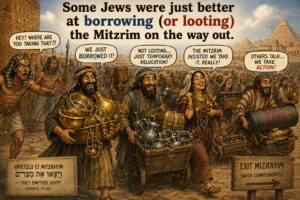
The Heylige Toirah never directly answers these questions. But it gives us clues. Yes, the Yiddin left Egypt fantastically wealthy, we talked about his topic just last week. “וינצלו את מצרים” — they emptied Egypt. Ober, the Heylige Toirah never once says the wealth was redistributed equally. In fact, human history suggests the exact opposite. Revolutions rarely eliminate hierarchy; they simply reshuffle it.
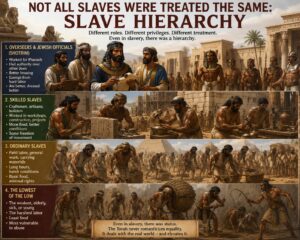
We must kler that even within slavery there were already layers of leadership and authority. The Jewish שוטרים clearly occupied positions between the Egyptian taskmasters and the people. Shevet Levi experienced different conditions altogether. Certain families undoubtedly emerged from slavery with greater organizational ability, stronger tribal influence, larger flocks, more experience managing people and resources. And the moment a society becomes free, inequality reappears almost instantly. Some people organize better. Some lead better. Some acquire influence faster. The Heylige Toirah never romanticizes human sameness because human beings themselves are not the same. What is remarkable is not that wealthy elites emerged in the desert. What is remarkable is the Heylige Toirah’s profoundly conflicted attitude toward them.
At first, Chazal criticize the Nesiim sharply. When donations for the Mishkan were initially requested, the Nesiim held back. They pledged to contribute whatever remained lacking after everyone else gave. On the surface this sounds generous, responsible, even noble. Yet, Chazal hear something subtly dangerous beneath their words: the quiet confidence that the project ultimately depends on them. “The tzibbur will give what they can — and we’ll cover the rest.” And suddenly the Heylige Toirah becomes nervous. Because the danger of wealth is not money itself. The danger begins when wealth starts believing itself indispensable. And so, as a shtikel punishment -as we were taught in yeshiva as to why the word נשאם was spelled missing one letter- two actually. Symbolically, the Heylige Toirah removed the letter Yud from their title. “נשיאים.” It is written defectively, what we call chosare- missing a letter.

The normal/full spelling is: נשיאים with two יודין. Ober, back when retelling of the donations to the Mishkan (Parshas Vayakhel/Pekudei), the Toirah writes it defectively as: נשאם – missing the יודין. Of course, our brilliant sages (medrish Tanchuma quoted by Rashi) jumped all over this and darshened that the missing letters reflect a subtle criticism of the Nesiim for delaying their donations and saying: “Let the ציבור give first, and we’ll complete whatever is lacking.” Avada the Ois points out that the heylige Toirah’s criticism is almost invisible. It doesn’t condemn them openly. It merely removes two tiny letters. As though the Heylige Toirah is saying: let’s not piss off our donors. And taka that’s a good lesson. A mild reminder that they could have stepped up earlier and not waited. And yet, the criticism/punishment is almost microscopic. Barely visible. Yet unmistakable.

But how long did that punishment last? Not very! Because in this week’s parsha, the same Nesiim are suddenly rehabilitated. Now they rush forward first, now they initiate, now they bring wagons and oxen for transporting the Mishkan, and now they dedicate the Mizbayach with magnificent offerings. And guess what? Their name is spelled full and correctly. And the Heylige Toirah rewards them and grants them something astonishing: Repetition.
Twelve times the Toirah repeats nearly identical korbonis. The Toirah could have summarized the entire section in six pisukim. Instead, every bowl, spoon, animal and measurement is repeated again and again with hypnotic detail.
Why? Perhaps because the Heylige Toirah is teaching a truth that modern society still struggles to admit: Civilization cannot function without people of enormous means. The Mishkan itself required gold, silver, animals, transportation, logistics, infrastructure, and national funding. The bottom line: Holiness itself required capital. The capital contributions of the Nesiim were recognized by the RBSO.
And that raboyseyee, remains true today no less than in the desert. People who donate typically (zicher not always) want to be recognized. The RBSO seems to have set the precedent. Today such recognition comes in the form of shout-outs, plaques, dedications, and other feel-good recognition. What a pshat! Mamish givaldig!
The bottom line: Every society publicly romanticizes simplicity while privately depending on someone writing very large checks. No organization, no matter how worthy is exempt. The list includes Yeshivas, kollels, shuls, hospitals, Hatzolah, mikvaos, Tomchei Shabbos, and myriad others (hundreds mamish). None survive on inspiration alone. Somewhere behind every great institution usually stands somebody quietly underwriting catastrophe, payroll, construction or survival.
And yet, the Heylige Toirah never fully trusts wealth either. The very same leadership class that builds later stumbles terribly. The Meraglim themselves -we’ll be reading about them in a few weeks- were princes and tribal leaders: “ראשי בני ישראל המה.” Our sages suggest they feared losing their positions upon entering the Promised Land. Koirach too is no simple populist revolutionary. He was from aristocracy; wealthy, prestigious, and influential. The Heylige Toirah seems to understand something timeless about power: elites are often both necessary and dangerous simultaneously.
Which is why the Heylige Toirah never proposes abolishing hierarchy altogether. It never imagines a world without leaders, donors, influence or wealth. Instead, it attempts something far more difficult: moralizing power. Sanctifying hierarchy. Demanding humility from those who possess influence. Perhaps that is why the Heylige Toirah both criticizes and honors the Nesiim.
Wealth itself is not evil; the danger begins when wealth forgets Who truly runs the world. Gold can become a Mishkan; the very same gold can become an Eigel. The difference lies not in the metal, but in the soul holding it. The Heylige Toirah never promised a society without elites. It demanded elites capable of kneeling before something greater than themselves.
Shoin, and so that I don’t complaints from those looking to read about the chap of the week, let’s spend a few paragraphs on the suspected Soita and here’s what’s on my mind because nowhere does the gap between the Toirah’s terrifying absolutes and lived reality emerge more sharply than in the very same parsha’s discussion of the Soita…”One of the most fascinating questions surrounding the Soita -of course anyone who went to yeshiva -including all bums and oisvorfs- paid very close attention to this subject- is whether or not, it ever actually happened in real life. What kind of question is that you ask? What chutzpah does the Ois have to question this? If the Heyilge Toirah dedicates 21 pisukim to the subject matter and describes the Soita protocol in terrifying detail, of course it happened! But did it? A woman suspected of adultery being brought to the Beis Hamikdash, forced to drink the bitter waters, and, if guilty, suffering a supernatural death? Oh, we left out a few other details all meant to embarrass her while still alive- and cause as much public humiliation as possible. These included uncovering her hair, exposing her breasts, and who knows what else but did any of this happen?

Exposing her breasts? Humm… Yes — according to the heylige Mishnah, part of the Soita procedure involved a very public degradation of the woman’s appearance and clothing, including tearing her garments in a way that could expose her chest. The Mishnah mamish describes her jewelry being removed, her hair uncovered, and her clothing torn from the neckline? Indeed so. More specifically, it says this: “If her garments were torn, her heart (chest) became exposed.” The purpose, according to our sages, was measure-for-measure humiliation (middah k’neged middah). If she had allegedly used beauty and secrecy in the context of immoral behavior, the process publicly stripped away dignity and allure. Then again, if she taka had beautiful hair and breasts, and had she been immoral by stripping down with another man, how would this new stripping down help to get her confession? Ver veyst, but one thing is zicher: the koihen assigned to the job had a good day!
Then again, we should avada point out that this was not meant as an erotic spectacle. Farkert: Chazal frame it as degradation and deterrence. The Gemora even says that if the exposure became excessive, they would cover her. Maybe the same if she enjoyed it, ver veyst? And the question is azoy: How much breast could be exposed before it became too much? Did size matter? There is zicher some tension in the sources between public humiliation and maintaining minimal standards of modesty.
May we kler (ponder) if the sheer extremity of the humiliation may itself indicate that the ritual’s practical function was psychological pressure more than actual execution? The Mishnah does repeatedly emphasize attempts to induce confession before the drinking ever occurred. In other words, the process seems almost designed to make a guilty woman say: “Enough. I admit it” before reaching the miraculous waters. Could that be why Chazal preserve so many details of the humiliation procedure yet virtually no stories of actual women dying from the waters? Ver veyst? Maybe it never went that far? Was the public shaming the visible earthly component; the miraculous punishment remained hovering in the background as the terrifying possibility no one wanted to test?
The bottom line: From a modern perspective, the Soita ritual is among the most difficult and unsettling passages in the heylige Toirah. Even Chazal appear somewhat uncomfortable with it at times, surrounding it with procedural limitations and eventually abolishing it altogether. But within the Toirah’s moral universe, the ceremony was understood as dramatizing the destruction of trust, intimacy, and sanctity within marriage — making private betrayal into a public moral crisis.
Yet, unlike so many other dramatic events recorded throughout Tanach, by our sages of the Heyilge Gemora and elsewhere, we are never told an actual story of a woman who drank and died. No names. No cases. No unforgettable public spectacle. And that silence is striking. Let’s get real because the Heyilge Gemora is specifically not shy about describing uncomfortable realities when it wants to. Chazal openly discuss executions, bodily decay, embarrassing sins, gruesome punishments, and miraculous events. The Gemora has no problem describing sexual improprieties, semen leakage, grotesque punishments, miraculous births, demons, martyrdom, and much more. And for that reason, the near-total absence of a concrete Soita narrative is conspicuous. Especially because Soita should have been one of the most dramatic public spectacles in Judaism: a woman brought publicly to the Beis, Hamikdash, Kohanim involved, some nudity (breasts only), miraculous waters, and immediate supernatural bodily collapse.
If this happened even occasionally, even once- one might indeed expect the Gemora to preserve the unforgettable story. Instead, what do we get? Crickets! Mostly procedural discussion. Instead, almost the entirety of the heylige Gemora Soita is procedural. The Gemora discusses warnings, witnesses, technicalities, delays, and qualifications- but not actual historical cases.
All this causes the heylige Ois to ask again: did this ever happen? Or, was the case of the Soita similar to other cases we read about in the Heyilge Toirah where our rabbis of the Gemora later decided never actually took place? Let’s ask more: The heylige Toirah did tell us about the public killings of the wood gatherer on Shabbis and the wisenheimer who profaned the RBSO’s name. The RBSO told us about Nodov and Avihu’s deaths, but when it comes to the Soita, nothing? Could it be that the Soita- despite her sin, and gruesome instructions about her punishment, was more like the person who poked out someone’s eye? There, they concluded that “an eye for an eye” meant monetary compensation. When it came to bout “You shall blot out Amolake, it was decided that this one remained on the books literally only in principle, though often impossible practically. Let not forget to shout out the Ben sorer u’moreh which became nearly impossible due to exegetical restrictions. And yet, our rabbis tell us that the Soita remains real but dependent on miraculous divine intervention and moral conditions? Is it? The Gemora itself famously says that certain Capital punishment exists in halacha, but the Mishnah says a Sanhedrin that killed once in 70 years was considered destructive. Which is the emes? Should men and women worry about this sin our times?
As it turns out, certain punishments in the Toirah were either never actually carried out, or were so vanishingly rare that they functioned more as moral instruction than courtroom reality. Let’s give honorable mention to the inhabitants of the ir Hanidachas (city where all inhabitants became wayward) -read all about them in the Gemora (71a).
That stated, is the Soita different? Chazal absolutely describe the possibility of a Soita dying, and they discuss the mechanics in vivid, concrete language; her stomach swelling, thigh collapsing, etc. But unlike many other dramatic biblical episodes, we are not given a famous narrative saying: “This particular woman drank and died.” At least not in an explicit, universally recognized way. We have almost no named case studies. We don’t hear that Mrs. X from Chevron drank on Tuesday and exploded in the Azarah. and that raboyseyee, is what’s on my mind. And guess what? This question has bothered later thinkers too. Some possibilities suggested implicitly by well-known exegetes and modern scholars include these possibilities: It really happened, but rarely. Like other Toirah punishments, the evidentiary hurdles made cases extraordinarily uncommon. Or, the woman usually confessed before drinking. The Mishnah says they pressured confession heavily before the actual drinking. A guilty woman might admit rather than risk miraculous exposure. Perhaps she did not want her breasts exposed. Or, the miracle itself deterred sin; if people believed it worked, few would risk it. Or, Chazal intentionally avoid sensationalism. That said, of course the heylige Gemora is chock full of stories that man a rabbi just imagined and told over for reasons we will chap one day when Moshiach makes an appearance.
The bottom line: Soita is not like ben sorer u’moreh, where a Tanna explicitly says “never happened.” But neither do we possess a famous catalog of dead Soitas; we have none. Many of the Toirah’s most severe punishments operate more as looming divine realities than as frequently observed public events.
And the final bottom line? The Mishnah and Gemora speak concretely about the woman dying if guilty, and they even record that Yochanan ben Zakkai eventually abolished the procedure when adultery became widespread and husbands themselves were no longer morally worthy. The halachic requirements were staggering. They brilliantly included a husband who himself was free of sexual sin. Ha ha! No wonder no woman ever died! Under such conditions, actual cases were impossible to find. And perhaps that is precisely why no famous Soita story exists. The Heylige Toirah wanted the fear of heaven more than the body count. Oh well!
A gittin Shabbis!
The Heylige Oisvorfer Ruv
Yitz Grossman
