Raboyseyee and Ladies,
The Midbar’s Branding Department
Jeopardy aficionados (yes, the Ois watches regularly, though admittedly with a success rate hovering somewhere between “less than respectable” and “why did I think Luxembourg bordered Peru?”) know that one category appears with astonishing frequency: Flags.
Apparently there exist human beings who can identify the national banner of Burkina Faso from fifty feet away, explain the symbolism behind Kazakhstan’s eagle, and discuss the geometric rebellion otherwise known as Nepal’s flag. Mamish amazing. Flags — their colors, symbolism, design, and tribal psychology, are on the Ois’s mind this week because Parshas Bamidbar -aside from dedicating kimat 100 of 159 pisukim to counting the Yiddin by group, by subgroup and by other measures- dedicates an astonishing amount of space and pisukim to the degalim, the banners and formations under which the Yiddin camped in the Midbar. One cannot help but wonder: What was up with flags and banners? What for? What purpose did flags and banners serve while the Yiddin were traversing the midbar for 40 years?
The heylige Toirah describes a nation that had just fled slavery, escaped Egypt in panic, crossed a split sea, entered a barren wasteland with no agriculture, no infrastructure, no permanent housing, no economy, and — according to the Toirah itself — not even enough time for their bread to rise. And yet, somehow, almost immediately, the Jews begin organizing themselves into one of the most visually elaborate societies in the ancient world. Suddenly there are flags, banners, colors and formation charts. Tribal insignias. Marching positions. Textile systems. Symbols. Precise camping arrangements. Our parsha reads less like the story of wandering refugees and more like the blueprint for a desert civilization designed by an obsessive event planner.
Were these the same Jews who fled Egypt so quickly there wasn’t enough time for bread dough to rise? Yes! The Yiddin were in fact wandering through the barren wilderness without agriculture, infrastructure, or permanent housing — surviving on miraculous heavenly food deliveries, aka: Munn! And yet somehow, amid all this instability, the Yiddin apparently found the time, energy, materials, craftsmanship, and organizational bandwidth to produce elaborate banners, tribal insignias, formation systems, colors corresponding to the Choishen (breastplate of the koihen Godol), and precise encampment maps?
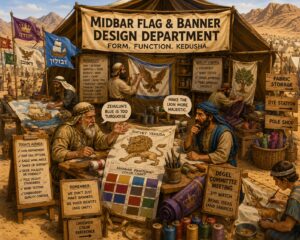
Who designed these flags? Who dyed the fabrics? Who had textiles at the ready? Who schlepped the raw goods all the way from Mitzrayim? Did they? Or, did they magically appear? Who embroidered the symbols? Did each sheyvet have its own graphics department? Was there a Vaad HaDegel arguing whether Zevulun’s blue was slightly too turquoise this year?
People read Parshas Bamidbar as if banners simply descended from heaven pre-assembled with matching poles and tasteful embroidery. But if one pauses for thirty seconds, the whole thing seems a shtikel bizarre. Where exactly did all these textiles come from? This was a desert; not Manhattan’s Garment District. Who was weaving fabric in the wilderness? Who had access to dyes? Who was sewing giant tribal banners while everyone else was collecting manna? And perhaps most importantly: who designed them? Did Betzalel open a side business? Was there an ancient Jewish version of a branding consultant somewhere near the Mishkan saying: “Yehuda really needs stronger lion imagery this season”? The emes is azoy: for all we know, the original degel of Yehuda may have been nothing more than a slightly wrinkled blue bedsheet tied to a stick. Meanwhile today every stained-glass window in America depicts a majestic gold lion that looks ready to apply for British citizenship.
And perhaps the strangest question of all: Why did any of this matter? With millions of Yiddin constantly complaining about their menu, their lack of water, and other things (to include newly prohibited sexual relations), who cared about flags and banners? And why did the RBSO want and order up flags in the first place? Why separate Jews from one another? Wasn’t Matan Toirah supposed to unify the nation? Why immediately subdivide everyone into tribal camps, formations, banners, and neighborhoods? Why institutionalize difference? Could a fellow from Shevet Dan -out on a shabbis walk- wander over to Yehuda? Could someone “switch flags” if he preferred the vibe elsewhere? Was there a tribal curfew system? Could boys and girls intermingle? Did people complain that their sheyvet was no longer what it used to be? Or, were flags and banners used to help those out and about find their way back to their own campground? Ver veyst?
Ober, pshat could be azoy: while the questions sound silly or funny, they actually reveal something astonishing about the newly minted Yiddin in the Midbar. As it tuns out, the Yiddin leaving Egyptian slavery were not primitive refugees. Not at all. Farkert: They were extraordinarily skilled. For over two centuries, they lived inside one of the most advanced societies on earth. Egypt was famous for: Weaving, dyeing, linen production, jewelry, metalwork, architecture, craftsmanship. Not to mention the hot shiksa Mitzri women many became attached to. Maybe they taka had had some relevant experience with flag poles, ver veyst- if you chap.
The Yiddin likely absorbed enormous technical skills there even while enslaved. And then came ביזת מצרים. They left Egypt carrying massive wealth: gold, silver, fabrics, precious materials, livestock, and household goods. The heylige Toirah mamish tells us that on their way out, they seemingly looted the place. Of course, this was kosher because the RBSO instructed that the Yiddin ask their neighbors to “borrow” all the items necessary. Avada you all know that when Yiddin say borrow, they mean forever. The thought of returning items, and avada valuables like gold and silver, never entered their minds. Says the heylige Toirah (Shmois 12:36) that they cleaned out Mitzrayim. “וינצלו את מצרים” (literally: “They emptied out Egypt.”). The bottom line: The Yiddin didn’t leave much behind.
And with that in mind, suddenly, the Mishkan begins making much more sense. Those tapestries did not materialize magically. The raw materials already existed. The artisans already existed. The Midbar was full of craftsmen. In fact, one of the heylige Toirah’s great hidden themes is that slavery in Egypt unintentionally trained the Jews to build sacred civilization later. The same hands forced to construct storage cities for Paroy would eventually build the Mishkan, its accorutments, and in our parsha, the flags and banners. The same textile skills once serving Egyptian royalty would now create banners surrounding the Shechinah. And that raboyseyee, is one of the greatest reversals of fortune in the heylige Toirah. As it turns out, the Midbar was not merely a survival camp; it was the construction site of a nation.
It’s taka emes that the RBSO could have commanded to use plain cloth. Simplicity only. Function over beauty. When it came time to designing and building the Mishkan and its accoutrements, the heylige Toirah repeatedly emphasizes: colors, fabrics, artistry, precious metals, embroidery, and design. The RBSO specifically demanded: techeiles, argaman, fine weaving, artistic craftsmanship, and symbolic imagery. The bottom line: The Midbar was aesthetically ambitious and pleasing to the eye. Even while wandering, even while temporary, and even while homeless. And that raboyseyee, might just be one of the deepest Jewish ideas of all: We Yiddin build beauty even in transit. Even here in golus. Especially here.
We could also argue that the banners carried another psychological function. Human beings lost in wilderness desperately need orientation. A flag is not merely decoration. A flag tells people who they are, where they belong, whom they travel with, and what story they inhabit. Without the banners, the Midbar may have felt like anonymous chaos. With them, it became organized identity. Could that be the reason why the heylige Toirah dedicates so much space to something that initially feels almost trivial? Why not? Got a better pshat? Feel free to share.
On the other hand….let’s get real: All images we have today on shul windows and other places come from the medrish and it’s entirely possible that each flag and banner in the midbar was a solid white or colored schmatta. Shoin I said it out loud but am I wrong? I don’t think so because most of the highly detailed imagery people imagine today: lions, ships, snakes, deer, elaborate tribal artwork, and stained-glass depictions, come primarily from the medrish and later traditional elaboration. They do not come from the heylige Toirah which -when it came to flag design- gives us almost no visual detail. Which means that much of what modern Jews mentally picture when hearing “degalim” is filtered through medrish, medieval commentators, artistic imagination, shul art, educational illustrations, and later Jewish symbolism. The bottom line: the iconic imagery hanging today in shul windows is largely downstream from Midrashic tradition and specifically not from explicit pisukim. Of course, it would be hard to get window dedications were each represented by a white or some other solid-colored schmatta. Imagery sells.
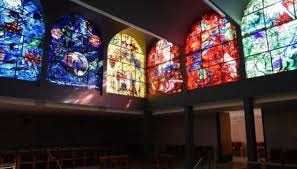
On the level of simple reading, what we call poshit pshat, one could imagine the banners being relatively simple colored cloth, tribal markers, basic standards, symbolic positioning, and perhaps minimal insignia. Maybe even, a solid white or colored schmatta. Absolutely nothing in the heylige Toirah rules that out. In fact, one could argue the Toirah’s silence almost invites that possibility. Because if the visual details were essential, the RBSO likely would have specified them more explicitly. He specifically did so when dressing the kohanim.
Oib azoy, if that’s the case, where did all this color and design come from? The answer is that our holy sages clearly imagined something richer and more symbolic. They were inspired by the details the RBSO ordered up for the Mishkan’s artistry, the bigdei kahuna (garments designed for the koihanim), the colored stones of the choishen, and perhaps also inspired by Egyptian textile sophistication. The final bottom line: Many unconsciously mistake midrashic visualization for explicit Toirah description. Those are not the same thing.
Might we argue that there’s something almost poetic about the ambiguity. Perhaps the heylige Toirah cared less about what the flags looked like and more about what they accomplished. And what they were meant to accomplish and did, was identity, belonging, structure, orientation, and mission. A plain colored banner could accomplish all of that but it would likely not inspire people to dedicate windows for many thousands of dollars.
The final bottom line: we humans naturally hunger to fill symbolic gaps. The heylige Toirah gave us flags and immediately, commentators began imagining colors, lions, symbols, heraldry, and meaning. That’s how civilizations create memory. It’s how institutions raise money. The heylige Toirah gave us one vague posik and within three generations, the Yiddin had lions, ships, stained-glass windows, commemorative plaques, and a dinner honoring the Degel Committee. Love it!
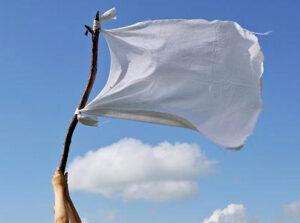
On the other hand, let’s not get carried away with the Ois’s “plain white schmatta tied to a stick” theory just yet. Avada there will be many who argue — perhaps even correctly — that just because the heylige Toirah does not explicitly spell out the exact visual details of the flags does not mean the RBSO failed to provide them orally to Moishe Rabaynu. They will argue -some strenuously- that the color and designs were zicher given over while Moishe was on the mountaintop. After all, enormous portions of Yiddishkeit were transmitted orally and never fully recorded in the written Toirah. The details of tefillin, shechita, sukkah dimensions, and countless other halachos are only vaguely referenced innvaynig and yet were clearly transmitted with precision through Toirah She’baal Peh.
Oib azoy (if that’s the case), perhaps the same was true regarding the degalim. Could be that somewhere on Har Sinai, along with everything else, Moishe Rabaynu was also handed the official tribal Pantone color chart, approved embroidery samples, authorized lion sketches, eagle positioning diagrams, and exact instructions regarding whether Zevulun’s blue leaned slightly turquoise or darker navy. Why not? The Ois is not mocking the possibility. Could very well be azoy. Efsher!
And truth be told, those making such an argument would not be entirely irrational. The Mishkan itself was designed with extraordinary precision. The dimensions, colors, fabrics, loops, hooks, and decorative elements are described in painstaking detail. The bigdei kehuna were aesthetically sophisticated. The Choishen featured carefully selected stones and colors. The entire Midbar experience was visually rich and symbolically loaded. Why should the flags have been any different?
Ober, even if one accepts that the RBSO may have orally transmitted detailed instructions for the banners, the Ois suspects there still remains a massive difference between: actual mesorah and later artistic imagination. Because nowhere do we possess an authoritative diagram showing precisely how Yehuda’s lion looked, whether Dan’s serpent resembled a cobra or a garden snake, whether Zevulun’s ship featured sails or oars, or whether Naftali’s deer looked majestic or slightly emotionally unstable.
And that raboyseyee, leaves plenty of room for later generations of Yiddin to do what Yiddin do best: fill symbolic gaps with glorious creativity.
The heylige Toirah gave us one vague posik about banners and within a few generations we already had lions, ships, stained-glass windows, classroom projects, illustrated chumashim, commemorative plaques, and shul committees figuring out how to price each.
The key posik (Bamidbar 2:2) is: “אִישׁ עַל־דִּגְלוֹ בְאֹתֹת לְבֵית אֲבֹתָם יַחֲנוּ בְּנֵי יִשְׂרָאֵל”
“Each man by his banner, according to the signs of their fathers’ houses, shall the Children of Israel encamp.”
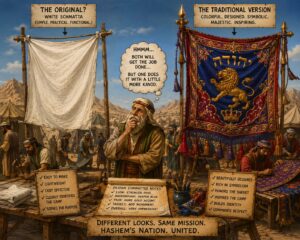
And the critical word about symbols/designs is: “בְאֹתֹת” — “with signs/symbols.” What signs and what symbols? What exactly were these “signs?” Lions? Eagles? Colored cloth? Tribal insignias? The Toirah never fully says. And perhaps that very ambiguity is what allowed generations of Yiddin — beginning with Chazal — to fill the Midbar with color, symbolism, and imagination.
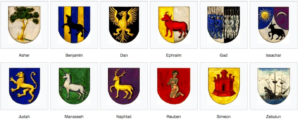
That one word is what gave Chazal room to elaborate. The medrish famously connects the colors of the degalim to the stones of the Choishen and assigns symbolic imagery to each sheyvet. Yehuda received the lion. Zevulun a ship. Dan serpent imagery.
And somewhere along the way, stained-glass window manufacturers hit the jackpot.
Could it be that these exact details were transmitted orally? Absolutely. Could it also be that generations of Jewish imagination expanded, beautified, dramatized, and artistically interpreted those details over time? Also absolutely!
And perhaps that itself became part of the story of the degalim. Because once the medrish began filling in the missing imagery — lions for Yehuda, ships for Zevulun, deer for Naftali, serpents for Dan — generations of Jewish artists took those symbolic hints and ran with them mamish.
Suddenly, the Midbar’s vague banners became:
- stained-glass masterpieces,
- illustrated chumoshim,
- poroiches designs,
- children’s classroom murals,
- silverwork,
- paintings,
- mosaics,
- and entire shul window collections sponsored l’ilui nishmas somebody’s uncle.
And let’s get real: more than a few artists became quite famous — and likely rather comfortable financially — bringing these imagined banners to life. From the dreamlike Jewish imagery of Marc Chagall and others, all the way down to local shul window designers in Brooklyn and Boro Park, Maimi, Yerusholayim and all around the world, the degalim became a booming artistic enterprise.
The emes is azoy: had the Toirah explicitly stated that each sheyvet carried nothing more than a plain beige schmatta tied to a stick, generations of Jewish art history might have looked very different. It is difficult to build a world-famous stained-glass career around “minimalist desert fabric studies.” Ober because the heylige Toirah left room for imagination, Jewish creativity flooded into the vacuum. And perhaps that too was part of the plan.
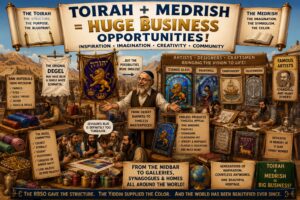
The final bottom lines: The RBSO gave the structure. The Yiddin supplied the color, texture, gold trim, commemorative plaques, donor dedications, and eventually the gift shop. Toirah plus medrish = big business!
A gittin Shabbis-
The Heylige Oisvorfer Ruv
Yitz Grossman
