Raboyseyee and Ladies,
The Girls Had the Last Laugh
This week, as the heylige Ois is in flight back to New York, he investigates the RBSO’s rather unusual choices for Jewish leadership. Let’s begin with one of the many headlines of the parsha.
Two girls got their father drunk, shtupped him, became pregnant, and gave birth to sons who would become the ancestors of nations. One of those nations would eventually produce the great-grandmother of Dovid HaMelech, progenitor of the Davidic dynasty and the lineage of Moshiach. Well, blow me down!
Try pitching that story to a Hollywood producer. He would probably ask you to tone it down. Too outrageous, too implausible, too difficult for a modern audience to swallow. And yet, it’s right there in the heylige Toirah, in black and white, without a disclaimer, a warning label, or even a footnote explaining that the events depicted should not be imitated at home.

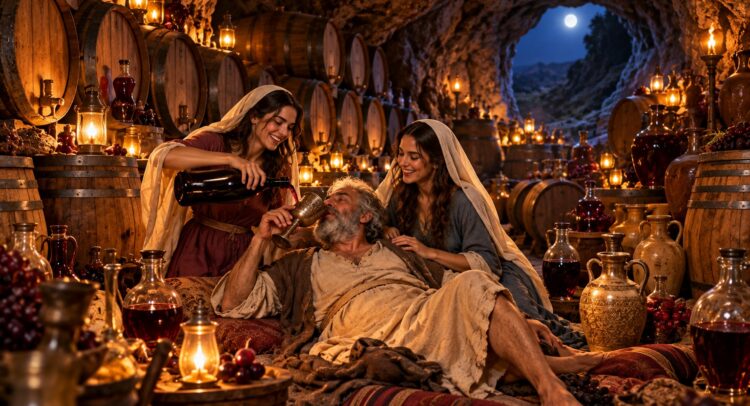
The protagonists? Loit’s two daughters. The setting? A cave, following the destruction of Sedoim (Sodom). The plan? Get Abba drunk enough that he won’t know what he’s doing, and then ensure that the human race survives. The outcome? Two sons, Moav and Ben-Ami, whose descendants would establish nations — and one of whose family lines would eventually lead to the royal house of Dovid. And the punchline? The girls had the last laugh.

Shoin, it’s not exactly the kind of family history one puts on a shidduch résumé. Not in our times. Not the sort of episode one proudly recounts at a family reunion. And certainly not the sort of ancestry that a public-relations consultant would volunteer when trying to establish the credentials of a future royal dynasty. Yet Chazal don’t simply dismiss these women as two daughters who committed an unspeakable act. They examine their intentions, distinguish between their conduct and their motives, and find lessons even in the names they gave their sons. Amazing. In reality, they act as their lawyers.
And that said, here are a few questions that make this episode worth revisiting: How does a story that begins with incest, drunkenness, and a desperate attempt to preserve humanity end up becoming part of the ancestry of Jewish royalty? And why, in telling us this story, does the heylige Toirah leave absolutely nothing to the imagination? Shoin, before we go veyter, let’s add another question about Loit: bad father or misunderstood protector? Before we get to the cave, let’s revisit what happened in Sedoim. The Ois has long maintained that Loit deserves a more sympathetic reading than the one he usually receives. The scene is well known. Two guests arrive at Loit’s home. The people of Sedoim surround the house and demand that Loit bring the visitors outside so that they can have their way with them. The Hebrew is explicit enough: וְנֵדְעָה אֹתָם — let us know them.
Rashi chapped what the Sodomites had in mind and explains that the words in Bereishis 19:5 refer to a demand for sexual relations between males. Shoin, I said it! The first homosexuals? Ver veyst? The people of Sedoim were not interested in offering the visitors a cup of tea, asking them about their travels, or inviting them to join the local chevra kadisha. They wanted the men. Loit goes outside and pleads with the mob. Then he makes an offer that has scandalized readers for generations: הִנֵּה נָא לִי שְׁתֵּי בָנוֹת אֲשֶׁר לֹא יָדְעוּ אִישׁ — I have two daughters who have not known a man. Virgins mamish! He offers to bring them out and tells the mob to do with them as they see fit, asking only that the men not be harmed. Nu, what kind of father does that? The conventional reaction is immediate condemnation. Loit is prepared to sacrifice his own daughters to protect two male guests! What could possibly justify such a proposal? Only a sick and demented father would do that; was he that person? But the Ois has always wondered whether there is another side to the story.

Loit knows what the mob wants. According to Rashi, their demand is for male sexual relations. Yes, Rashi says just that. Could Loit have believed that offering two women would divert the mob from his guests, who were the actual targets? Was he making a desperate attempt to protect the visitors by offering a substitute that the mob might reject? The text does not tell us that Loit knew his daughters would be safe. Indeed, he had no guarantee that the mob would accept his offer and leave them unharmed. But the mob rejects the proposal and attempts to break down the door to reach the visitors. The Ois’s argument is not that Loit’s offer was morally uncomplicated. It plainly was not. It is that we should at least consider the circumstances before reducing the man to a caricature of a heartless father. The Ois is proffering his own medrish here and wonders aloud whether his pshat isn’t as good as some of the other answers provided by various exegetes. Loit had chosen to live in Sedoim. He had become accustomed to a society whose values were profoundly corrupt. Yet when the mob came for his guests, he resisted. He was prepared to risk himself, and perhaps even his family, rather than surrender the men under his roof. Was that an act of extraordinary hospitality? A terrible miscalculation? A desperate attempt to protect his guests? Perhaps some combination of all three.
Ober, the heylige Toirah leaves us with an uncomfortable scene, and the Ois is not prepared to pretend that the answer is simple. But the story is not finished. Loit escapes Sedoim with his daughters. His wife is gone. The cities of the plain have been destroyed. And the family eventually finds itself in a cave, where the daughters will make a decision that will alter the course of Jewish history. And with the groundwork laid, if you chap, let’s look in on the girls in the cave. The older daughter looks at the situation and reaches a conclusion: אָבִינוּ זָקֵן וְאִישׁ אֵין בָּאָרֶץ לָבוֹא עָלֵינוּ כְּדֶרֶךְ כָּל הָאָרֶץ — our father is old, and there is no man in the world to come to us in the usual manner. Meaning, there is no man to service us sexually. There is no other pshat here. They believe that humanity has been wiped out. There are no men left to marry, no shidduchim to arrange, no future generations to continue the human race. Their solution? Get some of Loit’s, if you chap! Get their father drunk. The older daughter acts first. The next night, the younger daughter follows. Both become pregnant by Loit. The heylige Toirah tells us that Loit did not know when the older daughter lay down or when she arose. But the heylige Gemora, in Nozir 23a–b, notices a small dot over the letter ו in the word וּבְקוּמָהּ, “when she arose.” A small dot must avada mean something; it’s not a printer’s error. So Chazal interpret the dot to mean that Loit did not know what had happened when she lay down, but he did know when she arose. Of course! And the Gemora asks a rather pointed question: if Loit discovered what had happened on the first night, why did he drink again the following evening? The Gemora’s discussion places responsibility on him for that second night. He could not undo what had already happened, but he could have refrained from drinking again. The second night, therefore, could not be excused in the same way as the first. The bottom line: Nu, even in a cave, Chazal know how to conduct an investigation.
But the Gemora also examines the daughters’ intentions. They believed the world had been destroyed and that they were preserving humanity. Their actions are discussed under the concept of עבירה לשמה — an act undertaken with a particular mitzvah-oriented intention. Is that a thing? Avada, we must be careful here. Chazal are not giving blanket permission to do whatever one wishes in the name of a good cause. Of course, many take such liberties; all goes for the cause! That extended discussion is for another day. They are examining a very particular situation in which the women believed that the future of humanity depended on them.

And then the story takes a turn that nobody could have predicted. The older daughter gives birth to Moav, the ancestor of the Moabites. The younger gives birth to Ben-Ami, the ancestor of the Ammonites. One might think that this would be the end of the story. Two sons, born under extraordinary circumstances, become the founders of nations. But the heylige Toirah’s story of these women does not end in the cave. It leads us to Rus (Ruth). It leads us to Dovid HaMelech. And it leads to a question that the Ois has been asking for years: Was that the best the RBSO could do? And with that question, we must now look at the RBSO’s rather unusual recruitment policy.
Let’s get real for a moment. The RBSO had choices. He could have selected a fellow from Lakewood and it surrounds, a prestigious kollel family, or one of those families whose yichus goes back so many generations that the shadchan needs a separate spreadsheet to keep track of everyone. He could have chosen a man whose family photographs feature nothing but white shirts, black hats, carefully arranged seforim, and grandparents who never had an embarrassing moment in their lives. Instead, look at the family tree from which Dovid HaMelech emerges. It begins with Loit’s daughters and a cave. It passes through Yehudah and Tamar, whose encounter leaves Yehudah holding his signet, cord, and staff while trying to explain himself. It includes Rus, the Moabite woman whose ancestry traces back to that same cave. And then comes Dovid himself, whose reign includes the episode with Bas-Sheva and the terrible consequences surrounding Uriah. Grada, the heylige Ois has written about this topic many times. In fact, he has gotten into arguments with more than a handful of people over Dovid’s treatment — and what the Ois regards as the whitewashing of Dovid in the heylige Gemora.
Nu, if this were a contemporary shidduch résumé, how far would it get? Imagine the investigative committee. The first question is about the grandparents. The second concerns the great-grandparents. By the time the investigator reaches Loit, the meeting would probably be adjourned, the references would stop answering their phones, and someone would quietly suggest that perhaps another family should be considered. And yet this is the lineage the heylige Toirah gives us? Why? The Ois has long argued that the RBSO seems to have a rather unusual way of selecting people for greatness. The regular goody-two-shoes, the fellow with an impeccable record and an unblemished family tree, doesn’t seem to have the exclusive inside track. Farkert, the opposite is more emesdik. Again and again, the heylige Toirah introduces us to people whose histories contain sexual scandals, questionable encounters, or circumstances that would make a contemporary investigator reach for the antacid.

Perhaps we should issue a new recruitment notice: Applications for future Jewish leadership are now being accepted. Applicants should possess strong leadership skills, considerable spiritual potential, and a willingness to confront uncomfortable truths. A personal scandal is preferred. If the applicant has somehow avoided one, a close relative’s involvement in a juicy episode may be considered. Let’s get real: everybody has one! A complicated sexual history is certainly worth reviewing. An episode involving mistaken identity, a questionable encounter, or an unexpected pregnancy would be particularly helpful. Bonus points if the affair initially appears disqualifying but eventually produces a future king. No prior leadership experience is necessary. An impeccable reputation, however, may raise questions about whether the applicant has the necessary qualifications. Of course, this is satire. The heylige Toirah never tells us that a scandal is a prerequisite for greatness. But it does give us a remarkable collection of stories in which the ancestry of Jewish royalty passes through circumstances that conventional standards of pedigree would regard as disqualifying. And the question remains: why?
Perhaps the RBSO prefers people who are on the move? The Ois has another theory. Perhaps the odds of greatness actually favor those with checkered pasts. Nu, that sounds almost sacrilegious. We are accustomed to thinking that the fellow with the cleanest record, the most impeccable yichus, and the fewest embarrassing episodes is the one most likely to be selected for greatness. But does the heylige Toirah actually support that assumption? The evidence suggests not! The Ois is not suggesting that the RBSO rewards sexual misconduct. Chas v’sholom! Nor is he arguing that a scandal is a prerequisite for greatness. But perhaps we should ask whether the people who eventually become great are often those whose lives have been anything but uneventful. Think about it. The regular goody-two-shoes may have an impeccable record, but what has he actually done? Has he confronted a difficult situation? Has he ever been forced to make a consequential decision, acknowledge a failure, or face the consequences of his own conduct? Or has he simply managed to stay out of trouble? A checkered past, of course, does not prove greatness. It may indicate recklessness, selfishness, or a willingness to hurt others. But sometimes it also means that a person has lived through complicated circumstances, made consequential choices, and been forced to confront uncomfortable truths about himself. Perhaps the distinction is not between the person who has a scandal and the person who does not. Perhaps it is between the person who has never been tested and the person who, having been tested — and sometimes having failed — must decide what to do next.
And here is the Ois’s rather audacious hypothesis: perhaps the RBSO is not looking for people who have spent their entire lives sitting quietly on the sidelines, accumulating an impeccable record. Perhaps He is looking for people capable of doing something consequential — people who can act, who can make choices, who can be challenged, and who can respond when the truth catches up with them. Of course, being on the move is not enough. A person can be very busy making a mess of his life. And having a scandal does not make someone a candidate for greatness. But perhaps greatness is not the reward for having lived a life in which nothing ever went wrong. Perhaps it emerges when a person is forced to confront what went wrong and what he must do about it. Shoin, that would certainly explain why the RBSO’s royal family tree makes such uncomfortable reading for anyone conducting a conventional background check. The Ois is not yet ready to submit this theory for approval by the Vaad HaYichus or any other Vaad. But the evidence in the heylige Toirah certainly gives us something to think about. Let’s go veyter.
The next stop on this journey is Bereishis 38, the story of Yehudah and Tamar. Read all about it in a few weeks, Chanukah time. Tamar had been married to Yehudah’s son Er, who died. Rashi explains that Er had wasted his seed because he did not want Tamar to become pregnant and lose her beauty. She was then given to his brother Onan, who also died after deliberately wasting his seed rather than fathering a child in his brother’s name. He disappeared from the Toirah rather quickly — he came and he went — but he did leave behind the term onanism, a word derived from the biblical account, though the act described in the Toirah is specifically the wasting of seed, not the modern meaning often attached to the word. Shoin, at least he left a legacy. Yehudah promised Tamar his third son, Shelah, when he came of age, but failed to fulfill that promise. Tamar found herself in a position where her future had effectively been denied to her. She took matters into her own hands, disguised herself, and waited along the road where Yehudah would encounter her. Yehudah saw her and mistook her for a zoinah (prostitute). He slept with her, leaving his signet, cord, and staff as security for payment. Tamar became pregnant with twins. Mazel tov! When Yehudah learned that Tamar was pregnant, he initially demanded that she be punished — even put to death. Tamar then produced the identifying objects and forced him to confront the truth. His response is one of the most consequential admissions in the heylige Toirah: צָדְקָה מִמֶּנִּי — she is more righteous than I. There is no elaborate defense, no public-relations campaign, and no attempt to blame the woman. Yehudah acknowledges the truth. And from Peretz, one of the twins born to Tamar, comes the lineage that will eventually produce Dovid HaMelech. Stop right there. If the RBSO were assembling a dynasty and wanted to give it the cleanest possible pedigree, surely, He could have found a less complicated route. Why should the future royal line emerge from a union that begins with mistaken identity, a woman disguised as a zoinah, and a man who initially condemns the very woman with whom he had slept? Why Yehudah? Why Tamar? Why Peretz? What’s pshat?
The heylige Gemora, in Nozir 23b, makes the connection explicit. Ulla contrasts Tamar with Zimri, whose sexual transgression led to disaster for Israel. Of Tamar, the Gemora says: תָּמָר זִינְּתָה — יָצְאוּ מִמֶּנָּה מְלָכִים וּנְבִיאִים — Tamar engaged in what appeared to be sexual immorality, yet kings and prophets emerged from her. Avada, that is not the same as saying that every sexual scandal leads to greatness. The Gemora itself makes the opposite point by contrasting Tamar with Zimri. Intention matters. Circumstances matter. The consequences matter. And in Yehudah’s case, something else matters enormously: his willingness to admit that he was wrong. Perhaps this is the beginning of the pattern. The episode that could have destroyed Yehudah’s reputation instead becomes a defining moment in his character. He does not erase the scandal. He acknowledges his responsibility. And the heylige Toirah preserves both the embarrassment and the greatness.
Let’s now return to Moav, the son born to Loit’s older daughter. Generations later, a woman named Rus emerges from Moav. She marries into a Jewish family, becomes a widow, and chooses to remain with her mother-in-law Naomi rather than return to her own people. Her declaration to Naomi is among the most celebrated passages in Tanach: עַמֵּךְ עַמִּי וֵאלֹקַיִךְ אֱלֹקָי — your people shall be my people, and your G-d my G-d.
Rus — always near the top of the list of favorite Jewish women in all of Tanach, along with Rochel (let’s not forget Queen Esther who was instrumental in saving the Jewish people in Persia by servicing the King’s scepter) — eventually marries Boaz and becomes the great-grandmother of Dovid HaMelech. Let that sink in. Think about the irony. The line that begins with Loit’s daughters in a cave eventually produces a woman whose loyalty, kindness, and devotion become legendary. The heylige Toirah does not hide Rus’s ancestry. It makes it part of the story. And the story at the threshing floor, where Rus approaches Boaz at night, has generated centuries of commentary because of its suggestive language and circumstances. But we must avada be precise here: the text does not say that Rus and Boaz engaged in illicit sexual relations that night. The traditional rabbinic reading emphasizes Boaz’s restraint and the proper marriage that follows. Of course! The point is not that Rus herself committed a sexual scandal. The point is that she descended from a family whose origins were deeply complicated, yet she became one of the great heroines of Tanach. The bottom line: the RBSO’s chosen lineage does not depend on a sanitized family tree.
And then came Dovid. Did he ever! Dovid HaMelech himself was hardly immune from scandal. Shmuel II, chapter 11, tells us of his encounter with Bas-Sheva, the wife of Uriah the Chisri. Dovid sees her, sends for her, and sleeps with her. She becomes pregnant. Dovid then attempts to arrange matters so that Uriah will return home — her husband will get her pregnant and shoin, Dovid will avoid being exposed. But when those efforts fail, he arranges for Uriah to be placed in a position where he will be killed in battle. Nice! Noson HaNovi confronts Dovid, and the king is forced to face what he has done. We should not and cannot minimize this episode. The text presents it as a grave moral failure, and the consequences are devastating. Dovid’s greatness does not erase the wrongdoing. But neither does the Tanach erase Dovid. He is not cancelled. The king who is central to Jewish prayer and the hope for Moshiach is also the man whose actions require rebuke. His life contains extraordinary spiritual achievement and terrible failure.

And this is where the Ois’s long-standing argument with some of the interpretations in the heylige Gemora comes into sharper focus. Shabbos 56a famously states that anyone who says Dovid sinned is mistaken. The Gemora discusses the episode and offers arguments that defend Dovid, including the claim that soldiers in Dovid’s army gave their wives conditional divorces before going to war. It also discusses Uriah’s conduct toward the king and the legal circumstances surrounding his death. Nu, at least, the Gemora is not necessarily asking us to pretend that the entire episode never happened. It is examining the case through its own legal and interpretive framework. But the tension is hard to ignore. The plain narrative in Shmuel describes Dovid taking another man’s wife, attempting to conceal the pregnancy, and arranging the circumstances of that man’s death. Noson HaNovi does not arrive to congratulate Dovid on a clever legal maneuver. He confronts him with a devastating rebuke. So, what are we to make of this? Is Chazal defending Dovid because the halachic details change our understanding of what happened? Are they protecting the honor of a king whose spiritual stature is beyond dispute? Or are they teaching us that the relationship between the Tanach’s narrative and the Gemora’s interpretation is more complicated than a simple verdict of guilty or innocent? The Ois has argued about this more than once. One can respect Dovid HaMelech’s extraordinary greatness and still ask difficult questions about the way Chazal interpret his conduct. Indeed, perhaps the very fact that the heylige Gemora takes the trouble to defend him demonstrates how uncomfortable the episode is. If there were nothing to explain, why devote so much discussion to it? And yet, even after all that discussion, the Tanach leaves us with Noson HaNovi’s rebuke and Dovid’s response. Dovid does not simply silence the prophet or dismiss the accusation. He must confront what has been said to him. The episode remains part of the record, and the consequences remain part of the story.
Ober, does the trouble end with Dovid himself? Not! His son Amnon becomes obsessed with his half-sister Tamar, deceives her, isolates her, and rapes her. Dovid becomes angry when he hears what happened, but the family tragedy continues. Tamar’s brother Avshalom eventually arranges Amnon’s death and later rebels against his father. OMG! These are not merely colorful family stories. They are accounts of sexual violence, abuse of power, and the destruction of family relationships. Tamar is a victim, and the heylige Toirah gives us no basis for turning her suffering into a punchline. Still, the question remains: why does the Tanach preserve so many painful episodes in the family history of the royal dynasty? So, what is the RBSO looking for?
Perhaps the answer is not that the RBSO chooses people because they have committed sexual sins. That would be the easy way out -perhaps a shtikel irresponsible- and the heylige Toirah does not teach it. The more compelling question is whether the heylige Toirah is challenging our tendency to confuse a spotless biography with genuine greatness. Yehudah defining moment is his admission: צָדְקָה מִמֶּנִּי. Rus’s greatness is expressed through her loyalty and devotion. Dovid’s story includes both extraordinary spiritual stature and devastating moral failure, followed by rebuke and consequences. They share one remarkable feature: the heylige Toirah does not hide the uncomfortable pasts of people who become central to the future.
We human beings are obsessed with pedigree. We investigate families, scrutinize reputations, examine the conduct of parents and grandparents, and sometimes treat one embarrassing episode as though it permanently disqualifies every descendant. But should we? The heylige Toirah does not operate that way. Farkert! It does not conceal the scandals in the ancestry of Dovid HaMelech. It does not pretend that Yehudah never made a serious mistake or that Dovid never required rebuke. But neither does it declare that these failures make greatness impossible. Our exegetes worked hard to rationalize Loit’s daughters, Yehudah, Dovid, Queen Esther and so many others. Is the RBSO teaching us that greatness is not always found in a spotless biography? Sometimes it is found in what a person does when the truth can no longer be avoided.
The bottom lines: The royal family did not begin with a perfectly polished family tree. The heylige Toirah makes sure we know that. And perhaps that is precisely why the story deserves to be told. We began with two sisters in a cave, convinced that the world had ended. Their actions were extraordinary, troubling, and impossible to forget. Their sons became the ancestors of nations, and one of those nations eventually produced Rus, the great-grandmother of Dovid HaMelech. The girls had the last laugh.
But perhaps the deeper lesson is that the heylige Toirah’s story of a person is not always exhausted by the most shocking thing that person ever did. The heylige Toirah preserves the embarrassing details, the painful consequences, and the moments when people are forced to confront their own failures. It does not turn every scandal into a virtue. It does not suggest that the ends justify the means. It does not pretend that a noble destiny makes wrongdoing acceptable. What it does insist upon is that we keep reading. The story does not end because of the scandal. We read beyond the cave. Beyond the encounter between Yehudah and Tamar. Beyond Dovid and Bas-Sheva. We read about Rus, about Dovid, about the royal dynasty, about many others, and about the hopes for redemption that become attached to that lineage. The stories are not simple. That is precisely what makes it Toirah.
And as for the Ois’s recruitment theory? Perhaps the RBSO’s Department of Royal Appointments has never required a scandal on the application form. But the heylige Toirah’s archives suggest that a complicated past is not necessarily a disqualification. The Ois is not yet ready to submit this theory for approval by the Vaad HaYichus. But perhaps we should all think twice before assuming that the person with the cleanest résumé is automatically the one most capable of greatness. The girls, Loit’s daughters, taka had the last laugh. They went into that cave with no future in sight and came out having changed the future of the future Jewish People. And, if that isn’t a royal family planning strategy, what is?
A gittin Shabbis!
The Heylige Oisvorfer Ruv
Yitz Grossman
