
Raboyseyee and Ladies,
Looking for Noiach’s Teyvo — and Searching for Chein
Welcome to Parshas Noiach, which, as everybody knows, features the story of the Teyvo (Ark) that Noiach was instructed to build to save himself, his immediate family, and an assortment of animals, birds, creeping things, and perhaps Oig. The details of that last passenger — about whom we have spoken many times in past years — remain a subject for another week.
I had intended to begin with the word chein — meaning favor, grace, or charm — seemingly the attribute Noiach possessed that may have saved him from destruction. But with last week’s news about yet another potential discovery of the original Teyvo, the Ois has decided to begin with the breaking news, which has him wondering about something specific. Why is the world so fascinated with finding Noiach’s Teyvo? And why does so much of the publicity, drilling, expeditions, satellite imagery, and breathless announcing of discoveries seem to come from the goyishe world, particularly Christian groups? Avada, not every goy is climbing Mount Ararat with a shovel, and not every Yid is sitting in shul waiting for Kiddush. But the contrast is interesting. For decades, people have been examining suspicious-looking rock formations, studying underground anomalies, collecting soil samples, and announcing that they may finally have found the remains of the famous vessel. Every few years, somebody is certain that this time they have cracked the case. The headlines appear, the photographs circulate, and the rest of us wait to see whether the discovery amounts to anything more than another very expensive pile of rocks. The latest news hit the wire services just last week. Earlier this week, a headline in the Times of India on October 11 read: “Noah’s Ark mystery deepens as archaeologists drill into Turkey’s Mount Ararat site.” Researchers reportedly collected deep soil samples, and reports highlighted elevated organic content and pottery fragments found nearby. But the formation has long been interpreted by some geologists as a natural geological feature, and no conclusive evidence identifying it as Noiach’s Teyvo has been established. Nu, perhaps this time they will find something. Ver veyst? Why all the action on Ararat?
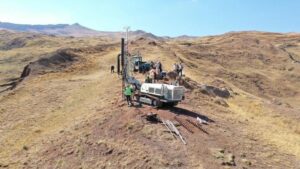
Nu, it so happens that the heylige Toirah (Bereishis 8:4) tells us very explicitly azoy:
וַתָּנַח הַתֵּבָה בַּחֹדֶשׁ הַשְּׁבִיעִי בְּשִׁבְעָה־עָשָׂר יוֹם לַחֹדֶשׁ עַל הָרֵי אֲרָרָט׃
“And the ark came to rest in the seventh month, on the seventeenth day of the month, upon the mountains of Ararat.”
When? The seventeenth day of the seventh month. Where? עַל הָרֵי אֲרָרָט — upon the mountains of Ararat. Let us note that the posik says “the mountains of Ararat” — plural — not specifically the modern Mount Ararat in Turkey. The Toirah does not provide a modern street address, GPS coordinates, or even directions from the nearest gas station. Ararat was the name of an ancient region generally associated with the mountainous territory around modern eastern Turkey. Over the centuries, the name became attached to the famous mountain. Other traditions point elsewhere. The Qur’an, which also acknowledges Noiach and the Teyvo, associates the Ark’s resting place with Mount Judi. Different traditions, different mountains, and plenty of room for people to disagree. So where exactly are the mountains of Ararat described in the heylige Toirah? Ver veyst?
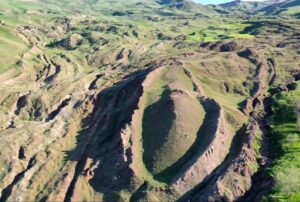
For many Christians who believe in a literal Flood narrative, finding the Teyvo would be the archaeological equivalent of hitting the jackpot. Imagine producing physical evidence of an enormous ancient vessel and arguing that it supports the biblical account. Faith would suddenly have something tangible to point to, something that could be photographed, measured, displayed, and, naturally, sold tickets to. Of course, finding an old piece of wood somewhere near Ararat would prove very little by itself. Somebody would still have to establish what it was, how old it was, and whether it had anything to do with Noiach. But why should a little detail like authentication interfere with a good headline? And yet, the modern search continues. In Kentucky, a Christian organization built Ark Encounter, an enormous attraction based on a life-size interpretation of the biblical vessel. Friends of mine have been there; they say it is quite amazing. In the Netherlands, a businessman constructed a gigantic floating replica. Shoin, when you cannot find the original, you can always build a replacement. The original has yet to be authenticated, but the gift shops are already open. Real or replica, business is business.
The Ois is avada not here to mock sincere religious conviction. If somebody eventually produces convincing evidence of the original Teyvo, we will certainly take notice. Many will travel to see it. Hundreds of thousands may zicher come and combine it with a Sukkis or Pesach vacation. Why not? But something about the whole enterprise intrigues me. The heylige Toirah tells us how the Teyvo was built, who entered it, what happened during the Mabul, and when the waters finally receded. Yet it never instructs future generations to recover the vessel. No mitzvah to organize an expedition. No requirement to establish a museum. No commandment to produce a souvenir miniature with two elephants sticking their heads out of the windows. The heylige Toirah tells the story and moves on. Noiach leaves the Teyvo, brings offerings, and receives the covenant of the rainbow. Humanity gets another chance. As an aside, they don’t do very well either.

But the emphasis is on what happened and what we are supposed to learn from it, not on whether somebody can excavate the original timber. Ober, this raises another question. Where are we Yiddin in this search? We are hardly strangers to archaeology. We dig throughout Eretz Yisroel, uncover ancient shuls, mikvaos, coins, inscriptions, and foundations of buildings that stood when our ancestors walked the land. We can argue for hours about whether a particular stone belongs to the First Beis Hamikdash or the Second, and still have enough energy left to argue about where to eat afterward. Where are the frum expeditions to the mountains of Ararat? Where are the Jewish institutions funding the search for the vessel that, according to our own Toirah, preserved the future of humanity? On the other hand, let’s get real. The proposed sites are far away, the terrain is difficult, the evidence is disputed, and the Toirah never told us to go looking. As well, Turkey’s political climate toward Israel hardly makes this an obvious destination for a Jewish expedition. Its president has hardly been a friend of Israel; he’s a hater mamish. That said, we have to admit that they are experts in hair transplantation. Ober, the Ois has his own theory about the real reason Yiddin are not involved in digging for the Teyvo. It has nothing to do with emunah, geography, or the fact that the Toirah never told us to look for it. We simply don’t know how to operate the machines! Avada, we can buy the excavators. We can finance them, trade them, lease them, insure them, refinance them, and form an LLC to own them. We can negotiate the price of the diesel, argue over the depreciation schedule, and make sure the entire operation is properly structured for tax purposes. But operate the thing? Move a pile of dirt from one place to another? With a machine? With levers? Yikes! We Yiddin can finance the excavation, own the equipment, arrange the insurance, and sue the operator if he scratches the paint. But put us in the driver’s seat of a bulldozer and ask us to dig a hole? Not happening! That’s for the goyim — and a few baalei teshuvah. Veyter!
And perhaps there is another explanation. If the Teyvo were sitting somewhere in Eretz Yisroel, we would likely have competing excavation teams, two archaeological committees, a dispute over who owns the site, and a fellow insisting that the entire operation belongs to his cousin. Not maybe. Zicher! We can all imagine the day when the Teyvo is mamish identified and authenticated. Yiddin will establish a committee to authenticate the wood, and a second committee will investigate the first committee. The Vaad may get involved. We’ll hire an accountant to structure the enterprise, a lawyer to establish ownership, and a frum real estate developer to explain why the original entrance is not economically viable and why a new entrance, with a gift shop, food court, and premium parking, is absolutely necessary. The Turks will ask who authorized us to collect admission. Who owns the parking lot? Who gets a share of the souvenir sales? Can we sell miniature ravens? Ver veyst! We may never get the archaeological questions resolved, but the parking dispute could keep three generations of lawyers employed. Until then, let the goyim do the heavy lifting. We Yiddin will wait until somebody demonstrates a real business opportunity before the site is added to one or more kosher and glatt-kosher expeditions.

Ober, perhaps the Ois has been unfair to us Yiddin. Perhaps our reluctance to search for the Teyvo has nothing to do with geography, money, or the absence of a promising business plan. Perhaps we are simply not anxious to revisit the memories associated with the place. Think about it. The goyim imagine a magnificent wooden vessel, pairs of animals marching aboard, a heroic survivor, and the miraculous rebirth of civilization. They see a floating monument to faith and perseverance. We Yiddin open the Chumish and remember a somewhat different story. Before the Mabul, the world had become so corrupt that Rashi tells us even the animals were mixing with species they had no business mixing with. In plain English, the animals were engaging in cross-species sexual activity. Shreklich! Wait! There’s more. Once everybody was safely aboard, the heylige Gemora (Sanhedrin 108b) tells us that three passengers failed to observe the “no sex on board” rules of the Teyvo: Cham, the dog, and the raven. Seemingly, none of the three could control themselves. Sound familiar? Aren’t most of us dogs? Say it’s not so! Apparently, even a world-ending flood was not enough to convince everybody to behave. As an aside, the “what happened on the Teyvo stays on the Teyvo” excuse did not fly; each was punished. One can only imagine the complaints from management. Noiach had spent 120 years building the place, loaded every species on earth, arranged the food supply, and assumed responsibility for keeping the operation running. He had no vacation days, no staff of trained zookeepers, no sanitation department, and certainly no customer-service hotline. And still, he could not get three passengers to follow the rules. Then came the disembarkation. Noiach, the great survivor, the man who had saved the world’s animal population, planted a vineyard, drank too much, became intoxicated, and lay exposed in his tent. Cham entered the picture, and Chazal tell us that what happened next was considerably worse than an ordinary family disagreement. Rashi (Bereishis 9:24) offers two interpretations of what went down: according to one, Cham castrated Noiach; according to another, he sexually violated him. Yikes! The heylige Gemora (Sanhedrin 70a) discusses these interpretations. Both versions are shreklich! The Toirah’s account proceeds to Noiach cursing Canaan. Quite a homecoming!
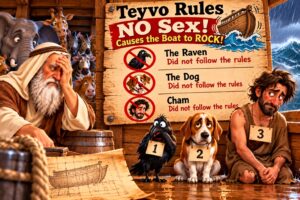
Shoin, after all the shenanigans aboard the Teyvo, after the Mabul, after Noiach’s vineyard and his unfortunate encounter with the effects of too much wine, we have to stop and ask a rather uncomfortable question: Was this the same Noiach who found chein in the eyes of the RBSO? The very same Noiach about whom the Toirah tells us that he was an נֹחַ אִישׁ צַדִּיק תָּמִים הָיָה בְּדֹרֹתָיו – ish tzaddik, tamim hayah bedorosav? What’s pshat? What is this thing called chein? How do we get some? Can it be bought? Nu, this question is not exclusive to the heylige Ois. In fact, twenty-two years ago, my oldest son spoke mamish on this very topic at his bar mitzvah. Of course I should remember the speech. I wrote it! The heylige Gemora (Sanhedrin 108a) teaches that Noiach, too, faced a decree of destruction, but found favor in the eyes of Hashem. What saved him? The Gemora points us to his chein. Read that again. The Gemora does not simply tell us that Noiach was a tzaddik and therefore deserved to be saved. It places the chein front and center. So what exactly was this chein? Was it the reward for his righteousness? Was it a kindness from the RBSO that went beyond what Noiach had earned? Or was Noiach gifted with that certain charm and grace? And if Noiach was taka such a tzaddik, why do Chazal spend so much time examining his qualifications? It is taka emes that the heylige Toirah calls him a tzaddik, but our sages were not prepared to let us read that title, pat Noiach on the back, and move on to the next parsha. They make us look again. And that is where the real story begins. Not with where the Teyvo landed, not with whether somebody will find a piece of ancient wood buried in Turkey, but with a much more uncomfortable question: was Noiach saved because he was a great tzaddik, or did he survive because, despite everything, he found chein? And while the gantza velt is busy looking for Noiach’s Teyvo, we ought to be busy looking for Noiach’s chein. It saved his life! Shoin, before we go shopping for chein, we have to understand what it is. Is chein something one earns? Is it a gift? Can a person cultivate it? And if the RBSO is the One dispensing it, is there anything we can do to improve our chances? Or must we simply hope that one morning the RBSO — metaphorically, avada — gets up on the right side of His bed, looks down at us, and decides that today we are looking particularly appealing? The heylige Toirah leaves us a fascinating clue. At the very end of Bereishis, before the world is washed away and the story begins again, we read:
וְנֹחַ מָצָא חֵן בְּעֵינֵי ה׳ – “And Noiach found chein in the eyes of Hashem.” (Bereishis 6:8)
And then, in the very next posuk, the Toirah tells us:
אֵלֶּה תּוֹלְדֹת נֹחַ נֹחַ אִישׁ צַדִּיק תָּמִים הָיָה בְּדֹרֹתָיו אֶת־הָאֱלֹקִים הִתְהַלֶּךְ־נֹחַ׃
“These are the generations of Noiach; Noiach was a righteous man, wholehearted in his generations; Noiach walked with Hashem.” (Bereishis 6:9)
Notice the order. First, chein. Then his tzidkus. The Toirah could have introduced Noiach as a tzaddik and then told us that he found chein. Instead, it tells us that he found chein, and only afterward describes his righteousness. Is the order meaningful? Avada, we cannot prove an entire theology from the order of two phrases, but it certainly invites a question: are we being told that Noiach was saved because of what he was, or that there was something about his relationship with the RBSO that cannot be reduced to a list of his good deeds? The Medrish (Bereishis Rabbah 29:1) explores the question of Noiach’s place among the righteous and the role of divine favor. Chazal do not present chein as a simple synonym for a trophy awarded to the best-behaved person in the room. The relationship between merit and favor is more complicated than that. Oib azoy, what is chein?

In ordinary language, chein means favor or grace. But how do you define something that some people seem to possess naturally, while others can try their entire lives and never quite manage to acquire? In some ways, it reminds me of pornography. Say what? In 1964, U.S. Supreme Court Justice Potter Stewart, writing in Jacobellis v. Ohio, famously said: “But I know it when I see it, and the motion picture involved in this case is not that.” Shoin! When it comes to chein, some people just have it. Others don’t. We recognize it when we see it, but explaining exactly what it is can be a different story. Of course, chein is not the same thing as chesed, which describes kindness expressed through action, or rachamim, compassion aroused by another’s circumstances. Chein concerns the favor one finds in the eyes of another. And when the other is the RBSO, we are dealing with a concept far more profound than being somebody’s favorite. Over Tanach (Mishlei 3:4) we read this: וּמְצָא־חֵן וְשֵׂכֶל־טוֹב בְּעֵינֵי אֱלֹקִים וְאָדָם׃ – “And find favor and good understanding in the eyes of Hashem and people.”
Notice that the posik speaks of finding chein both in the eyes of the RBSO and in the eyes of human beings. Apparently, chein is not an idea reserved for Noiach, nor is it confined to the ancient world before the Mabul. It remains part of the human condition. We certainly know people who have chein. They walk into a room and people warm to them. They are not necessarily the wealthiest, the most learned, the most handsome, or the loudest people at the table. Some are not even particularly good at telling jokes — a serious handicap in certain circles. Yet people want to be around them. They inspire trust. They make others feel comfortable. Their presence is pleasing. And then there are people with impressive résumés, long lists of accomplishments, and enough self-proclaimed greatness to fill several volumes of their own biographies — yet somehow they leave a room colder than they found it. They may possess credentials, but credentials and chein are not the same thing. Of course, we cannot simply transfer the rules of human popularity to the relationship between a person and the RBSO. The heylige Toirah is not promising that if everyone likes us, the RBSO must like us too. But Chazal do offer a suggestive principle in Pirkei Avos (3:10):
כָּל שֶׁרוּחַ הַבְּרִיּוֹת נוֹחָה הֵימֶנּוּ רוּחַ הַמָּקוֹם נוֹחָה הֵימֶנּוּ
“Whoever is pleasing to people, the Omnipresent is pleased with him.”
Now we’re talking! That‘s a statement worth thinking about, not a license to run a popularity contest. Perhaps one place to begin is by asking what sort of person makes it easier for others to find favor in him. Someone who is generous with respect. Someone who does not need to win every argument. Someone who can listen without preparing his rebuttal while the other fellow is still speaking. Someone who can give credit to another person without first checking whether the credit will diminish his own standing. Someone who can be important without making everyone else feel unimportant. And yet, these qualities do not buy divine favor. We cannot put a few acts of kindness into a vending machine and expect a packet of chein to drop out. But they may tell us something about the kind of person we are trying to become. That stated, we return to Noiach, because the Toirah is not merely asking whether he was a good man. It calls him a tzaddik. The harder question is what sort of tzaddik he was.
Rashi, quoting the heylige Gemora (Sanhedrin 108a), brings the famous dispute over the words “bedoiroisov” — in his generations. One opinion reads them favorably: if Noiach could remain righteous in such a corrupt generation, imagine how great he might have been in a generation of righteous people. The other opinion reads the qualification more critically: Noiach was righteous relative to his generation, but in the generation of Avrohom, he might not have been regarded as anything special. Well, blow me down with a feather! The man survived the Mabul, saved the world’s animal population, and earned a place in every child’s picture of the parsha, and our sages still ask us to examine the fine print?! Perhaps this is where the question of chein becomes especially interesting. Was Noiach’s greatness that he remained uncorrupted by his generation? Was it that he obeyed the RBSO and built the Teyvo? Was the chein an expression of divine kindness that cannot be reduced to a human calculation? The sources give us different ways to approach the question. They do not invite us to dismiss Noiach’s righteousness; they invite us to examine it more carefully.
And now we arrive at the pshat my son Zachary shared at his bar mitzvah, right here in Parshas Noiach, twenty-two years ago. How does one get chein? Can we earn it? Can we work for it? Is there some secret mitzvah that, if performed properly, will make the RBSO look upon us with special favor? Perhaps the observance of certain mitzvis brings chein as its reward. The problem is that the RBSO never gave us a list. He did not tell us which mitzvis bring chein, how much chein each one earns, or whether some mitzvis are more effective than others. Surprisingly, neither did Chazal hand us -or make up- a chart with all the answers. Why not? Nu, imagine what would happen if the RBSO announced that a particular mitzvah was the one that brought chein as a reward. What would we do? We’d all excel in that mitzvah. We would perform it with enthusiasm, precision, and perhaps even a little extra enthusiasm when somebody important was watching. Meanwhile, the other mitzvis might find themselves waiting on the sidelines. The RBSO, in His infinite wisdom, did not give us that information. We have to do them all. And this, raboyseyee and ladies, of course, is precisely the point of the heylige Mishnah in Pirkei Avos (2:1): “Hevei zahir bemitzvah kallah k’vachamurah, she’ein atah yodea matan secharan shel mitzvos” — be as careful with a seemingly minor mitzvah as with an important one, because you do not know the reward of the mitzvis. The Mishnah does not specifically say that a particular mitzvah earns chein. That connection is our pshat, an application of the Mishnah’s principle. Perhaps the mitzvah you consider minor is the very one that brings you the chein you have been looking for. Perhaps the mitzvah you performed without fanfare, without an audience, and without expecting anything in return is the one that made the difference. Or perhaps it was a mitzvah you performed years ago and barely remember. We simply do not know. And that may be the beauty of the system. If we knew exactly which mitzvah brought chein, we might concentrate on that one and treat the rest as optional extras. Instead, we are required to live with uncertainty. We do all the mitzvis, and we leave the accounting to the RBSO.
Which brings us right back to Noiach. The Toirah tells us that Noiach moyzo chein — he found chein in the eyes of the RBSO. It does not give us a formula. It does not tell us which particular mitzvah earned him that favor. It does not provide a spiritual spreadsheet showing how many points he accumulated and how many were required to survive the Mabul. Noiach found chein. The rest, as they say, is history. Which mitzvah will bring us the chein we need? Which mitzvah will make the difference? Ver veyst! That is precisely why we cannot afford to ignore any of them. We do them all, and leave the accounting to the RBSO. The gantza velt can keep looking for Noiach’s Teyvo. We Yiddin have our own search to conduct. The Teyvo may be buried somewhere in the mountains of Ararat. But chein? That is the treasure we are all looking for.
A gittin Shabbis –
The Heylige Oisvorfer Ruv
Yitz Grossman
