
Raboyseyee and Ladies,
The Four Mysterious Words Nobody Ever Explained
One more mazel tov to the entire extended Felder (Aaron and Esti) upon Nussie’s wedding to Yona Schulman earlier this week. And what a wedding it was. May the new couple be zoche to build a beautiful family together.
Mazel tov to Cheryl and Mordechai Schreck upon the birth of their first grandchild, a granddaughter born to their children Mindy and Yaron Kahan. Mazel tov to the entire extended Schreck and Kahan families.
Mazel tov to Jenny and Joey Felder upon the birth of a grandson born to their children Jillian and Idan, their first. May baby Ben Homa bring much light and joy into the entire extended family. Such nice news.
Mazel tov to Shaindy and Mendy Handler upon the upcoming wedding this coming week – yes, we’ll be there avada- of their daughter Gila who be marrying Asher Arnold, he the son of Daniella and Alex Arnold. Mazel tov to both extended families.
Shoin, this past Shabbis at the Felder aufruf, I found myself sitting next to Dr. Abe Abbitan, a well-known dermatologist and hair specialist (Gone Yesterday, Hair Today) here in the 5 Towns. And a chaver. In the course of conversation -of course bein gavra legavra- he was full of compliments on the Ois’s parsha reviews which he reads regularly. Givaldig and certainly deserving of a plug, if you chap. Following the extravagant kiddish, and on the way to the Schreck kiddish – mazel tov shout out above- the heylige Ois found himself walking alongside other friends, let’s call them Aroni & Chani Parnes. Chani and I were discussing which rabbi to follow when there are differing opinions and of course whether or not one can shop around to see who says what before deciding on which rabbi to follow. From that conversation…welcome to Parshas Shoiftim which grada mentions these concepts broadly.

Let’s begin with something I have never completely understood. Apparently, I am supposed to “find yourself a Rav” and stick with him. One rabbi. My rabbi. My halachic rabbi. My spiritual GPS. The man who tells me whether the chicken is kosher, whether Coke is kosher on Pesach even without the farkakteh yellow cap, whether the eruv is kosher, and the list goes on. And, if some people had their way, whether I am allowed to change my socks on Tuesday. That said, if, after hearing what my rabbi said or ruled, I ask another rabbi, does all hell break loose? Have I committed rabbinic adultery. “You asked another Rav?! After everything I have done for you?” Oy vey! Relax. I was only asking a shaylah. I wasn’t running away to another kehilla. But this raises a serious question. Where exactly does the heylige Toirah say that a Jew must appoint one rabbi and then follow that rabbi for every halachic question for the rest of his life? Not that “it’s customary.” Not “that’s what everybody does.” Not “my rebbe said so.” I’m asking: Where does it say that?
Welcome to Parshas Shoftim where the heylige Toirah discusses such authority, judges, disagreements, and what happens when a person has a difficult question in halacha. And once we start looking at the sources, things get considerably more complicated. While the parsha taka deals with justice and authority, what’s on the Ois’s mind this week, are the pisukim right there in the very first aliya. They teach us what to do when difficult questions arise and where we are supposed to turn for answers. But before we open the Chumish as we’ve been doing these last two weeks, I’d like to ask what I think is a perfectly reasonable question. It’s a question that has bothered me for years: Why shouldn’t I -or you- seek a second opinion? It seems only logical if I’m not satisfied with the first answer. In fact, our lives are full of second opinions. Last year, my cardiologist (shoutout to Dr. Duv Weinstock- always more than responsive) reviewed my test results, looked over his computer, and said, “You really ought to get a second opinion.” Wow! I wanted to hug him. Not because I wanted another doctor to disagree with him, but because he cared more about getting the right answer than about protecting his own ego. My attorney once said, “Before you sign this agreement, have another lawyer take a look.” My accountant told me, “This tax issue is complicated. Let’s have a specialist review it.” An architect brings in another engineer. An oncologist encourages another oncologist. Business partners hire consultants. Corporations hire outside auditors. Apparently, in every profession on earth, getting a second opinion is considered a sign of wisdom.
Unless… the opinion happens to come from a rabbi. Suddenly the room gets quiet. Mic drop! You can almost hear people whispering. What? “He asked another Rav?” “After Rabbi Cohen already paskened?” “Who does he think he is?” Mamish blasphemous! Should he be thrown out of shul? An oisvorf for sure! And worse! At that moment you would think I had violated one, or all the three-cardinal sins. OK, that discussion for another day; Yom Kippur is just around the corner. The bottom-line question is this: Why can I get a second opinion from my cardiologist but not from my rabbi?
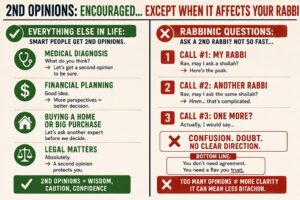
Now, before anyone gets excited, let me explain what I’m not talking about. I’m not talking about lying to Rabbi Number Two. I’m not talking about hiding facts. I’m not talking about changing the story until someone finally tells me what I want to hear. I’m not dialing for a heter! At least not today. Farkert! Quite the opposite. If I go to Rabbi Number Two, this is exactly what I would say: “Rabbi, I asked Rabbi Cohen this very same question. I gave him these exact facts. He prohibited it. I respect him but I’m struggling with his conclusion and I’d like to hear your opinion. Here are the same facts I gave him. What do you think?” What exactly have I done wrong? That’s not deception. That’s not manipulation. That’s not ‘Dail-a Heter- Rabbi shopping.’ That’s called getting a second opinion. And if that’s considered responsible when my heart is involved…If it’s considered responsible when my business is involved…If it’s considered responsible when my legal rights are involved…why does it suddenly become irresponsible when my soul is involved. Maybe I’m missing something. Is the heylige Toirah so fundamentally different? Maybe the halachic process works by an entirely different set of rules? Oib azoy (if that’s true), I’d genuinely like to understand why.

Every time the second opinion discussion comes up, somebody inevitably invokes the famous words of the heylige Mishneh in Pirkei Avos: “Aseh lecha Rav.” “Make for yourself a Rav.” Beautiful. Wise. Important; so gishmak, we quote it at many an aufruf and sheva brochis speech. And the emes is azoy: I agree completely. Every Jew should have someone from whom he learns Toirah, someone whose judgment he respects, someone who knows him and can guide him. But then I looked at the Mishneh again. And then I looked a third time. Unless my copy is missing a page, I couldn’t find where it says: “Choose one rabbi and never seek another opinion.” I couldn’t find: “Lifetime exclusive agreement required.” Nor did I find: “Void if consulting another recognized posek.” Maybe I’m reading the wrong edition. Because the Mishneh tells me to make for myself a Rav. It doesn’t seem to say that every other qualified Rav on the planet immediately disappears. What if I like two rabbis or even three? What if one talks to my head and the other to my heart? What if one has a background in the topic of interest? What if I belong to more than one shul? So happens that I do! As an aside, the same Mishneh also says to acquire for oneself a friend. One friend? That’s if for life? Did the Mishneh really mean that? Or, can I acquire many friends without violating?
And then I found something that made this even more interesting. Apparently, “Aseh lecha Rav” does not necessarily mean what many of us have been led to believe it means. There are serious halachic authorities who say that there is no blanket requirement for a person to choose one rabbi and follow only that rabbi’s rulings for every question that comes up for the rest of his or her life. One may have particular expertise in checking spotted underwear, ver veyst?! For some reason, ver veyst, many are still reluctant to give that up. Another may know everything there is to know about kashrus while a third may be the address for money disputes. A person can learn from more than one authority, and there are circumstances in which he may establish one particular scholar as his Rabbi and follow his rulings. Says the Chazon Ish: where a person has two recognized scholars who are close to him, he can choose one of them as his Rav and follow that Rav’s approach. In other words, perhaps the heylige Toirah is asking me to have a Rav, but it isn’t necessarily telling me that every other Rav on earth has been placed behind a velvet rope with a sign saying, “Do Not Ask.”
Settled? Not yet because now I have to ask an even more interesting question. If halacha recognizes that I can choose a legitimate authority as my Rabbi, and if I can learn from and rely upon recognized authorities other than him, then maybe the real issue isn’t whether I am allowed to hear another opinion. Maybe the real issue is what I do after I hear it. Am I choosing the one whose approach I am prepared to follow consistently, or am I simply picking the kulah (leniency) that happens to make my life easier today? Such confusion! Perhaps I should forget both rabbis and stick to Rabbi Google or Rabbi Chat?! Hec, they know how to sell my chometz and get it back timely!

Shoin, let’s get back to our parsha which commands us to turn to Toirah authorities when difficult questions arise. It teaches us that Judaism is not a religion in which everyone invents his own rules. The heylige Toirah has authority. It has judges. It has a process. But here’s the question I can’t get out of my head. If two recognized Toirah authorities, both learned, both G-d-fearing, both steeped in the same Gemora, the same Rambam, the same Shulchan Aruch, reach different conclusions on the very same issue… who says I am forbidden to rely upon the one whose reasoning I find more compelling? The one whose approach comports with my logic? For hundreds of years very well-known rabbis who authored halachic works argued vehemently with each other. Their opinions were mamish opposing. Their rulings were reduced to writing; we study them. And that raboyseyee, is what’s on my mind this week. So happens that I regularly discuss and argue over this topic with many others; it’s always gets me worked up.
Let’s analyze veyter: If your mechanic tells you that you need new hot water tanks for $6,800, your wife doesn’t say, “Wonderful! Write the check.” She says, “Get another mechanic to look at it.” If your roofer -after finding one leak- tells you the entire roof has to be replaced, you don’t immediately order forty bundles of shingles. You call another roofer. As an aside, both have mamish happened to me. If a jeweler tells you the diamond is worth $40,000, you’re thrilled but you’re still walking across the street to another jeweler. If you’re buying a house, your lawyer reviews the contract. Then your accountant reviews the tax implications. Your engineer inspects the foundation. Then your home inspector tells you the engineer missed something. By the time you’re finished, you’ve had more opinions than the Supreme Court. And taka, mamish a few weeks ago, when our fridge stopped working, I called one repairman. He pronounced it dead. I called another. He replaced a $59 thermostat circuit board, charged me $550, and the fridge is in top shape. Apparently, even Sub Zero believes in techiyas hameisim. When I buy a watch, I read reviews. When I buy a TV, I compare brands. When I buy a car, I test-drive three different models. When I need surgery, I consult two specialists. When I invest money, I ask multiple advisors. Apparently, when my money is at stake, my health is at stake, my house is at stake, my business is at stake, and even my refrigerator is at stake, everyone applauds me for seeking another opinion. But the moment I tell my own son-in-law that I’d like to hear how another recognized posek (halachic decisor) would rule about the use of a scooter on shabbis (one ruled that a two -wheel scooter is forbidden but a three-wheel one was ok), he’s considering gathering a minyan to say Kaddish over my Yiddishkeit. Somehow, only in this one area are we expected to believe that asking another qualified expert is a sign of disloyalty rather than a sincere search for clarity.
As mentioned, I’ve been asking the question of whether I was permitted to seek a second opinion from another Rabbi for many years; I love debating it. It’s certainly an interesting discussion, but I don’t think it’s the question of the week. I found a better one: I found four words that may have saved me from a lifetime of rabbinic monogamy that appear over and over throughout the halachic literature. Drumrooll please: “יש על מי לסמוך “Yesh al mi lismoich.” Mic drop again! In plain English, “There is someone upon whom to rely.” Well, blow me down! Those four words completely changed the way I was thinking. Givaldig. I finally found somebody upon whom to rely. The only problem was figuring out who, when, and for what. Let’s stop for just a moment and appreciate what they actually mean. Who coined them? When? Can I find them in the heylige Gemora? Who gave them legitimacy? Are they universal? The honest answer is azoy: they don’t have one inventor; the phase seems to have evolved as part of the vocabulary of halachic writing over centuries, much like expressions such as:
- “בשעת הדחק”
- “בדיעבד”
- “המחמיר תבוא עליו ברכה”

More on those soon but all became part of the halachic lexicon. More modern day halachic decisors discuss what the phrase means. When asked exactly what “יש על מי לסמוך” means, Rabbi Yitzchok Yosef explained that it does not mean “this is the preferred ruling.” Rather, it means there is a legitimate opinion that can be relied upon when the halachic circumstances justify relying on it—for example, in situations of need or other recognized considerations. The phrase -as quoted in our times- is not found in the Mishneh, Gemora, or even the medrish. It becomes common much later and especially by the Acharoinim (Later Sages) and responsa literature. They use it as shorthand for: “There is a recognized halachic authority or opinion upon whom one may rely.” The bottom line: it’s a phrase of the poskim, not a formal Talmudic rule. When a rabbis rules “Yesh al mi lismoich,” he is acknowledging something enormous. He is telling us that another opinion still possesses halachic legitimacy. Rabbi B isn’t some fellow who printed his own Toirah in the basement. He’s recognized. He’s speaking the language of Toirah. He’s quoting the heylige Gemora, Rishonim and Shulchan Aruch. He’s part of the halachic conversation. And my question is: When does halacha permit me to rely upon that other legitimate opinion? Always? When do these four words become activated? Are they ubiquitously always in play?
As I kept digging, I noticed something interesting. The phrase appears all over the responsa literature. Every posek seems to know what those four words mean; I wasn’t so sure that I did. What exactly is a posek telling me when he writes those four words? He doesn’t write: “The other opinion is nonsense.” He doesn’t write: “Ignore that rabbi.” He doesn’t write: “That opinion died three hundred years ago.” Quite the opposite. He’s telling me: There is someone upon whom to rely. The words are alive and refreshing. The question is: When does halacha permit me to rely upon that other legitimate opinion? Are they always available? Only b’dieved? Only b’shaas hadechak? Only where there is great financial loss? Only when no accepted custom exists? Only for Sephardim? Only for Ashkenazim? Only on Tuesdays? Only if the moon is in Pisces? Only if your mother-in-law approves? Only if you’re an oisvorf? Only if your name begins with the letter “Y”? I’m joking……but only a little. Everyone knows the expression. Very few people ever stop to define it.

One respected decisor says that Coca-Cola on Pesach requires the yellow cap. Another universally respected rabbi says it doesn’t. One is Ashkenazi. One is Sephardi. Both have spent decades immersed in the laws of kashrus. Both know the ingredients. Both know the manufacturing process. Both know the halachic sources. Neither one received semichah from the back of a cereal box. Now tell me where my mistake is. If I decide to rely upon the one who permits the Coke, have I ignored the heylige Toirah? Or, have I relied upon a recognized Toirah authority? When does the halachic system itself say that I may rely upon a recognized opinion, and when does it say that I may not? What are the rules? Not, “Because that’s our minhag.” Not, “Because he’s Sephardi.” Not, “Because that’s what everybody does.” Maybe those ultimately turn out to be the right answers. But first show me the halachic road that gets us there. Because until I understand that process, I keep coming back to one very simple question. If the RBSO didn’t want future generations ever relying upon Rabbi B, why did He allow Rabbi B to become one of the great renowned rabbis who are well versed and recognized? Why preserve his opinions? Why continue learning them? Why continue quoting them? Shoin, enough theory. Let’s see whether these four magical words actually mean anything in real life. Let’s go back to Coke on Pesach. The OU rabbis says that on Pesach Coke requires the yellow cap. Another universally respected halachic decisor says that it does not. I’m not saying one of these rabbis is ignorant. I’m not saying one of them is making things up. I’m not saying one of them doesn’t know halacha. Farkert! Both have spent decades immersed in the laws of kashrus. Both have devoted their lives to the heylige Toirah. Both know the manufacturing process. Both know the ingredients. Both know the halachic sources. Both are recognized as serious poskim. Now, if I rely upon the posek who permits the Coke… Where exactly did I leave the reservation? Did I? Did I stop following the Toirah? Am I drinking chometz? Is my house no longer kosher? Or, did I follow Toirah law according to a recognized authority? Remember, I didn’t wake up one morning and decide that capless Coke tastes better; I relied upon a real decision by a real guy. Not my yetzer hara. And not just any posek one whom others quote with respect. One whose seforim sit on the shelves of batei medrash throughout the world. One whose words continue to be studied.
That said, what about the heylige Gemora (Avoido Zoro (7A) תנו רבנן: הנשאל לחכם וטימא — לא ישאל לחכם
“The Sages taught: One who asks a sage and he declares [the matter] impure, should not ask another sage and have him declare it pure. If he asks a sage and he prohibits [the matter], he should not ask another sage and have him permit it.” Excellent catch. But let’s keep reading because Toisfis immediately asks the obvious question: If I already asked one wise man, why can’t I tell another the entire story and let the two opinions be examined? Toisfis answers that the problem is only when the questioner fails to tell the second rabbi that the first already prohibited it. If I tell Rabbi Number Two the whole story, the second rabbi may hear the shaylah. The second rabbi, however, is not automatically free to overturn the first ruling. Toisfis discusses circumstances in which he may do so, such as when the first ruling was based on an error. The bottom line: The famous “don’t ask another rabbi” rule is considerably more nuanced than the way it is often presented.
Shoin, perhaps this is where I have to be a little more honest with myself. There is a difference between choosing a Rav and choosing a kula. The heylige Gemora in Eruvin famously warns against taking the leniencies of Beis Shammai in one matter and the leniencies of Beis Hillel in another. If you follow one approach, you are expected to accept its framework rather than build yourself a personal Chinese menu of whichever leniencies happen to taste best. So perhaps my argument cannot simply be, “Rabbi B permits Coke, therefore I take Rabbi B’s Coke.” The stronger argument would be: “Rabbi B is a recognized Toirah authority whose halachic approach I have chosen to rely upon.” And, taka, that brings me right back to those four words: Yesh al mi lismoch. If there really is someone upon whom I may rely, the question becomes whether I am actually relying upon that person—or merely relying upon the particular answer I happen to like. That distinction may be the difference between following a legitimate Toirahdike opinion and simply shopping for a heter. I don’t want to do the second. I am trying to understand whether the first is permitted—and if it is, under what rules.
Then another thought occurred to me. Perhaps I’ve been asking the wrong question again. But what if I never asked either one? Suppose I already know the published opinions. I know that one universally respected rabbi permits it. I know that another -also respected, prohibits it. I haven’t hidden anything. I haven’t deceived anybody. I haven’t gone shopping. I haven’t asked for a ruling. I’ve simply learned that there are two recognized opinions. Now what? Where exactly does the heylige Gemora tell me what to do? As far as I can tell, the Gemora quoted above discusses a person who already received a ruling and then goes -somewhat deceptively- looking for another one. That’s not my case. My case is this: the Toirah world itself has preserved two legitimate opinions. The holy books are sitting on the shelf. The arguments have already been made. The poskim have already written. One says yes. One says no. And later generations sometimes write those fascinating words: “Yesh al mi lismoich.” And my question is this: Who says I must first obtain permission from somebody else before relying upon it? Where is that rule? Is this a custom or a rule? I’m not saying it doesn’t exist. I’m saying I’d like to learn it. Because that’s not the Gemora’s case. That’s a different sugya altogether for another day. Perhaps the halacha is that I may not rely on that published opinion without consulting my own posek. Where is that written?
The final bottom lines: After 120 years, when I stand before the Heavenly Court, I hope I never have to answer for inventing my own religion. But if they ask me, “Why did you drink that Coke without the yellow cap?” I won’t answer, “Because I liked Coke.” I won’t answer, “Because I didn’t care.” I won’t answer, “Because I decided halacha no longer applied to me.” I’ll answer very simply: “Because I relied upon an opinion that generations of poskim themselves recognized: And if the RBSO calls for malkis (lashes) as a punishment, if I hear “one more for the Coke,” I’ll know we’re getting close to the end.. I don’t need everyone to agree with my conclusion.
A gittin Shabbis!
The Heylige Oisvorfer Ruv
Yitz Grossman
