
Raboyseyee and Ladies,
RIVKAH: A PROPHETESS WITH A PLAN
Shoin, it’s Monday morning and the Ois has a six-hour flight in front of him. He’s disgusted mamish from the elections and cannot watch another minute of news; it’s all bad! Blatant open antisemitism is out of control; yikes! Shades of Europe in the early 1930s. What to do? Let’s review Parshas Toldos. Buckle up; it’s going to be a long one.

Last week, the Heylige Ois stepped into some rather dangerous and potentially controversial territory by daring to ask whether our forefathers and foremothers were, in fact, perfect. We examined some rather questionable behavior by Avrohom Ovenu, particularly when it came to dealing with his children. He survived and shoin, here we are. This week, we’ll turn our attention to Rivkah Imeinu, Yitzchok’s only wife. Was she actually flawless? Was she incapable of making mistakes? Did every decision she made reflect the highest possible moral standard? Or was she, like the rest of us, a human being? Did she, with all her admirable qualities, also suffer from occasional lapses in judgment, complicated relationships and, perhaps, some rather questionable behavior? You decide. I’m just here to report the facts the RBSO decided to share with us. If anyone has a problem with the material, please take it up with the Author. I merely quote the text!
Let us begin. And what better place than with the extraordinary circumstances surrounding the birth of Yaakov and Eisav? After twenty years of marriage, Yitzchok and Rivkah were finally blessed with a pregnancy. Yitzchok was forty when he married Rivkah and sixty when the twins were born. Twenty years! That’s a long time to wait for a child. One can only imagine the excitement, relief and gratitude when Rivkah finally conceived. Except that the joy was apparently short-lived. What should have been a long-awaited blessing turned into a rather uncomfortable, if not downright frightening, pregnancy. The heylige Toirah tells us:
“וַיִּתְרֹצֲצוּ הַבָּנִים בְּקִרְבָּהּ” — The children struggled within her. Rivkah was sufficiently distressed to exclaim: “אִם כֵּן לָמָּה זֶּה אָנֹכִי?” What, exactly, was happening? Why was this pregnancy so difficult?

And then comes a seemingly innocuous statement that opens up an entire Pandora’s box: “וַתֵּלֶךְ לִדְרֹשׁ אֶת ה׳” — Rivkah went to seek Hashem. What’s pshat she went to see Hashem? Can one just walk in, or even make an appointment to see Him? Ober, our Sages tell us that she went to the academy of Shem and Ever. The Ois has questions, and here we go! She went where? Says who? Not the heylige Toirah! The heylige Toirah doesn’t say Rivkah went to Shem. It doesn’t say she went to Ever. It doesn’t say she went to a prophet, a rabbi, a Beis Midrash or even the local kollel. It says, in unmistakable language: “וַתֵּלֶךְ לִדְרֹשׁ אֶת־יְהוָה”. The Toirah actually spells out the four letters of the RBSO’s holy name! She went to inquire of Hashem. Period! Now, the Ois has seen many an exegete give words a new meaning but admits that this is the first time the holy name of the RBSO is spelled out and someone tells us, na, it’s not Him! It’s some guy with a yeshiva by the name of Shem. Give me a break, please.
Who then decided she went to Shem? Rashi! He follows the medrish. Fair enough. Ober, says the Rashbam that she went to the prophets of those days, without identifying anyone by name. There were prophets back then? Says the Ramban that לדרוש את ה׳ means to pray to Hashem directly. No Shem. No Ever. No academy. Just Rivkah and the RBSO. The bottom line: Before we build an entire pre-Sinai yeshiva system around one posik, which is exactly how this was taught to us in yeshiva, we should zicher acknowledge that some of our greatest Rishonim understood the words rather differently. Why the Shem and Ever yeshiva story stuck, ver veyst? The Ois’s take: It’s mamish mindboggling that a medrish takes a posik that explicitly says Rivkah went to inquire of Hashem and identifies her destination as some academy. Whether that academy was a real institution or a midrashic description of a spiritual authority is another question entirely. That said, let’s play along and assume the medrish is correct.
Rivkah, in pain mamish from her pregnancy, doesn’t seek out the help of an obstetrician or a midwife; she goes to yeshiva instead. Ironical, people with pains, typically leave yeshiva. And the question is this: why not seek counsel from Avrohom? He was still alive. The man who introduced monotheism to the world was available for consultation, yet Rivkah apparently bypassed him and went looking for Shem? Shem who? Why Shem? Who was this man? What qualified him to answer Rivkah’s questions? And what exactly was going on in the academy of Shem and Ever? Shoin, before we can chap why Rivkah chose to consult Shem, we need to establish just who this fellow was. What were his bona fides? He was one of the three sons of Noiach, a survivor of the Mabul, and the progenitor of an important portion of humanity. More significantly, Chazal identify him with Malki-Tzedek, the mysterious personality who appears in Parshas Lech Lecha. Who’s that? Following Avrohom’s victory over the kings, the heylige Toirah (Bereishis 14:18) introduces us to this rather unusual figure:
“וּמַלְכִּי־צֶדֶק מֶלֶךְ שָׁלֵם הוֹצִיא לֶחֶם וָיָיִן וְהוּא כֹהֵן לְאֵל עֶלְיוֹן”
Malki-Tzedek, king of Shalem, brought out bread and wine, and he was a kohen to Hashem, the Most High God.
What does that mean? Beats me! Rashi, citing the heylige Gemora (Nedarim 32b), identifies Malki-Tzedek as none other than Shem ben Noach. Confused? You’re not alone, ober halt kup, because this raises an interesting question. What exactly does the heylige Toirah mean when it calls him a כהן לאל עליון? A kohen of what? There was no Jewish nation, no Mishkan, no Beis HaMikdash, no Aharoin HaKoihen and no formal Jewish priesthood. Shem was a בן נח, living in a world that preceded Matan Toirah by generations. The bottom line: he wasn’t even Jewish! What kind of a koihen was he before there was such a category and class of people? As an aside, in a few parshas, we will read that Tamar -she of Yehuda fame- was his daughter. Of course she was!
Nu, maybe he served the RBSO through the religious practices available in that pre-Sinai world. Perhaps he offered sacrifices, as demonstrated by Noiach, who offered korbonis after leaving the Teivah, and by Avrohom, who built altars and offered sacrifices. But the heylige Toirah does not furnish us with a job description for Shem’s priesthood. The Gemora goes even further: It teaches that Shem’s priesthood was transferred to Avrohom because Malki-Tzedek blessed Avrohom before blessing Hashem. More confused? Me too! What we have here is a fascinating personality: a descendant of Noiach, a king, a priest of Hashem, and, according to Chazal, the head of an academy that Rivkah considered an appropriate address for her most pressing spiritual question. Let’s go veyter. But hold on; this medrish has more holes than Hunter Biden’s laptop story. An academy? A Beis Midrash? A yeshiva? Let’s get real. As mentioned above, there were no Jews yet. There was no Toirah given at Sinai, no 613 mitzvis, and no established Jewish educational system. What exactly were Shem and Ever teaching? Was it one yeshiva with two names or two different yeshivas? A breakaway, efsher? Were they teaching the seven Noachide commandments? Monotheism? The traditions handed down from Noiach? The medrish taka tells us that Rivkah went to their academy, but it does not give us a curriculum. Tuition? Basketball team? What real yeshiva doesn’t have one? As an aside, Ever was Shem’s great-grandson. A family business? And Ever was no mere footnote. When Yaakov leaves home, Chazal tell us that he spent fourteen years studying in the house of Ever. Fourteen years! That’s not a weekend seminar. That said, what might they have been teaching?
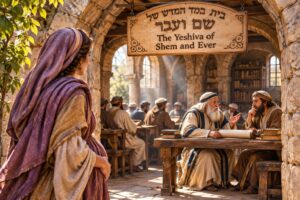
Let’s read what a few had to say. Says the Ohr Somayach that they studied the seven mitzvis Bnei Noiach, together with the wisdom and prophetic traditions of those generations, whatever that means. Some, based on Rav Kook’s Oros HaToirah, suggest that the principal subject was derech eretz, natural morality and the development of character. No U-turns, double parking or parking outside the designated lines. Mamish chutzpah!

Before one can absorb the kedusha of Toirah, one must first establish a foundation of basic human decency. And that’s what I call an academy! A rather important lesson, especially in our times, when some people seem to have mastered the entire Shas—over and again—but somehow missed the chapter on derech eretz.

And for good measure, let’s read a fascinating idea from Rav Avrohom Shapira, who suggests that there were actually two different types of educational institutions. The academy of Shem and Ever was for people who came voluntarily seeking spiritual growth, faith and yiras Shomayim. Avrohom’s enterprise was something else entirely. He went out into the world, challenged idol worship, gathered people, taught them about the RBSO, and actively brought them closer to the truth. In other words, Shem and Ever waited for students to come to them. Avrohom went out looking for students. One was a destination; the other was a movement. Two very different models of education. Gishmak! Shoin! Apparently, the pre-Sinai world was not entirely devoid of religious education. There were traditions, moral teachings, knowledge of the RBSO, and even institutions devoted to spiritual development. The bottom line: We know what some later authorities believe they were teaching; we do not know exactly what went on inside those walls.
Ober, let’s get back to the question that started this entire investigation. Avrohom was alive! In fact, according to the chronology established by Chazal, Avrohom would live until Yaakov and Eisav were fifteen years old. He was not some distant historical figure whose teachings had to be accessed through a secondhand source. He was Rivkah’s father-in-law, the grandfather of the children she was carrying, and one of the greatest spiritual personalities in human history. So why Shem? Says the Tur HaAruch that Rivkah may have wished to spare Avrohom the distress of hearing about her difficult pregnancy. Nice! His daughter-in-law was experiencing a pregnancy that appeared to be anything but ordinary, and we may kler that Rivkah simply didn’t want to upset him. A considerate daughter-in-law? Quite possible. Or, perhaps she wanted an independent authority. Avrohom and Yitzchok were not neutral observers. This pregnancy concerned their own family and the continuation of the covenant. Perhaps Rivkah wanted someone outside the immediate family, someone who could interpret what was happening without the emotional involvement of a father and grandfather. Why she went, ver veyst? What exactly did Rivkah learn, and what did she do with that information? What did Hashem tell her? The heylige Toirah tells us: “וַיֹּאמֶר ה׳ לָהּ שְׁנֵי גוֹיִם בְּבִטְנֵךְ וּשְׁנֵי לְאֻמִּים מִמֵּעַיִךְ יִפָּרֵדוּ”
Hashem tells her that two nations are in her womb and that two peoples will separate from within her. Notice the wording. The Toirah doesn’t say that Shem told her. It says וַיֹּאמֶר ה׳ לָהּ. Hashem said to her. The heylige Toirah spells out the name of Hashem, and we are told that Rivkah went to seek Him. Yet Chazal discuss whether the answer came through an angel or through Shem. The medrish offers different possibilities. The fact that the Toirah identifies Hashem as the speaker does not necessarily tell us how the message was delivered. Ober, asks the Gur Aryeh, azoy: if Hashem Himself was going to answer Rivkah directly, why did He wait until she went to the prophet? Why didn’t He simply answer her before she left? The Maharal’s point is that the journey to the prophet was not incidental. It suggests that the answer came through an intermediary. Ah ha! Was Rivkah speaking directly to Hashem? Or was Shem acting as a prophet and delivering the message? Was it an angel? The medrish records different opinions. The Toirah gives us the message, but doesn’t spell out the mechanics. Had the RBSO wanted us to know exactly how it happened, He could have told us. He didn’t. Shoin. But this brings us to an even bigger question, one that may be more interesting than the identity of Shem, his priesthood, or the curriculum of his academy. Was Rivkah herself a prophetess? Was she a Neviah? Let’s see. She went to inquire of Hashem. She received a message about the destiny of the two children in her womb. Years later, she somehow knew that Eisav intended to kill Yaakov. How did she know? The heylige Toirah tells us that Rivkah was informed, but doesn’t identify the informant. Chazal, however, have something rather startling to say. Says the Midrash (Bereishis Rabbah 67:12): “אִמָּהוֹת נְבִיאוֹת הָיוּ וְרִבְקָה הָיְתָה מִן הָאִמָּהוֹת”
The Imahos were prophetesses, and Rivkah was one of the Imahos. There you have it! Rivkah was a neviah. Not merely a clever woman, not merely a perceptive mother, not merely someone who had a good feeling about what was going on. A prophetess! But hold on! We have a problem. If Rivkah was a neviah, why did she have to go looking for Shem in the first place? Wasn’t she capable of asking the RBSO herself? Did she need an appointment with another prophet to obtain information that she, as a prophetess, could presumably have received directly? Was Shem better connected? Did he have a more reliable line upstairs? And was Rivkah’s prophetic license not yet fully activated? Of course, being a prophetess does not necessarily mean that one has a permanent hotline to Heaven. Prophecy is not something one can order up whenever a question arises. Perhaps Rivkah was a neviah, but she did not know why her pregnancy was so difficult or what the future held for these children. She therefore sought out Shem, a recognized spiritual authority, to obtain an answer from the RBSO. But that answer only takes us so far. The medrish that identifies Rivkah as a prophetess appears in connection with a later episode, when she learns that Eisav intends to kill Yaakov. It does not explicitly tell us that she was already functioning as a prophetess when she went to Shem. Perhaps she was, ver veyst? Perhaps the prophetic ability was revealed later. We simply don’t know. Apparently, even a neviah sometimes needs to consult another neviah—or at least someone with better heavenly reception! So far, so good. But now comes another problem. The heylige Gemora (Megillah 14a) asks a rather straightforward question: שבע נביאות מאן נינהו? Who were the seven prophetesses? And the Gemora proceeds to name them: Sarah, Miriam, Devorah, Channah, Avigail, Chuldah and Esther. Seven names. Soro is there. Miriam is there. Devorah is there. Channah, Avigail, Chuldah and Esther are there. But where is Rivkah? What happened to Rivkah Imeinu? The very medrish we just quoted calls her a prophetess, yet the Gemora’s famous list of seven leaves her out. Did the Gemora forget her? Was she not considered a full-fledged neviah? Did she receive a message but not qualify for the particular category being discussed? Or are Chazal using the word neviah in more than one way? Gotcha? Not so fast. We need to look carefully at the Gemora’s wording. It introduces the seven as prophetesses who נתנבאו להן לישראל—who prophesied to Israel. Perhaps the Gemora is not attempting to compile a complete list of every woman who ever received prophecy. Perhaps it is identifying those whose prophetic messages had a particular role for the Jewish people. The Gemora is so clever: one can never chap it in a mistake; it’s always the reader misreading. Clever!
But even that explanation doesn’t entirely solve our problem. Rivkah’s message was hardly trivial. She was told that two nations were in her womb, and that the older would serve the younger. This was not some private prediction about whether the pregnancy would be difficult or whether she would have a boy or a girl. It was a message about the future of two peoples, and ultimately about the destiny of the Jewish nation. So why isn’t she on the list? And there is this wrinkle. The medrish (Bereishis Rabbah 63), in discussing Rivkah’s original inquiry, records a debate about how Hashem communicated with her. One opinion says through an angel; another says through Shem. Could that be the distinction? Perhaps the Gemora’s list is concerned with women who received prophecy in a particular sense, while Rivkah’s message was delivered through someone else. Efsher. But let’s be honest: that is an explanation we are proposing. The Gemora itself does not tell us that this is why she was omitted. The bottom line: we have a rather unusual situation. The Toirah says Hashem spoke to Rivkah. One Midrash says she was a prophetess. Another discusses whether the message came through an angel or through Shem. And the Gemora, when listing the seven prophetesses, leaves her out. The heylige Ois has a simple question: Was Rivkah a neviah or wasn’t she? And if she was, perhaps we need to reconsider some of what follows. Because this is not merely an academic discussion about titles and lists. Rivkah later takes matters into her own hands, sends Yaakov to obtain (read: swindle) the brochos intended for Eisav, and orchestrates an elaborate deception of her husband. She does so knowing what she had been told about the future of these two children. Was she acting as a mother who had a hunch? A wife who disagreed with her husband? A woman who believed she understood the divine plan? Or was she acting as a prophetess who knew something Yitzchok did not? Those are very different descriptions of the same woman. And one final question: if Rivkah was indeed a prophetess, why does the Toirah never introduce her as one? Miriam is called מִרְיָם הַנְּבִיאָה. Devorah is called דְּבוֹרָה אִשָּׁה נְבִיאָה. Chuldah is called חֻלְדָּה הַנְּבִיאָה. Rivkah gets no such title. Then again, aside from Miriam, no one is called a Novee or Neviah in the text of the Toirah itself.
And now we get to the part that really makes the Ois scratch his head. What exactly did Shem and/or Ever, or the two of them combined, tell her? Let’s assume, for the sake of argument, that Rivkah did, in fact, visit the academy of Shem and Ever, and that one of them delivered the message from the RBSO. What exactly did they tell her? That the older would serve the younger. But what were the instructions? Did Shem or Ever tell Rivkah to keep this information from her husband? Did they tell her not to share the prophecy with Yitzchok? Did they explain why Yitzchok apparently had not been told the same thing? Was she specifically instructed to ensure that Yaakov, rather than Eisav, would receive the brochos? Did they tell her that the only way to accomplish this was to orchestrate an elaborate deception? Or did they simply tell her what the future would hold and leave the rest entirely up to her? Let’s be very clear: the heylige Toirah does not tell us that Shem or Ever instructed Rivkah to deceive anyone. It does not say they told her to keep quiet, to favor Yaakov, to interfere with Yitzchok’s plans, or to arrange for Yaakov to impersonate his brother. Not one word! We know what the prophecy said. We do not know what, if anything, the messenger told her beyond that. And if they did tell her to keep quiet, why? Was Yitzchok not entitled to know what the RBSO had revealed about his own children? Was Rivkah instructed to withhold this information from her husband? Did she decide on her own that telling him would be counterproductive? Or did she simply assume that she understood the prophecy better than everyone else? The heylige Toirah does not tell us. What it does tell us is that Rivkah apparently never shares this information with Yitzchok. At least, we are never told that she did. And that silence becomes particularly interesting when we arrive at the brochos. Veyter.
Let’s move onto the brochos episode. Yitzchok announces his intention to bless Eisav. Rivkah overhears the conversation and immediately takes action. Not Yitzchok. Not Shem. Not even Ever. Rivkah! And what a production she puts together! She decides that Yaakov must be the one to receive the brochos. She sends him to fetch two goats. She prepares the food exactly as Yitzchok likes it. She takes Eisav’s clothing and puts it on Yaakov. She covers his smooth hands and neck with goatskins. She coaches him through the impersonation. When Yaakov worries that his father might discover the deception and curse him, she reassures him:
“עָלַי קִלְלָתְךָ בְּנִי” — Let the curse be upon me, my son. That’s quite a commitment! This was no casual suggestion from a concerned mother. This was a carefully choreographed operation, and Rivkah was its director, producer, costume department and scriptwriter! And let’s not forget the final act. Yitzchok asks Yaakov who he is. Yaakov answers: “אָנֹכִי עֵשָׂו בְּכֹרֶךָ” — I am Eisav, your firstborn. That’s not merely withholding information. That’s a direct falsehood. Yaakov doesn’t simply remain silent; he tells his father that he is Eisav. And Rivkah, who devised the plan and prepared the disguise, was hardly a bystander. She was involved in virtually every detail of the deception.
And the Ois has questions! Did Shem or Ever tell her to do any of this? Did they tell her to take an active role in helping Yaakov fool his father? Did they authorize her to participate in what was, by any ordinary understanding of the words, a family-wide deception? Or was this entirely Rivkah’s own plan? We have two separate questions. First, did Rivkah do the right thing by withholding the prophecy from Yitzchok? That’s deception by omission. Second, even if she believed Yaakov was supposed to receive the brochos, did that justify helping him lie directly to his father? That’s deception by commission.
Perhaps Rivkah believed she was fulfilling the divine plan. Perhaps she understood something Yitzchok did not. Perhaps she believed that the prophecy left her no choice. But where does the heylige Toirah tell us that she was instructed to take matters into her own hands? And even if she was convinced that Yaakov had to receive the brochos, did the ends justify these means?
One more question: if the RBSO had already declared that “וְרַב יַעֲבֹד צָעִיר”—the older would serve the younger—why did the prophecy need to be fulfilled through an elaborate scheme involving disguises, false statements and a blind father who was being deceived by his own wife and son? Could Rivkah have spoken to Yitzchok? Could she have reminded him of the prophecy? Could she have challenged his decision openly? We don’t know what would have happened. The Toirah doesn’t tell us. But it certainly leaves us with questions. And perhaps the biggest question of all: was Rivkah acting on instructions from Heaven, or was she taking a prophecy and deciding for herself how to make it happen? There is a rather important difference between receiving a divine message and appointing oneself its executor.
And now we return to the question that started this entire discussion. Was Rivkah perfect? Was she a flawless matriarch whose every decision was necessarily correct? Or was she an extraordinary woman, a woman of great faith and spiritual stature, who was nevertheless capable of making decisions that leave us uncomfortable?
The Ois isn’t pretending to know what was in Rivkah’s heart, nor is he issuing a verdict on one of the great women in our history. But neither should we pretend that the questions don’t exist. Perhaps Rivkah was right. Perhaps she was wrong. Perhaps there are explanations we haven’t considered. But why must we automatically assume that every action of every great biblical personality was perfect simply because of who that person was? Our Ovos and Imahos were extraordinary people. They built families, founded a nation and changed the course of human history. But greatness and perfection are not necessarily the same thing. A person can be spiritually elevated, even a prophet or prophetess, and still leave us scratching our heads over certain decisions. The Ois isn’t here to tear down our Imahos. He’s here to read the heylige Toirah honestly, ask the questions that arise from its words, and resist the temptation to turn every biblical personality into a plaster saint.
Shoin. We report. You decide!
I told you it was a long flight!
A gittin Shabbis!
The Heylige Oisvorfer Ruv
Yitz Grossman
