Anniversary Special
Raboyseyee and Ladies,
Who Said That & When?
King Solomon famously said that two are better than one.
Two mazel tov shoutouts and wishes to our friends Susan and Alan Heideman and their entire extended family. First, upon the birth last week and the bris this past Sunday morning of a grandson born to their children Eliana & Daniel Wisotsky. May Yonah Pinchas (Jonah Philip) Wisotsky bring much nachas and only joy to his parents, grandparents and of course great grandmother, Ruth Goldstein. It was our pleasure to attend.
A second mazel tov to Susan and Alan upon the birth -over in Jerusalem 13 days earlier- of a grandson born to their children, Dassi and Yitzi Rothschild. Welcome to the world Amiel Elimelech Rothchild. May you be a source of much happiness and joy to your entire family. Givaldig!
——————————————————————————————————————-
Year 17 of heylige Ois weekly parsha posts begins this week! Wow! As on past anniversaries, a few shoutouts. First, to Dr. Avi Winkler who may well have been the inspiration for all this. To my very dear friend Mike Kogan, whose idea it was to start posting them online. No matter where he finds himself, he still maintains the burgeoning site. As well, to my friends Andrew and Teri Herenstein, who were hosting me in Westhampton Beach that weekend as I was pecking away on my blackberry (OBM), putting out what would later -in 2012- become Oisvorfer.com. Wow!
As you all know -or should, Parshas Vo’eschanan, among its many remarkable topics, includes the first part paragraph of what later became the Shema prayer, the warning against avoido zoro (idolatry) and the mitzva to teach our children. But towering above all of them is the second presentation of the Aseres Hadibris (Ten Commandments). Naturally, the first question everyone asks is the obvious one: Why? Why repeat them? If Moishe is merely reviewing history for a new generation that never (physically) stood at Har Sinai, why doesn’t he simply read from the original transcript? These are the Aseres Hadibris! Every child in yeshiva knows they were spoken by the RBSO Himself. If there is any text in the history of mankind that ought to remain word-for-word identical, this would seem to be it. Yet Moishe changes wording. He adds here. He omits there. He emphasizes differently. Why? Ver veyst? And why repeat them? For well over a thousand years, our greatest sages have filled libraries trying to explain every nuance. Countless shiurim have been delivered. Enough ink has been spilled to refill a few local mikvehs.
On the other hand, we may efsher rationalize azoy: As their leader before and after Matan Toirah (Revelation), Moishe was uniquely qualified -an eyewitness mamish- to their bad behavior. Weeks after its first presentation, the Yiddin were hard at work violating a few big ones; does the golden calf ring familiar? We also know how they violated most others during their midbar experience; shreklich! Moishe chapped; they needed a second reminder of the Commandments. And taka, Moishe gives them a “rerun.” Only it isn’t really a rerun. Not exactly. Just last week, (Parshas Devorim), we saw that Moishe doesn’t simply hit the rewind button and recite history word for word. He retells it. He reshapes it. He emphasizes certain points, omits others, and, in the case of the Aseres Hadibris, even changes some of the wording. A change to the Ten Commandments? Intentionally? Ver veyst? Did he remove “Thou Shall Not Covet?” Not! Avada, these changes did not escape the attention of our sages and many exegetes to follow. They still write about it. Rabbis still talk about it. For well over a thousand years, the greatest minds have analyzed every added word, every missing word, every subtle nuance, and every apparent discrepancy between the version given at Har Sinai in Parshas Yisroy and the version repeated here in Vo’eschanan. Libraries have been filled with explanations. But this week, the Heylige Ois would like to leave that well-traveled highway and take a different exit. Not the exit to Grossinger’s, The Pioneer, the Pine View, or even the Homowack, all -at some point- thriving hotels and especially so on Shabbis Nachamu which always somehow coincides with this parsha.
They’re all gone; may their collective memories be a blessing. We miss you! As an aside, if you’re under forty, you probably have no idea what I’m talking about. If you’re over sixty, you’re smiling. Once upon a time, those exits led to places where half of Klal Yisroel spent the summer and the other half wished they could. Today those same exits lead to bungalow colonies, yeshiva campuses, developments with names like “Mountain View Estates” where nobody can actually see a mountain, and enough traffic on Route 17 to remind you of Central Avenue, 13th Avenue, Avenue J, Main Street, and others. The exits along Rt 17 are all still there; in fact, a new one appeared in the last 25 years, but today they lead only to various summer camps, one Indian casino that will one day house some yeshiva or another TURO campus, and developments designed for the Chasidim who have been priced out of Williamsburg, Monroe and other such enclaves.

This week, we’re taking a different exit altogether. Instead of asking why Moishe repeated the Aseres Hadibris differently, let’s ask a far more basic question -one that many of us have never even considered. What exactly did the Yiddin experience at Har Sinai? What did they hear? And what did they see? Who spoke the Ten Commandments? Did the RBSO Himself pronounce all ten commandments directly to the entire nation? Only the first two? Only the first? At what point, if any, did Moishe become the intermediary? If your immediate reaction is, what kind of a question is that, and there the Ois goes again with his amiratzishe questions because everyone knows the answer, I would respectfully suggest that you keep reading. Because the greatest Toirah scholars who ever lived were not nearly as certain that the answer was as simple as we might think. Let’s begin with the heylige Gemora (Makkos 24a) which says this befeirush:
“אָנֹכִי” וְ”לֹא יִהְיֶה לְךָ” מִפִּי הַגְּבוּרָה שְׁמָעוּם
“Anochi” and “Lo Yihyeh” were heard directly from the Almighty Himself!
In plain English: The first two commandments were given over by the RBSO Himself. Ober, notice what the heylige Gemora doesn’t say. It does not say: “Only two commandments were spoken by the RBSO.” It simply says that those two were heard mi’Pi HaGevurah, from the RBSO. And the others? Let’s read that Gemora again. It says the first two were heard mi’Pi HaGevurah. It never says, ‘and the remaining eight were not.’ That single missing sentence raboyseyee, is how centuries of discussions began.” It’s the ah-ha moment. Did you chap that? A few very popular sages, to include the RambaM and the RambaN read these words carefully and saw an open window and asked azoy: What does that imply about the remaining eight? Interestingly, the greatest debates among the Rishonim (early sages) are often not about disagreeing with the heylige Gemora or medrish; they’re about drawing different conclusions from what Chazal chose to say, and just as importantly, what they chose not to say.
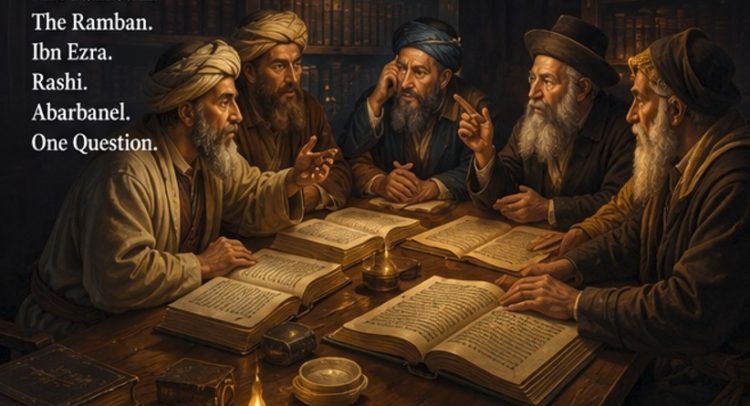
The bottom line: had one of us invited Rashi, the Rambam, the Ramban, the Ibn Ezra, the Abarbanel and the Sefer Ha-Ikkarim to the same Shabbis table and asked each of them to describe—minute by minute -what actually happened at Har Sinai, would they all tell exactly the same story? As we will see below, seemingly not! That said, before we open a Rambam, or ask the Ramban to explain why the Rambam misunderstood the posik, and before the Ibn Ezra quietly rereads the pisukim and politely informs everyone that they’re asking the wrong question, and before the Abarbanel objects, let’s do something almost revolutionary. Let’s open a Chumash and read the pisukim as though we’ve never seen them before. It’s a radical approach, I know. We sometimes become so fascinated by what everyone says about the heylige Toirah that we forget to ask what the Toirah itself says. Let’s open to the beginning of the Aseres Hadibris in Parshas Yisroy and then compare them with Moishe’s review in this week’s parsha. At first glance, everything appears perfectly straightforward. The RBSO descends upon Har Sinai amidst thunder, lightning, smoke and the blast of the shofar. The mountain trembles. The people tremble even more. Then the heylige Toirah tells us that Hashem spoke. Simple enough. Except…the more carefully you read, the less simple it becomes. In our parsha, Moishe, just before his new reading of the Ten Commandments, tells the new generation of what took place at Revelation:
“פָּנִים בְּפָנִים דִּבֶּר ה’ עִמָּכֶם בָּהָר…” “Hashem spoke with you face to face at the mountain.”
Face to face. Those are remarkably powerful words. Not through a malach. Not through a prophet. Not through an interpreter. Face to face. The RBSO gave over the Ten Commandments. Had the Toirah stopped there, this week’s parsha post would have been considerably shorter -haha- and you could have gone back to arguing whether the rabbis were really serious about not showering during the nine days and other such restrictions. Did you remember to put on and quickly take off nine pairs of underwear along with shirts and pants? Let’s get real! But the heylige Toirah doesn’t stop there. Only a few pisukim later, Moishe reminds the people what happened next. Terrified by the overwhelming sound and light display, they cried out: The people said to Moishe: Shmois 20:16:
וַיֹּאמְרוּ אֶל־מֹשֶׁה דַּבֵּר־אַתָּה עִמָּנוּ וְנִשְׁמָעָה וְאַל־יְדַבֵּר עִמָּנוּ אֱלֹקִים פֶּן־נָמוּת׃
“Speak with us yourself, and we will listen; but let G-d not speak with us, lest we die.”
Then, in our parsha (Devorim 25:7), Moishe recounts the same episode in greater detail:
קְרַב־אַתָּה וּשְׁמָע אֵת כָּל־אֲשֶׁר יֹאמַר ה’ אֱלֹקֵינוּ וְאַתְּ תְּדַבֵּר אֵלֵינוּ אֵת כָּל־אֲשֶׁר יְדַבֵּר ה’ אֱלֹקֵינוּ אֵלֶיךָ וְשָׁמַעְנוּ וְעָשִׂינוּ׃
“You go near and hear all that Hashem our G-d will say, and you tell us everything that Hashem our G-d tells you, and we will hear it and do it.”
And here’s the million-dollar question… When did they say this? Before or after the commandments were given? If the RBSO spoke directly to the entire nation, when did Moishe become the spokesman? Immediately? After the First Commandment? After the Second? After all ten? And if Moishe became the intermediary, which commandments did the Yiddin actually hear directly from the RBSO? Did every Jew standing at Har Sinai hear precisely the same thing? Or did six hundred thousand Jews experience six hundred thousand different revelations? When the heylige Toirah tells us that Hashem “spoke” to an entire nation, what does that actually mean? Did they hear words? Did they hear sounds? Did they experience prophecy? Or, are we using human language to describe something too awesome to comprehend? And our exegetes, what sayeth they? They all believe the very same Toirah. They all believe the events at Revelation. Yet, when they begin explaining how Revelation unfolded, the paths begin to separate. Some hear more. Some hear less. Some focus on the words. Others focus on the experience. Some see Moishe entering the picture earlier. Others later. It’s almost as if the greatest Toirah scholars in history attended the same wedding, sat under the same chuppah, ate the same meal, danced to the same loud music… and then went home remembering different parts of the evening. The difference, of course, is that this wasn’t a wedding. This was Har Sinai. It wasn’t? I don’t know about you but I seem to recall many a medrish and even Gemora stating that indeed the Yiddin got married to the RBSO on that eventful day. A wedding is exactly how Revelation is described by the heylige Gemora. It was the most important seminal event in Jewish history. In fact, that’s one of the oldest and most beautiful themes in Chazal. While the Toirah never explicitly says, “Har Sinai was a wedding,” our brilliant Sages -and many later commentators- repeatedly develop exactly that metaphor. The heylige Gemora (Taanis 26b) interprets the posik in Shir HaShirim 3:11: “בְּיוֹם חֲתֻנָּתוֹ” — “On the day of His wedding.” The heylige Gemora says: זה מתן תורה – “This refers to the day of Matan Toirah.” The medrish develops the imagery further. Har Sinai is compared to the chuppah. The Toirah is compared to the kesubah (marriage contract). The RBSO is the Choson, and us Yiddin, His Kallah. And says the heylige Zoihar that Shavous is the anniversary of that wedding. The custom of learning all night on Shavous is explained as “adorning the kallah” before she enters the chuppah. And says the Maharal that Matan Toirah wasn’t simply legislation. It was the creation of an eternal bond. Exactly as marriage (in some cases) creates a permanent relationship, so too Sinai created an eternal covenant.
More on how the wedding and wedding vows worked out a bit later. It’s not much better in our times. Yikes! And guess what raboyseyee and ladies too; these aren’t modern academic questions. They’re Toirah questions. The heylige Toirah itself raises them. And once you notice them, they’re impossible to ignore. Suddenly, the greatest event in Jewish history becomes even more awe-inspiring.
Shoin, having laid out the questions, let’s check in and see what a few luminaries had to say. The greatest minds in Jewish history, arrived at different understandings of precisely how it unfolded. Says the Rambam (Moireh Nevuchim II:33), that the Yiddin -600,000 men plus millions more women and children heard only the first two commandments—“Anochi Hashem Elokecha” and “Lo Yihyeh Lecha”—directly from the RBSO. After those first two commandments, the nation was so overwhelmed by the intensity of the Revelation that they begged Moishe to become the intermediary. From that point forward, the remaining commandments were conveyed through Moishe. Now before anyone writes me an angry email accusing the Rambam of “taking away” eight commandments from the RBSO, calm down. The Rambam isn’t minimizing the gravity of Har Sinai. He’s trying to explain it. His question is not whether the RBSO gave all ten commandments. Of course He did! His question is far more subtle: How much direct Divine communication could ordinary human beings possibly endure? The heylige Toirah itself tells us that the people feared they would die if Hashem continued speaking to them. The Rambam simply takes those words very seriously. He sees this as the key to understanding the entire sequence of events. Revelation begins with direct communication from the RBSO, reaches an intensity beyond human endurance, and then continues through Moishe. Let’s review. Rambam says: The people experienced a unique Divine revelation. They understood the first two commandments directly from Hashem. After that, they could no longer endure the experience. Moishe then transmitted the remaining eight commandments. Notice I bolded the word understood because for the Rambam, the emphasis is on understanding. According to him, if the Gemora singles out the first two as being heard directly from Hashem, then the remaining eight must have been transmitted through Moishe.

Ober the Ramban who argue with the Rambam quite often, says not so fast because the Gemora never says the remaining eight weren’t spoken by the RBSO. The Toirah says “וַיְדַבֵּר אֱלֹקִים אֵת כָּל הַדְּבָרִים הָאֵלֶּה”—Hashem spoke all these words. And later:
“אֶת הַדְּבָרִים הָאֵלֶּה דִּבֶּר ה’ אֶל כָּל קְהַלְכֶם”
“These words Hashem spoke to all your assembly.”
His position: Everyone heard all ten Debris from the RBSO. However, there is a difference between hearing and understanding. The first two Dibris were understood by the Yiddin as clearly as Moishe understood them. The remaining eight were heard as a Divine Voice, but Moishe had to explain their meaning afterward. Nice! It merely highlights the unique status of the first two. Why are they unique? Because the nation fully comprehended those two directly. The remaining eight were also spoken by the RBSO, but they required Moishe’s explanation. Again, let’s chazir: According to the Ramban: All ten were spoken by the RBSO. The first two were uniquely understood directly. The heylige Gemora is emphasizing their uniqueness—not excluding the other eight. Imagine your wife sending you to Costco or Gourmet Galtt with a shopping list while she’s talking on speakerphone. You put someone on hold to take her call. Your head is elsewhere. You heard every word she said. Did you understand every word she said? Judging by the fact that you came home with six jars of pickles, no eggs, and three gallons of almond milk that nobody in the house drinks… apparently not. The Ramban would say that hearing and understanding are not necessarily the same thing. The bottom line: They’re not arguing over the Gemora; they’re arguing over what the Gemora intended to emphasize. Here’s a moshol (example): “Reuven and Shimon arrived first.” One person concludes “So Levi must have come later.” Ober, another says no. The Gemora is simply highlighting Reuven and Shimon because they did something special.” Same sentence. Different inference.
Case closed? Not even close. As soon as you begin opening more seforim, you discover that Har Sinai may have been the greatest gathering in Jewish history, but it also became the site of one of the greatest Toirah discussions in Jewish history. Ironically, the very posik that everyone quotes to prove his opinion is the one posik that never tells us when the people uttered those words. That’s exactly why the Rishonim had so much to discuss. Shoin, just when you think you’ve identified the two sides of the debate, the Ibn Ezra rereads the chronology and concludes that the Toirah itself may indicate something quite different. According to his understanding, the Yiddin heard all ten commandments directly from the RBSO. Only after the Aseres Hadibris were completed did the people beg Moishe to become the intermediary for everything that followed. In other words, the request, “You speak with us,” was not an interruption of the Ten Commandments. It was the beginning of the rest of the Toirah. Now things become very interesting. We no longer have two opinions. We have three. Rashi says two. The Rambam also says two but explains why. The Ibn Ezra says all ten. The Ramban says, “It’s more complicated than either of you are making it.” And then, because no great Toirah discussion is complete without another distinguished participant; let’s welcome the Abarbanel who was not persuaded by the Rambam’s explanation. He challenges both the philosophical assumptions and the reading of the pisukim, arguing that the text itself points toward a far more direct national revelation than the Rambam allows. The debate is no longer simply, “How many commandments were heard?” It becomes, “How should we read the Toirah’s own description of the greatest moment in Jewish history?” and then comes the author of the Sefer Ha-Ikkarim, who adds another fascinating layer. He explains that the first two commandments are indeed unique because they establish the indispensable foundations of Jewish faith. Yet he emphasizes that the RBSO desired the nation to hear the Aseres Hadibris from His own mouth as the basis of the eternal covenant. In his discussion, the first two Dibris occupy a special halachic and theological status because they were heard directly from the Almighty without the mediation of a prophet. At this point, you may be wondering whether anyone actually agrees with anyone else. The answer is yes. On the essentials, every one of these giants stands shoulder to shoulder. The disagreement concerns only one breathtaking question: Exactly how did the impossible become possible? The truth is that we don’t know with absolute certainty exactly how the Revelation unfolded. We know that it happened. The debate begins only after that. Did the Yiddin hear all ten commandments directly from the RBSO? Only the first two? Perhaps only one? Was the experience something that cannot even be described in ordinary human language?
The Toirah leaves just enough mystery to keep the greatest minds in Jewish history busy for centuries. And perhaps that’s exactly the point. People joke that if you ask two Jews a question, you’ll get three opinions. Whoever coined that expression obviously spent some time yeshiva or even shul. Our sages were never frightened by difficult questions. On the contrary, they embraced them. They challenged one another. They debated one another. They argued passionately—always מתוך יראת שמים—to understand one more posik, one more word, one more nuance of the Toirah. And efsher (maybe) that’s one of the greatest lessons of Har Sinai. The RBSO didn’t merely give us the Toirah. He gave us permission to spend the next three thousand years trying to understand it. And if, after reading this article, your grandchildren ask you, “Zeidy, so who really spoke the Aseres Hadibris?” You can smile and answer: “Sit down. This may take a while.” After all… If the Rambam and the Ramban couldn’t finish the conversation… what chance do you and I have?
One final observation before we close the Chumash. By now you’ve probably concluded that no one can say with absolute certainty exactly how the Revelation unfolded. The debate continues. But there is one thing about which there is absolutely no debate. It didn’t take us very long before we began violating those very same commandments. Whether the Yiddin heard one, two, or all ten directly from the RBSO, the honeymoon didn’t last very long. Before long came the Eigel. Then the complaints. Then the mis’oinenim. Then the meraglim. Then Korach. Then Mei Merivah. Then the mass orgy coupled with avoido zoro at Ba’al Pe’or. OMG! Time and again, the Toirah records moments when the RBSO declared that justice demanded the nation’s destruction. Time and again, Moishe stood in the breach, pleaded on their behalf, and reminded them -and us- that this relationship was not a passing arrangement but an eternal covenant.
And perhaps that is the greatest lesson of Har Sinai. The greatest miracle was not only that Heaven and earth met at the foot of a mountain. The greatest miracle was that the covenant survived our repeated attempts to destroy it. The RBSO knew exactly whom He was marrying. He knew our strengths. He knew our weaknesses. He knew that we would stumble, complain, rebel, repent, and stumble again. Yet He chose to bind His Name to ours forever. Why? Ver veyst? The others had to have been much worse! He must really love us! Har Sinai was not the beginning of a perfect marriage. It was the beginning of an enduring one. Many can relate.
A gittin Shabbis Nachamu wherever you find yourselves.
The Heylige Oisvorfer Ruv
Yitz Grossman
