
Raboyseyee and Ladies,
LONG LIFE: GUARANTEED BY THE RBSO
Long life. Who doesn’t want it? We all strive for it. We all desire it. And most of us -if we’re being honest- will do just about anything to get a few more good years on this planet. From the time we’re young, we’re taught that life is precious. Then we spend the first half of it trying to become adults and the second half trying to become young again. At 20, you can’t wait to be 30. At 30, you want to be 25. At 50, you want to be 40. At 70, suddenly 60 sounds mamish like a bochur. Kimat everybody wants to live a long life. Nobody wants to get old. We want to be 90 -provided we can still be 70. We want the extra years, just not the wrinkles, the aches, the hearing aids, the walkers, the medications, or the fellow standing behind us at CVS who wants to skip the line because of his proclaimed prostate issue. We want long life with a warranty. Everybody wants to beat the clock. Ask a typical 80-year-old what medications he takes and you’ll get a list longer than the parsha.

For thousands of years, people have searched for its secret. We have become obsessed with longevity. We exercise to live longer. We diet to live longer. We take supplements to live longer. We inject ourselves to live longer. We ask doctors for tests so we can catch things earlier and live longer. We ask AI to discover medicines that might let us live longer. To help us, we hit the gym, hire personal trainers, use fitness watches, take vitamins and supplements, go on fancy diets and eat organic foods. Some – the more disciplined- have home workout regimens. We have doctors who specialize in longevity, scientists studying the aging process, and billionaires spending fortunes trying to figure out how to keep the body going long after the warranty should have expired.
And then came the GLP-1s, a game changer mamish! Suddenly people who couldn’t lose weight with diets, exercise and every other gimmick known to mankind are injecting a little medicine into their stomachs and announcing that they’re on their way to a healthier, thinner and, hopefully, longer life. And if all that weren’t enough -many times it isn’t- in more recent times, we are also blessed with AI. Artificial intelligence is moving at lightning speed into medicine, diagnostics, drug discovery and personalized treatment, all with the same ultimate objective: Help us live better. And preferably: Help us live longer. But, is the secret to long life mamish new? Not!

Because, long before the first treadmill was invented, long before somebody figured out how to inject a GLP-1, long before AI could read an MRI faster than a doctor, and long before anybody had even heard the words “longevity research,” the Heylige Toirah -thousands of years ago mamish- was already talking about long life. And not merely talking about it. And what’s particularly interesting is that the Toirah doesn’t promise long life for eating kale, walking 10,000 steps or taking a weekly injection. It promises long life for doing a mitzvah. In fact, it does it twice. It gave us a prescription.100% guaranteed by the RBSO Himself.

Let’s check it out. In Parshas Yisroy, in the Aseres Hadibris, the RBSO tells us:
“Honor your father and your mother, so that your days may be lengthened.”
And again, in this week’s parsha of Ki Say Tzei, we encounter one of the strangest mitzvis in the entire heylige Toirah — a mitzvah involving a bird, a nest, some eggs or baby chicks, and a mother who apparently needs to be sent packing. And for doing it? The heylige Toirah once again promises:
“L’maan yitav lach v’ha’arachta yamim.” So that it will be good for you, and you will have long life.
More on all that below but first this: Welcome to Parsha Ki Say Tzei where Moishe – mamish days before his own passing, still found the energy to rattle off 74 mitzvis and among those, is one that come with the assurance of long life to those who perform it. Ober, before we try wrapping our arms around this most rewarding mitzvah, the big question on the table is: how was Moishe going to get the Yiddin to listen and stay focused as he was about to teach or review 74 commandments – a record mamish- in one single parsha? How would the Yiddin absorb this information? How did he expect them to remember all this? It’s not one flowed into another; many were completely unrelated to one another? Did he distribute SparkNotes? Not! Not. He had one thing: His voice. And the Yiddin had one thing: Their attention spans. And, as we are about to discover, apparently Moishe knew exactly how to get their attention.
And taka, it used to the case that attention spans of people, was, -according to experts who dabble in this type of research- as long as 40 minutes. That’s how long the average person could and would pay attention to a task or lecture, remain fully engaged, and stay focused on what a speaker had to say. Nu, that was avada before TV, movies, magazines, video games, the heylige Internet bichlal (in general), and Instagram and Tic Toc bifrat (more specifically). In today’s times, with distractions all around us, sociologists and other experts tell us that the average time a person remains focused on any one topic is down to twenty, ten, and even as little as five minutes. That’s givaldig when compared to the notoriously ill-focused goldfish whose attention span is but nine seconds. Ober listen to this: A widely cited Microsoft study claimed that the average attention span for most people has dropped from 12 seconds -yes, you read that correctly- to eight seconds…..Yikes! After eight seconds, most begin to daydream.
And why is this all relevant? Can we even imagine how much time it took him to deliver 74 mitzvis? It’s not like they were all related and that he transitioned seamlessly from topic to topic following a natural progression. Fuhgeddaboudit! It’s taka emes that a small number of mitzvis, according to many a medrish and commentator, might be related. Limoshol (by way of example) the topics of the war-bride, the wayward son and the hated wife. Our sages teach us that one who married a war bride (in addition to the wife he already had waiting at home), would eventually come to hate her (or the first wife), and together, they will eventually produce a wayward son. A trifecta mamish! Ober, others being taught -some for the very first time- covered a wide range of disparate topics including (not in any order) levirate marriages, returning lost property, bills of divorce, shatniz, illicit relationships (again), cross dressing, the spiritual purity of the camp, including instructions to have and use a shovel to cover human waste, remembering that the RBSO punished Miriam with leprosy for speaking some loshoin horo about Moishe, murder, accurate weights and measures, and what to do to a woman who grabs a man by his privates while he, the perpetrator is striking her own man. You read that correctly and there’s much more. Stamina he seemingly did have until the very end. Oh, and also the somewhat strange an unusual mitzvah of shooing away the mother bird when one wanted to get his hands on the baby chicks.
And the question is azoy: How did Moishe expect the Yiddin to pay attention while he was delivering these 74 commandments? An answer only the heylige Ois can deliver (and get away with) and possibly how it taka went down is that Moishe chapped that the Yiddin had little interest in what he had to say. He knew their attention spans, even in the midbar which was devoid of most distractions -save the Moabite shiksas and other mischief they either encountered or concocted- was razor thin. He knew how he would talk and they didn’t listen. What to do? He had a plan: he began the parsha with the following mitzvah and let’s learn it again (as we do yearly by popular demand). Said he azoy:
10. If you go out to war against your enemies, and the Lord, your God, will deliver him into your hands, and you take his captives,
- And you see among the captives a beautiful woman and you desire her, you may take [her] for yourself as a wife.
- You shall bring her into your home, and she shall shave her head and let her nails grow.
- And she shall remove the garment of her captivity from upon herself, and stay in your house, and weep for her father and her mother for a full month. After that, you may be intimate with her and possess her, and she will be a wife for you.

The bottom line: Moishe chapped that by leading with the parsha with the mitzvah of sanctioned battlefield sex with a shiksa captive, he would have the Yiddin’s attention! They would be standing firm, if you chap, listening to every word for more. He mamish lured them in. Heylige Ois readers know from years past that I have covered every aspect of this most unusual service reward; feel free to check them out in the archives at Oisvorfer.com. You will not be disappointed! We shall not go any further other than to say that this model has been emulated by most armies over the centuries. Veyter.
Somewhere in the middle of the mitzvah marathon, Moishe suddenly changes lanes and starts talking about a bird. After myriad mitzvis, including shiksas, sons who need a good shpritz of cold water, wives who hate each other, lost objects, shatnez, human waste, dishonest businessmen, and all kinds of other shenanigans, we arrive at Perek 22, pisukim 6 and 7 and mamish one of the strangest mitzvis in the entire heylige Toirah. And it goes azoy:
“Ki yikarei kan tzipor lefanecha baderech…” If a bird’s nest happens to be before you on the road, in any tree or on the ground, and there are chicks or eggs in the nest, and the mother bird is sitting upon them, you may not take the mother together with the young. You must first send away the mother bird, and only then may you take the young for yourself.
And then comes the part that makes the Heylige Ois scratch his head: “L’maan yitav lach v’ha’arachta yamim.” So that it will be good for you, and you will have long life. Excuse me? Long life? For shooing away a bird? We can all chap the long-life reward for honoring your parents. That mitzvah requires patience, restraint, gratitude and, in some cases, the ability to listen to the same story for the 400th time without muttering under your breath. And taka, Heyilge Toirah tells us just that: “Kabeid es avicha v’es imecha… l’maan ya’arichun yamecha.” Honor your father and your mother, so that your days will be lengthened. But sending away a bird? What exactly did the bird do for you? And more importantly, what exactly did you do that was so givaldig that the RBSO decided to reward you with extra years on this planet? You saw a bird. You chased her away. You took her eggs. Mazel tov. Here’s another ten years. What’s pshat?

The RBSO has apparently put honoring your parents and chasing a bird away from her nest into the same longevity program. Why? Ver veyst and the question on my mind is this: How did these two mitzvis end up together? Let’s get real: Kibbud av v’eim can be difficult, kimat impossible a times. It requires patience, money, time, sacrifice, schlepping, doctor appointments, phone calls, endless repetition, and sometimes the ability to hear the same complaint for the 17th time and answer, “Of course, Ma, you’re absolutely right. And then there’s shiluach ha’ken. You happen to walk down the road. You see a nest. There’s a mother bird sitting on eggs or chicks. You shoo her away. You take what you want. And the RBSO says: Good job. Long life. Avada, the Ois was not the first to ask this question, let’s taka see what a few had to say. Says the Yerushalmi (Kiddushin 1:7), that the heylige Toirah equated the easiest of the easy mitzvis with the hardest of the hard, because both come with the same promise: ‘v’ha’arachta yamim’ — long life. Does that answer the question? Not! It mamish makes the question bigger.” Shiluach ha’ken is among the easiest mitzvis, while kibbud av v’eim can be among the most demanding. And yet the reward is described in the same language? What’s taka pshat? Says the medrish that the heylige Toirah is not operating a points system where the harder the mitzvah, the bigger the prize. There is no Heavenly spreadsheet saying: Five points for shiluach ha’ken. Fifty points for visiting your mother. A hundred points for schlepping your father to the doctor. And 500 points if you manage to do it without losing your temper. Apparently, that’s not how mitzvis work. Were that the case, avada, we’d be focusing on those mitzvis only. In the RBSO’s world, a person can perform what looks like the easiest little mitzvah in the world and receive a reward described in the most exalted terms. The bottom line: Never assume that because a mitzvah looks small, it is small. We humanoids have a funny way of evaluating things. If something takes tremendous effort, we assume it must be important. If something takes five minutes, we assume it’s insignificant. The RBSO apparently doesn’t see things that way.
That said, the question we might ask is this: Why does the RBSO care whether you send away the mother bird? The obvious answer is: Rachmanus, compassion. You shouldn’t take a mother together with her babies. You shouldn’t cause the mother the pain of watching you take her children. Sounds reasonable. Sounds humane. Sounds like the RBSO is teaching us to be kinder to animals. Except for one small problem. The heylige Mishnah (Brochis 5:3 and Gemora 33b) tell us that if a person is davening and says : הָאוֹמֵר: עַל קַן צִפּוֹר יַגִּיעוּ רַחֲמֶיךָ, וְעַל טוֹב יִזָּכֵר שְׁמֶךָ, מוֹדִים מוֹדִים — מְשַׁתְּקִין אוֹתו ֹ “ “One who says, ‘Your mercies extend to the bird’s nest,’ or ‘For the good may Your name be remembered,’ or ‘We give thanks, we give thanks’ — we silence him.” Essentially, “Just as Your mercy extends to the bird’s nest, so should Your mercy extend to us” — we silence him. Meshtakkin oisoi. We shut him up?! What? Why? What did he say wrong? He is asking the RBSO for rachmonis. He is even using a mitzvah as his source. He sees the RBSO commanding us not to take the mother together with her children, and he says: RBSO, if You care about that bird, please care about us. Sounds like a pretty good tefillah to me. Apparently not. This is where Chazal teach us something that should make all of us a little more humble. We don’t necessarily know why the RBSO gave us a mitzvah. Maybe the mitzvah is about mercy. Maybe it isn’t. Maybe we understand one tiny piece of it. Maybe there’s another dimension we don’t see.
Says the Ramban that the mitzvah isn’t necessarily telling us that the RBSO Himself is having rachmonis on the bird. After all, if the entire purpose were to spare animals suffering, why does the heylige Toirah permit us to slaughter animals for food? Grada my vegan son Max asks this question regularly. Ramban says the mitzvah is designed to teach us the trait of compassion and prevent cruelty from taking root inside the human being. That’s a very different idea. The RBSO isn’t necessarily saying: “Poor bird. I feel terrible for her.” He may be saying: “I don’t want you becoming the kind of person who can casually inflict cruelty.” That might be a much bigger lesson. Because cruelty doesn’t necessarily begin with murder. It can begin with something very small. A person becomes accustomed to causing pain. Then more and more pain. Eventually, the pain doesn’t bother him anymore. Seemingly, the heylige Toirah is worried about what cruelty does to the perpetrator. Not just what happens to the victim. Shoin, the bird has suddenly become a lesson in human psychology.
The heylige Zoihar takes it even further, seeing the mother bird, her nest and her separation from her young as a mystical reflection of the Shechinah (the RBSO’s Divine Presence) and us Yiddin here in golus. In other words, what looks to us like a simple act of sending away a bird may be doing something both within the person performing the mitzvah and in the higher spiritual worlds as well. Exactly what that means, ver veyst, but for those who follow kabolo, it must mean something. The bottom lines: The Ramban is telling us the mitzvah changes the person doing it. The Zoihar is telling us it may also change something in heaven. Why not? All this from shooing away a bird. Gishmak!
Ober, just when we think we’ve figured out the mitzvah, our Sages bring us a story that turns the whole thing upside down. The heylige Gemora (Chullin142A) tells us about a young boy whose father told him: “Climb to the top of the building and bring me some fledglings.” The boy climbed up, sent away the mother bird and took the young, thereby fulfilling two mitzvis at the very same time — kibbud av, by obeying his father, and shiluach ha-ken, by sending away the mother before taking the young. And then, on his way back down, the boy fell and died. Yikes and oy vey! Houston, we have a problem. A big one. Where is the long life? Where is the “it will be good for you”? The boy did what he was told. He did the mitzvah. He even performed two mitzvis simultaneously. And he’s dead!? The heylige Gemora asks exactly that: “Where is the long life of this one? Where is the goodness of this one?” “היכן אריכות ימיו של זה? והיכן טובתו של זה” “Where is this one’s long life, and where is this one’s goodness?” the Gemora answers: “למען יאריכון ימיך” — בעולם שכולו ארוך; “ולמען ייטב לך” — לעולם שכולו טוב.
Rebbe Yaakov (Kiddushin 39b) answers with one of the most important ideas in this entire sugya. The heylige Toirah isn’t necessarily promising that you will live to 97 years old because you sent away a bird. Pshat could be azoy: “That your days may be long” refers to a world that is entirely long; “that it may be good for you” refers to a world that is entirely good. In other words: The promised and personally guaranteed reward isn’t necessarily on this side of the grave. And now we chap why this little story is so important. Because the mitzvah itself wasn’t the problem. Our assumption about the reward was the problem. We may have gotten pshat wrong. We assumed: Mitzvah → reward → longer physical life. Chazal say: Not necessarily. There is another world. There is another accounting. There is another dimension of existence.
Shoin, before we continue, we need to meet one of the most tragic characters in our glorious history. His story is mamish from the heylige Gemora (Kiddushin 39B). let’s meet Elisha ben Avuya, who eventually became known as Acher. Who was he and what happened to him? Acher means “the other one.” That wasn’t his real name. He was Elisha ben Avuya -a great Toirah scholar, a man of enormous intellect and stature. Chazal tell us that he was so learned that Rabi Meir, one of the greatest Tannaim of his generation, continued learning Torah from him even after Elisha had gone off the derech. Well, blow me down and that’s how complicated this story is. Acher wasn’t some ignoramus who didn’t know any better. He knew. He chapped. He had learned. He sat among the greatest sages. And then something happened that shook him to his foundation. Chazal give several accounts of what he saw. One was the story of the young boy quoted above whose father sent him to perform shiluach ha-ken. The boy fulfilled the mitzvah, honoring his father and sending away the mother bird — two mitzvis for which the Toirah promises long life. And the boy died. Acher saw it and couldn’t reconcile what he was seeing with what he believed the Toirah had promised. Another tradition in Chazal tells us that Acher saw the tongue of Rabbi Chutzpit HaMeturgeman, one of the Asoro Harugei Malchus, being dragged through the dirt by a pig. And Acher couldn’t take it. He looked at that tongue — the tongue of a man who had spent his life speaking words of Toirah — and said, אָמַר פֶּה שֶׁהִפִּיק מַרְגָּלִיּוֹת יְלַחֵךְ עָפָר? נָפַק חָטָא. “ “A mouth that produced pearls should now be licking dust?” And again, he couldn’t reconcile what he was seeing with the justice he believed the world should contain. He went out and sinned. Acher didn’t merely become a skeptic. Once he crossed that line, the heylige Gemora describes a man who violated Shabbis, rode on Yom Kippur, openly rejected Toirah observance, and in one horrifying account even murdered a child. The heylige Gemora is not romanticizing him. He did terrible things. But what makes his story so tragic is that he didn’t begin there. He began as Elisha ben Avuya, a tremendous talmid chacham, and Chazal tell us that somewhere along the way, what he saw in the world became impossible for him to reconcile with what he believed about the RBSO. And yet the story doesn’t end there because -as mentioned above- even after he became Acher, Rabi Meir continued learning Torah from him. The heylige Gemora describes Rabi Meir as separating the good from the bad: “He ate the fruit and discarded the peel. “Meaning: Rebbe Meir knew that even when the man had gone off the derech, the Toirah he had learned remained real.
The bottom line lesson: A person can fall. A person can become bitter. A person can even walk away. But the heylige Toirah he taught doesn’t automatically become worthless. And perhaps that is why Chazal preserved Acher’s story so carefully. Because sometimes the greatest danger to emunah isn’t ignorance; it’s a question you can’t answer. Acher had questions. The question of the bird. The question of reward. The question of suffering. The question of why the righteous die. And instead of saying, “I don’t understand,” he decided: “There must be something wrong with the system. “And that’s where a little bird’s nest in Parshas Ki Seitzei leads us into one of the biggest questions a human being can ask.
Said Rav Yoisef that had Acher interpreted these verses the way Rebbe Yaakov did -understanding “it will be good for you” as referring to a world that is entirely good, and “your days will be lengthened” as referring to a world that is entirely long, he would not have sinned. Acher saw what appeared to be a contradiction. He saw the kid do the mitzvah. He saw the kid die. And he couldn’t reconcile the two. How can people who did everything right suffer like this? And that is taka one of the deepest questions in the entire heylige Toirah. Because we can understand a mitzvah. We can understand reward. What is much harder to understand is when the reward doesn’t seem to arrive.
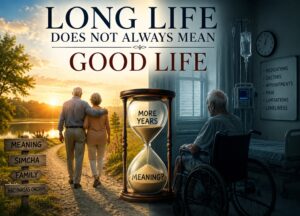
And with that myseh, perhaps we need to rethink our opening question. We began by saying that everybody wants to live longer. We have gyms. We have diets. We have supplements. We have doctors. We have medications. We have GLP-1s. We have AI. We have billionaires spending fortunes trying to defeat aging. And the heylige Toirah? The Toirah taka talks about long life. But maybe it’s telling us something very different. It isn’t promising: Do one cute little mitzvah and you’ll live to 110. It is telling us that life itself has a dimension we cannot measure with a calendar. We count years. The RBSO counts something else. We count birthdays, the RBSO counts eternity. And perhaps that’s why the heylige Toirah can put the same promise on a mitzvah as simple as sending away a bird and on a mitzvah as difficult as honoring one’s parents. Because the value of a mitzvah isn’t necessarily measured by how impressive it looks to us. Gishmak.
And perhaps that’s real pshat. We spend our lives asking for more years. But the heylige Toirah never promised that long life and a good life are the same thing. In fact, the pisukim give us both: “v’ha’arachta yamim” — long life — and “v’yitav lach” — that it will be good for you. Maybe the two are deliberately separate. At times they may even be mutually exclusive. Because living longer isn’t necessarily living better. Long life is not always good life. Perhaps the ultimate promise isn’t how many birthdays we get. It’s what those years ultimately mean. We count years. The RBSO counts eternity.
A gittin Shabbis –
The Heylige Oisvorfer Ruv
Yitz Grossman
