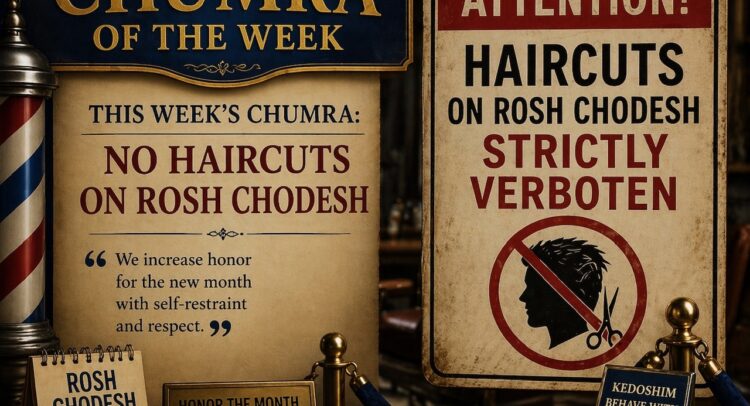
When Thursday Became Friday
A Haircut, Rebbe Yehudah HaChassid, and Other Shades of Gray
Shoin. Last Thursday, one week ago today, the day before Rosh Chodesh, and before I had a chance to think about the next double-header Parshas of Achrei Mois–Kedoshim, a topic appeared out of nowhere mamish when a fresh halachic drama broke out right in my own dining room.
My son-in-law Yaakov-who together with my daughter and their newborn have been staying with us these past weeks (a joy, to be clear) walked in Thursday afternoon looking suspiciously renewed. He was sporting a fresh haircut, his beard was trimmed, and his face was mamish shining. He looked like a man who had just won an argument. Looks as we all know, can be deceiving.
Now, anyone in the Five Towns with an inbox and a pulse knew that this year, since Rosh Chodesh fell on Friday and Shabbos, there was lots of buzz regarding haircuts during Sefira. Kimat every rabbi with a keyboard issued a bulletin, clarification, addendum, counter-clarification, or emergency footnote. The common theme was simple: because Friday carried the double honor of Erev Shabbis and Rosh Chodesh, kimat all agreed and permitted haircuts and shaving specifically for Friday even for those observing sefira from Pesach until Lag B’omer. Gishmak! As an aside, the biggest news of all was that they all agreed.
Wrote Rabbi Freundlich to his Beth Sholom membership, “This Friday, in honor of the day being both Rosh Chodesh and Erev Shabbos, one is permitted to take a haircut and shave, even for those observing the first half of Sefira.”
Rabbi Trump of the YILC, wrote this: “Dear Friends, A good number of people have been asking about haircuts this Erev Shabbos so I wanted to clarify this halacha. Being as this Friday is not only Erev Shabbos, but also Erev Rosh Chodesh, it is permitted to shave or get a haircut this Friday. This adds to honoring the dual happiness of Shabbos Rosh Chodesh. (Mishna Berura 493:seif katan 5). This leniency applies regardless of which set of days of sefira you are accustomed to observe [first 33 or last 33]. Wishing everyone a Shavua Tov!
Similar notices were shared in many other communities. Mamish gishmak, but what they wrote was very specific to Friday. Not Thursday. So, I asked gently: “Yaakov… what exactly happened here? What’s pshat with the haircut and trim”? He answered with the four most dangerous words in modern Judaism: “I asked a Rav.” Already, I knew we were entering deep water. I was ready!
When further pressed, he explained that because he follows the customs of Rebbe Yehudah HaChassid, who is cited by many as discouraging haircuts on Rosh Chodesh and since Friday was Rosh Chodesh, Friday was blocked. As well, his own barber was unavailable. A friend’s barber was fully booked for Friday. And then the coup de grâce when he tried selling me on this: since he shops for Shabbis on Thursdays, therefore, in his particular case, Thursday was functioning as Friday, Erev Shabbos and shoin, he was good to go with his haircut. Well, blow me down! I do recall Tom Carvel advertising that Wednesday is Sundae, but never before heard that Thursday was Friday.

Shoin, for those old enough to remember… “Wednesday is Sundae at Carvel!” was a pun on Wednesday / Sundae, promoting special deals on sundaes every Wednesday. Often it was a buy one, get one free offer. It became one of the most recognizable local ad slogans in the tri-state area and ran for years. Carvel’s own history page preserves versions of the ad copy: “Every Wednesday is Sundae at your Carvel store…”
Thursday is Friday? What?! At that point I threw the red challenge flag. Of course, red because just last week the heylige Ois put out his already famous shtikel titled “Fifty Shades of Red” and avada -if you missed it, you must go back to read it here:_ https://oisvorfer.com/tazria-metzoira-2026-fifty-shades-of-red/ Ober Thursday is now Friday? Yaakov was valiantly using his Gemora-kup (head); finding every loophole to argue his case, but I had heard enough. I told him he was going down! He was on the precipice of losing another machloikes to his shver; yikes! By his logic, Sunday is like Monday, Chol Hamoed begins early, and before long Tu B’Shvat is adjustable due to weather. He wasn’t ready to concede; he had one more play: He argued that a rav (rabbi) was consulted and permission was granted by text. A rav told him that Thursday was ok? I did believe Yaakov because ever since I met him, I am more than aware that he consults with his rav regularly. Why? Ver veyst? Ober, how could that be? Which rav would rule that Friday was now Thursday?

On the way back from shul Friday night I pressed my case and told him I was going to call his rabbi to find out what leniency he was relying on when he gave my son-in-law permission for the Thursday cut and trim. At that point, Yaakov provided these additional facts.
- Hs own barber is sadly out fighting an illness; may he get well very soon, Omen!
- He called a friend for a barber recommendation
- The friend recommended one but later advised that he was fully booked for Friday
- Yaakov asked the friend if he knew a rabbi that could be consulted given his unique facts (he shops on Thursdays; he follows Rebbe Yehudah Hachosid and the barber was booked for Friday)
- The friend called the rabbi who sent back a text with permission.
- Haircut fully sanctioned and maybe also blessed.
My challenge was taking shape and again I teased that in this argument (as in last week’s), despite all his learning, he was going down to defeat to his shver.
Now truth be told, Yaakov already knew his position was weak and to his credit came back from shul Friday morning and told me that he and another friend were discussing this issue when Rabbi Teitelbaum (Rabbi Emeritus of the YILC) overheard the conversation and chimed in that he never heard of the leniency. And that would be the first time in many years that Rabbi Teitelbaum and I were on the same page. Yaakov was beginning to see his case fold up like a cheap suit but wasn’t quite ready to fully admit that he snookered the system.
Fast forward to Shabbis when the son-in law came back from his own shul and admitted that his own rav told him that he was out of bounds when he took the Thursday haircut. And thus, the season standings moved to:

Shver: 2 Son-in-law: 0 but with many halachic arguments yet to come. The good news: while he tried valiantly to use a loophole, or what the Ois calls the color gray, Yaakov does remind me and the rest of the family to count sefira nightly and I have gotten further this year that I have been in the past 10 years (at least). Kudos to him. Shoin, Yom Kippur not too far away.
But now a new question interested me more than the haircut itself. Who was this Rebbe Yehudah HaChosid whose twelfth-century caution nearly justified a twenty-first century fade? And why would Yaakov rely on a person that most never heard of? Let’s find out. Shoin. Rebbe Yehudah HaChosid of Regensburg lived from approximately from 1140 to 1217 in Germany. This was centuries before the Shulchan Aruch, before the Rema, and certainly before online barber reservations. He was one of the great figures of Chassidei Ashkenaz, a movement of piety, discipline, ethics, and spiritual seriousness.

He is most famous for two things. First, Sefer Chassidim, a work of moral guidance, warnings, conduct, humility, and practical holiness. Second, the famous ‘Tzava’as Rebbe Yehudah HaChosid,’ a collection of decrees (cautions and family practices) attributed to him. Many people know him today mainly through the warning list which includes these famous examples:
- Not marrying a woman with the same name as one’s mother
- Not marrying a man with the same name as one’s father
- Avoiding marriage where bride and groom parents share names in certain patterns
- Not building a house so that doorways align in certain ways
- Certain warnings about uprooting fruit trees near a house
- Certain cautions about moving into unfinished homes
- Warnings involving cemeteries, danger zones, and nighttime practices
- Some cautions regarding naming children after living relatives in certain circumstances
And yes, no haircuts on Rosh Chodesh!
Do people follow him? Some strongly. Many selectively. And of course, most inconsistently. Many do invoke him for his same-name ban. By way of example, he cautioned about a mother and her future daughter in law having the same name. He issued decrees about nail cutting on certain days, about haircuts, and many others. As mentioned, some follow some of his advice and admit to quietly ignoring many other matters entirely. Meaning: Rebbe Yehudah HaChosid has become, in some homes, a part-time relative. When convenient, we have him over. Now let’s be real and fair. According to many others, most of his statements and decrees were for his descendants, his locale, and specific circumstances. That said, some were accepted as broader minhogim (customs) but many major poskim do discuss limiting application: Not every warning became binding halacha; farkert, most did not!
And the question on the Ois’s mind is this: If one invokes Rebbe Yehudah HaChosid for Thursday haircuts, must one also accept the full package? All his stringencies? Isn’t that what Chasidim do? Don’t they follow what their rebbe says? Taka an excellent question ober the answer is that most people often choose the chumra that helps today, not the ones that inconvenience tomorrow. And the bottom line? The Shulchan Aruch is the baseline law while Rebbe Yehudah HaChosid is extra caution / pietistic shade. Reality check: For most modern users, his decrees mean we select whichever solves our scheduling conflict.
Following Rebbe Yehuda’s decrees when convenient or when a particular one talks to you, or because that’s what your father did, created the modern Jewish specialty: the selective chumra (stringency). We love adopting stringencies that improve identity. We are less enthusiastic about adopting stringencies that inconvenience scheduling. And this, dear readers, is where a haircut story becomes larger than a haircut. It becomes a color story and that color is a shade of gray. Veyter.
Last week we discussed Fifty Shades of Red. This week the palette expands. Red is a clear line. Gray is what happens when convenience approaches the line carrying sources. The son-in-law did not wish to violate anything; chas v’sholom; he is a good guy, the real deal. He merely wished to remain well-groomed while preserving minhag, convenience, timing, barber loyalty, and personal dignity, all under rabbinic supervision. It so happens that the heylige Ois chapped him and made him to his homework. No more Thursday is Friday nonsense. On the other hand, he did donate a kidney less than a year ago. He can do whatever he wants; the RBSO surely has his back.
That said, turning Thursday into Friday was not rebellion; it was artistry. And if you think this phenomenon began with my dining room, think again. Years ago, I wrote, and it remains true, that Sefira itself seems to have undergone a remarkable slimming process. It’s been shaven down, so to speak. Once upon a time Sefira meant something. No music. No weddings. No parties no endless celebrations. Caterers disappeared. Bands took vacations. People remembered that twenty-four thousand students of Rebbe Akiva died for lacking proper respect one for another. You felt the season. Or did they? During the entire 40 days of sefira? I don’t think so ober that topic for another time.
Today? Between pre-Rosh Chodesh leniencies, post-Rosh Chodesh explanations, Lag B’Oimer, Yom Ha’atzmaut, small l’chaims, medium l’chaims, engagement vorts somehow classified as “not really a simcha,” and every fresh category invented by men who break into a rash if they go three weeks without live music, we have managed to trim the mourning customs of Sefira down to approximately fourteen and a half serious business days. Perhaps we should count Sefira without a brocho on any night we attend a party. That said, one must admire the emotional versatility of the modern Jew. On Yom Ha’atzmaut morning, many are reciting Hallel, with or without a brocho, depending on zip code, hashkofo, and which rabbi answered the text first. Then, having completed the songs of praise, we return home and resume mourning Rebbe Akiva’s talmidim by not shaving. Such range. Such depth. Such scheduling. Can one get a haircut on this day on the way to or from shul? Shoin, I should check in with my son-in-law!
Which brings us directly to this week’s parshas of Acharei Mos–Kedoshim. These parshas do not speak in hints, suggestions, or pastel shades. There is no gray. They speak in bold colors. Especially red. Red lines. They lay out areas of life where the heylige Toirah does not say: “Use your best judgment.” It says: Do not cross here. Forbidden relationships. Moral boundaries. Holiness in private life. Restraint in public life. Respect in human life. They are all red lines. The heylige Toirah understands something we often forget: Where human desire is strong, lines must be bright. Where temptation is clever, language must be clear. Where people naturally prefer gray, the heylige Toirah sometimes writes in red. The bottom line: Our parsha teaches us that not everything bold, dramatic, or oozing with excitement, if you chap, belongs inside a person. Especially one on the forbidden list; it’s a red line.

Let’s close with one more red line, this one red mamish -as in blood mamish. The instructions in our parsha state: do not eat blood. A few words of concept, a lifetime of implementation. Because the moment that posik was heard, the still newly minted Yiddin responded the only way Jews know how: with questions. What kind of blood? How much blood? Inside the meat or only outside? Chicken also? Liver also? What if it dried? What if I rinsed it? What if I like my steak rare? And just like that, a few words became not just a red line but also a full sugya. What to do? Enter Toirah shebaal peh – in today’s parlance, AKA the Mishna and heylige Gemora because if the written Toirah gives headlines, the Oral Toirah provides operating instructions. And thus, were born: soaking, salting, rinsing, draining, roasting, timing, checking, and passionate disagreements near the sink.

The posik says: “כי נפש הבשר בדם היא” – For the life of the flesh is in the blood. Meaning: blood is not merely juice with bad public relations; it represents life itself. And life, says the Heylige Toirah, is not a dipping sauce. The ancient world was fascinated with blood. They worshipped with it, drank it, feared it, used it in rituals, and treated it as power. The Heylige Toirah arrived and said: You are not pagans. You are not wolves. And you are definitely not Dracula. You may eat meat. But not in a way that looks like the animal might still hire a lawyer and file a complaint. Which brings us to practical halocho. We first read about blood in Parshas Noiach (before Matan Toirah). Next In Vayikra, again in Vayikra, and then a full encore performance in Acharei Mos, followed by another reminder in Devorim. At a certain point the heylige Toirah is no longer informing; it is repeating for the fellow in the back who keeps ordering his bloody steak. If the Toirah says something once, learn it, if the prohibition is stated seven times, put down the fork.
The RBSO must mean it when He reminds us not once but between 7- 10 times throughout His Toirah that we may not eat blood. How many times? Enough times that one gets the impression He chapped we would ask again. He chapped that His Chosen People were a bunch of oisvorfs who would ignore it otherwise; hence repetition. Let’s review the list:

- Bereishis 9:4 To Noiach after the flood: But flesh with its life, which is its blood, you shall not eat.
- Vayikro 3:17 All fat and all blood you shall not eat.
- Vayikro 7:26 You shall not eat any blood, of bird or beast.
- Vayikro 7:27 Whoever eats blood shall be cut off.
- Our parsha (Perek 17) multiple times in Pisukim 10, 11, 12, 14
- I will set My face against one who eats blood
- Life is in the blood
- Therefore do not eat it
- Devorim 12:16 – Only the blood you shall not eat.
- Devorim 12:23–25 Repeated again: Be strong not to eat the blood.
The final bottom lines: There are red lines in relationships. There are red lines in speech. There are red lines in money. And there are red lines on your plate. May we merit to keep the red lines red, the gray zones small, and our arguments in the family warm, humorous, and ongoing. As for Yaakov, he’s still a good guy, beloved son-in-law, serious learner, and worthy opponent. Let’s see what next week brings.
A gittin Shabbis –
The Heylige Oisvorfer Ruv
Yitz Grossman
