
Raboyseyee and Ladies,
We begin with big mazel tov wishes to our newest (and maybe youngest) friends, Batsheva and Shaul Katz and their entire extended family upon the recent engagement of their son Yoni to Tammy Zeigler, she the beautiful daughter of Galina and Amichai Ziegler, they of Brooklyn, New York. We were honored to have attended this great celebration. May Tammy and Yoni merit to build a beautiful life together.
The Stolen Menorah
Some thirty-plus years ago, a rabbi friend of mine shared that he was part of a group headed to the Vatican on a mission to get back the Menorah taken by the Romans when the Second Beis HaMikdash was destroyed. While some details are a bit murky after so many years, earlier this week I was able to speak to one of the participants, and he confirmed the basic story.
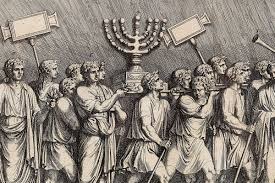
The group had been led to believe that the heylige Menorah would be handed over in exchange for a very large pot of money. A certain gentleman—father of a Beth Sholom member—was in charge of raising the funds. The bottom line? The group was duped, the supposed middleman disappeared with the money, and the Menorah, likely already a duplicate of the original fashioned for the first Beis Hamikdash, that one a dupe of what is described so vividly in this week’s parsha—remains missing. In other words: the Romans took it, the Vatican maybe has it, and the Jews paid for it twice. Classic. Shoin, having made the connection, let’s begin.
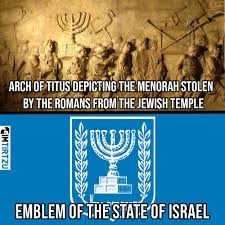
All agree that the Menorah of the Second Beis HaMikdash was taken by the Romans after the destruction in 70 CE. It appears prominently on the Arch of Titus. Yet even here, there is debate: Was that the authentic Menorah? Or a later version? Was the original hidden away? Is it in the Vatican? In a cave? In a warehouse in Rome next to confiscated scooters? Ver veyst? These questions will either be answered when Moshiach arrives—or when Hollywood releases a Spielberg-produced adventure film called Raiders of the Lost Menorah.
But just as intriguing as to where the Menorah ended up, is another mystery: why so many medroshim insist that Moishe himself couldn’t figure out how to build it. And with that, welcome to Parshas Terumah, Tetzaveh, Vayakhel, and Pekudei—the four-week stretch devoted almost entirely to the Mishkan project.
And when we say Mishkan, we mean the whole operation:
- The boards
- The curtains
- The coverings
- The Aron
- The Shulchan
- The Mizbeach
- And, of course, the heylige Menorah
There are few mitzvis in the Heylige Toirah that sound as deceptively simple as the command to build the Menorah. After all, how complicated can a candelabra be? Seven branches, some cups, knobs, flowers—gold, of course—and you’re done. Except… you’re not. Because when the Heylige Toirah gives the instructions, the language becomes dense, technical, and almost impossible to visualize. And then Chazal (our sages) tell us something even stranger: Moishe himself couldn’t quite chap it. Mamish? Indeed so. The man who spoke to the RBSO ponim el ponim (face to face)? The man who split the sea? The man who stood on Har Sinai for forty days without eating or drinking? The man who led an entire nation out of Egypt? That same Moishe looked at the instructions for a golden lamp and says: “Riboinoi Shel Oilom… can we go over that again!?” What’s pshat here?
And the question of the week is this: What prompted the sages of the medrish to declare that Moishe couldn’t get it done? Did they just decide this on their own? Stam azoy? Not at all; were that the case, they wouldn’t be called sages! It appears they were responding to subtle textual clues -evidence- in the pisukim themselves; let’s read what they did.
Shtikel Evidence #1: “See… as you were shown” The Heylige Toirah says: “And see and make them according to their form, which you were shown on the mountain.” Our sages decided that these words were unusual. By most keylim (vessels), the RBSO simply says: “make it like this.” Ober by the Menorah, we got: “See” and “Shown on the mountain” as in already seen and shown. And if Moishe had to be shown a model, it suggests that the verbal description wasn’t enough. Something about the Menorah required a visual. Shoin, from here, Chazal inferred that Moishe had difficulty understanding its form. He did not chap!
Shtikel Evidence #2: “It shall be made.” The posik says: “מִקְשָׁה תֵּעָשֶׂה הַמְּנֹרָה” – (The Menorah shall be made of hammered work.) Normally the Heylige Toirah says: “וְעָשִׂיתָ” – “You shall make.” But here it switches to passive language: “It shall be made.” From this, the medrish concluded that the Menorah was not made in the usual way. Instead, the RBSO told Moishe: “Throw the gold into the fire.” And from the fire, the Menorah emerged fully formed. Not assembled, not constructed, not engineered; it formed itself. Mamish a heavenly assembly line. No contractors, no permits, no inspections, and not even a delay because the gold shipment is stuck at the port. Straight from the fire, ready for use. The heylige Gemora (Menachos 29a) says that this is what went down: The RBSO showed Moishe a vision of a fiery Menorah but even after, Moishe still struggled. Finally, the RBSO told him: “Throw the gold into the fire, and the Menorah will come out by itself.” If this is what took place and of course it did, the Menorah was not merely crafted, it was almost miraculously formed. As an aside, that was a gutsy call because the last time gold was thrown into the fire, an eygel (golden calf) came out and you know the rest of that story. A happy ending it was not for many. On the other hand, this time, the RBSO Himself gave the instructions, not Aharoin. Shoin, that story for another day.
Shtikel Evidence #3: The complexity of the instructions which are long, technical, repetitive, and filled with unfamiliar terms: Cups, knobs, flowers, and almond-shaped ornaments. It almost reads like a cookie-making activity. They are especially long and complicated when compared to The Aron and the Shulchan, with their simple dimensions. But the Menorah needed six branches, three cups per branch, knobs at precise points, four cups on the center shaft, and all from one solid piece of gold. OMG! At some point, Moishe must have thought maybe we can do this in silver? Gold seems a shtikel ambitious. The bottom line: If a master goldsmith would need blueprints, avada we can chap that Moishe, who until now was busy splitting seas and not running a jewelry workshop, needed external help. We can chap that had these instructions been handed to a modern-day contractor, he’d ask for a rendering?
On the other hand, and though Moishe was of course very talented, our sages teach us that he had been stumped before. They tell is that Moishe needed more clarity -as in an image- on two other occasions. I total, there were three things, three mitzvis where Moishe needed a visual aid:
- Kiddush HaChodesh
- The half-shekel
- The Menorah
Taka azoy? And we know this how? Because our very smart sages chapped that the same word appears at all three. By each, the Heylige Toirah uses the word: “זה” – “This is what it looks like.” Which means that even at Har Sinai, there were moments when Moishe said: “Can I see a picture?” The bottom line: Apparently, even the greatest Novee who ever lived sometimes needed a heavenly screenshot. It’s more than kideye (worthwhile) to read the Medrish Tanchuma on the imagined exchange – as Reb Levi conjured it up- between the RBSO and Moishe over the menorah. His imagination was inspired from one specific posik in the parsha, where we read this (Shmois 25:40)וּרְאֵה וַעֲשֵׂה בְּתַבְנִיתָם אֲשֶׁר אַתָּה מָרְאֶה בָּהָר-
ר’ לוי אמר מנורה טהורה ירדה מן השמים.
למה? שאמר לו הקדוש ברוך הוא למשה ועשית מנורת זהב טהור.
א”ל כיצד נעשה.
א”ל מקשה תעשה המנורה.
אעפ”כ נתקשה משה, וירד ושכח מעשיה.
עלה ואמר רבש”ע שכחתי.
א”ל ראה ועשה, שנטל מטבע של אש, והראה לו עשייתה, ועוד נתקשה על משה.
א”ל הקדוש ברוך הוא לך אצל בצלאל והוא יעשה אותה.
ירד משה ואמר לבצלאל, מיד עשאה.
התחיל משה תמיה, ואמר אני כמה פעמים הראה לי הקדוש ברוך הוא ונתקשיתי לעשותה, ואתה שלא ראית עשית מדעתך, בצלאל שמא בצל אל היית עומד כשהראה לי הקדוש ברוך הוא.
And now in English:
“And see that you make them after the pattern that you are shown on the mountain.” Noting that Moishe had to be shown an image and that Bezalel is the one to build it, this midrash reports: R. Levi says, “A pure menorah came down from heaven.” How so? The Holy One, blessed be He, said to Moishe, “You shall make a menorah of pure gold.” Moishe said, “How shall we make it?” G-d said to him, “The menorah shall be made of beaten work.” Nevertheless, Moishe found it difficult, and when he came down, he forgot how it was to be made. He went back up and said, “Master of the Universe, I have forgotten!” G-d said, “Look and make it,” and He formed a fiery image and showed him how it was to be made, but Moishe still found it difficult. The Holy One then said, “Go to Bezalel and he will make it.” Moishe went down and told Bezalel, and he immediately made it. Moishe was astonished and said, “To me the Holy One showed it many times, and I still found it difficult, but you, who did not see it, made it on your own! Bezalel, perhaps you were standing in the shadow of G-d when He showed it to me?”
Well, blow me down and avada we must feel bad for Moishe. This medrish tells us that even after the RBSO showed Moishe a fiery Menorah, he still couldn’t reproduce it. The RBSO then said: “Go to Bezalel. He will make it.” Moishe went down, explained the instructions, and Bezalel immediately constructed it. A stunned Moishe then said “I was shown this many times and still struggled. You never saw it, and you built it immediately. Maybe you were standing in the shadow of Hashem when He showed it to me.” The bottom line: Moishe, the auditory learner was no match for the tactile Bezalel. Wow! The bottom line: Moishe attended the lecture. Bezalel built the prototype. And sometimes, that’s the difference between inspiration and execution.
And we close with this: Yes, there have been real and fairly recent attempts by Jewish leaders to raise the subject of the Menorah with the Vatican, though none of these efforts were officially recognized as “rescuing the Menorah. To date, none have succeeded in producing any artifact. What happened is best understood as a combination of official diplomatic inquiries and unverified rumors/legends.
They include a 1996 effort by Shimon Shetreet, then Israeli Minister of Religious Affairs who formally asked Pope John Paul II to help search for the Temple artifacts, including the Menorah. In 2004, during an official visit to the Vatican, Israel’s two chief rabbis at the time — Rabbi Yona Metzger and Rabbi Shlomo Amar — raised the issue with Pope John Paul II. And beyond official state visits, in 2013, Rabbi Yonatan Shtencel of Jerusalem wrote a public letter to Pope Francis asking him to consider returning the “golden Menorah” as a gesture of goodwill. Vatican officials responded that they would look into any evidence, but reiterated that there is no proof the artifacts are in their possession. There are also many stories circulating outside official channels, often without documentation:
The official Vatican position is straightforward: They state they do not have the Temple Menorah or any such artifacts. They have also said that if proof were provided, they would consider facilitating a review or inquiry — but no evidence has been produced. Historians generally conclude that: The Roman triumph depicted on the Arch of Titus shows the Menorah being taken from Jerusalem to Rome. However, ancient records of the Temple treasures disappear by the 5th century CE. It’s much more likely the Menorah was lost, melted down for the gold, or destroyed when Rome was sacked, or otherwise lost to history after that point. Rumors about rabbis secretly seeing the Menorah in basement vaults are almost certainly folklore or legend, with no reliable documentation.

On the other hand, if they do have it, with gold prices at all-time highs, now would be an opportune time for Church officials to find, dust it off, and sell it. It’s worth a fortune. Let’s get real: avada we all chap that the church will need additional funds to help pay out huge sums on behalf of priests gone rogue. We no longer want it. Besides, according to yet another medrish, when the third Beis Hamikdash appears -and I say appears because according to the medrish, it will fall from the sky with all its accoutrements already in place, we’ll have ourselves a brand spanking new Menora -built to spec as the RBSO had intended- which will also help solve yet another mystery. What mystery is that you ask or should be asking?
Mistama, you missed the famous machloikes between the Rambam and his followers -to include the Lubavitcher Rebbe- vs other important rabbis who argue over the shape of the konim that emerged from the Menora. What are konim you ask? Shoin, let’s go back and chazir the instructions and materials list. Says the heylige Toirah (Shmois 25:32), azoy:
שמות כה:לב וְשִׁשָּׁה קָנִים יֹצְאִים מִצִּדֶּיהָ שְׁלֹשָׁה קְנֵי מְנֹרָה מִצִּדָּהּ הָאֶחָד וּשְׁלֹשָׁה קְנֵי מְנֹרָה מִצִּדָּהּ הַשֵּׁנִי.
And there shall be six branches (or, “stalks,”) going out of its sides, three branches of the lampstand out of one side of it and three branches of the lampstand out of the other side of it.
And while all seemingly agree that konim are “branches,” now this: There are no biblical or rabbinic instructions on how to fashion the konim. Ancient rabbis as well as most other interpreters are silent on whether the branches were straight or rounded. The vast majority of visual and textual interpreters have assumed rounded branches, a tradition so firm that it did not require discussion. And taka, whenever we come across images of what the Menora might have looked like – such images emblazoned in our memory banks from the time we were kids in yeshiva and looked forward to seeing all the images of the Mishkan and its keilim in a special pamphlet that cost approximately ten cents – we imagined the Menora with rounded branches. But is that emes? Is that what the RBSO had designed? Case closed? Does everyone agree? Of course not!
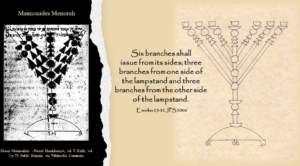
You shouldn’t be surprised to learn of a fascinating machloikes that nobody argues about at the Shabbis table—but maybe they should. The Rambam says the branches of the Menorah were straight. Not curved, not rounded, not like some fancy Italian candelabra. Straight. Clean. Simple. Six diagonal lines, all business. A Menorah that looks like it learned in Brisker Yeshiva, for those who chap.
But for almost two thousand years, the Jewish people have been looking at a different picture entirely—the one carved into the Arch of Titus in Rome. You know the scene: the Romans destroyed the Beis HaMikdash, grabbed the Menorah, paraded it through the streets like a trophy, and then carved the whole thing into a victory monument. What shape are the branches there? Beautiful, elegant, rounded curves, like something you’d find hanging in a five-star Roman dining room next to a bowl of olives.
And yet, us Yiddin, yes us, with our long memory and short art department, look at that Roman carving and say, “Ah! That must be what the Menorah looked like.” For centuries, we’ve drawn it that way. That’s how it appears on some siddurim, on the Emblem of Israel, on shul windows, on sukkah decorations, and on gravestones. The Romans took the Menorah; and we took their picture of it and ran with it. We made it holy. It’s like someone steals your silver kiddush cup, wins a trophy with it at a state fair, puts it in a display case—and then you buy the postcard in the gift shop because, “Nu, at least we’ll have a picture.” Shreklich!
And then, along came the Rambam, calmly, without fanfare, and said, “By the way, the branches were straight.” Straight! Which means that for generations, Jews were looking at these elegant curved Menorahs thinking, “Ah, so traditional, so authentic,” while the Rambam is sitting in Gan Eden saying, “I literally drew you a picture. It was straight lines. Straight! What did you think I meant?”
So now we have this quiet, dignified machloikes: the Rambam on one side with his straight, no-nonsense Menorah… and two thousand years of Jewish art on the other side saying, “But the curves look so much nicer on the mantel.” The bottom line: Only by us Yiddin could the official picture of the Beis HaMikdash come from a Roman victory monument. And only by the Jewish people could we turn even that into a minhag. But, what about the Rambam? Don’t we trust him with everything?
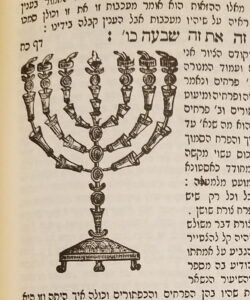
So happens that the Rambam, in his handwritten manuscript of his Mishnah commentary (now at Oxford University), drew a schematic menorah with straight branches. And while the Rambam admits in his commentary that his drafting skills are not well developed, he maintains that the branches were straight. His son Avrohom ben HoRambam, an important scholar in his own right, wrote in his commentary on Exodus (ad loc.) that his father intended straight branches:
וששה קנים—הקנים (כמו) ענפים נמשכים מגופה של מנורה לצד ראשה ביושר, כמו שצייר אותה אבא מרי ז”ל, ולא בעיגול כמו שצייר אותה זולתו.
“Six Kanim”—the Kanim (are like) branches that extend from the base of the lampstand towards its head in a straight line, just as my father of blessed memory drew it, and not in an arc, like others have drawn it. Oh well!
Let’s close out with this: Of course, many want to know if there is a deeper meaning to Moishe forgetting and struggling incident with the menorah. Why would the RBSO set Moishe up to be embarrassed by Betzalel? And why the Menorah? What message was the RBSO sending through Moishe’s inability to build the Menorah? Avada this incident baffled many an exegete and some say so gishmak azoy: Could the message be that there are certain mitzvis, missions, and responsibilities that are too big for us to build on our own.
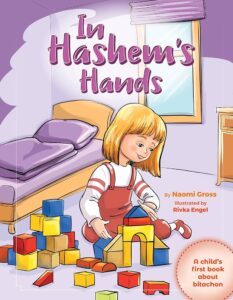
Even for a giant of a man like Moishe. Even with the clearest of instructions, and even though the RBSO showed him the blueprint in fire. At some point, the RBSO chapped Moishe’s efforts and said “You throw in the gold, I’ll take care of the rest.”
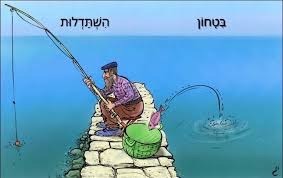
Your job is the hishtadlus, the effort, the attempt, and the willingness to try. As to the result and finished product? Leave that to Me said the RBSO. And doesn’t that ring familiar? Isn’t that the emes as we muddle through life? At times -seemingly many- the final result is mamish out of our domain; that comes from Above. Sometimes, even the greatest among us must step back, admit confusion, and let the RBSO finish the job. It happens to me on a regular basis.
A gittin Shabbis!
The Heylige Oisvorfer Ruv
Yitz Grossman
