Raboyseyee and Ladies,
SPECIAL EDITION
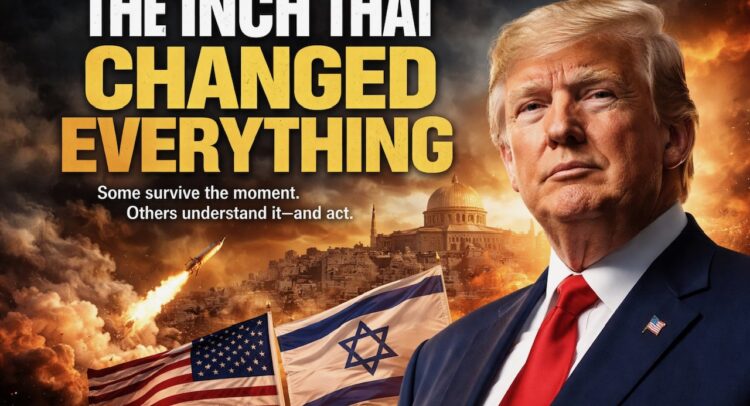
The Inch That Changed Everything
Some survive the moment. Others understand it – and act.
There is an irony in the Purim story that is almost too striking to ignore.
Yes, the festive days of Purim are now in our rearview mirror. Yes, the משלוח מנות (those baskets of food and drink) have been delivered, the last crumbs of homontashen swept away, and Jews across the world have already shifted—almost seamlessly—into Pesach mode. The shopping has already begun—mamish as if the shelves will never be restocked. Newsflash: they will. Almost instantly.
So why an article about Purim now?
Because the entire Megillah unfolds in Persia—Paras—the very land that the modern world now calls Iran. Empires have changed. Names have evolved. Regimes have risen and fallen. But the stage—remarkably—has remained the same. The geography hasn’t moved. Only the players have. And once again, the eyes of the world turn to that very region, where the fate of nations—and in many ways, the fate of the Jewish people—feels as though it hangs in the balance.
Though our Megillahs have been rolled up and returned to their place until next year, certain words do not fade quite so quickly. Among its many memorable lines, there is one that has stayed with me for years—one I have returned to time and again in moments that mattered. Not because it is poetic, but because it is painfully real. It speaks not only to Shushan—but to life itself.
There comes a moment in the Purim story when everything hangs in the balance. The decree is sealed. The fate of the Jewish people is no longer theoretical—it is imminent. So it was in the days of Haman, who sought to eradicate the Jewish people near and far. His plan was advanced. The ruler of 127 provinces had already signed off. And in that moment, Mordechai does not offer comfort. He does not engage in strategy or palace calculations. He sends a message—sharp, urgent, and impossible to ignore: ומי יודע אם לעת כזאת הגעת למלכות. “And who knows if for a moment just like this you attained royalty.”

It is not a compliment. It is a confrontation. Mordechai is not telling Esther that she is fortunate—he is telling her that she is accountable. You think you are here because of circumstance? Timing? Politics? No. You are here because you were placed here—for this moment. And if you fail to recognize it—if you choose silence over action—history will move forward without you, but you will have missed the very reason you were brought here in the first place.
There are moments in life when those words stop being part of a Megillah and start becoming a question directed at a person. Moments when everything is measured differently—not in years, not in terms, not in carefully calculated steps—but in inches. Moments when people stand an inch away from collapse, from change, from something that will redefine everything.
Because sometimes, a man comes within less than an inch of not being here at all. And when that happens, the question of “why” is no longer philosophical—it becomes immediate, personal, unavoidable. Why was I spared? Why am I still here? And what am I expected to do with it?
And in those moments, the noise begins to fall away. The polls, the advisors, the headlines, the endless calculations—they lose their grip. Because when a person realizes how close he came to the edge, he understands that he was not preserved merely to continue as before. He was preserved because something is being asked of him. This is where leadership is born.
Not when the path is easy. Not when the markets are calm. Not when the timing is convenient. But when a leader understands exactly what it will cost—and acts anyway. Leadership is not tested when it is safe; it is revealed when it is costly.
And every so often, those words step out of the Megillah and into the present. Because history does not only produce moments—it produces people who are placed into those moments. And the question is always the same: Who recognizes it?
There are leaders who pass through history. And there are leaders who realize—sometimes suddenly—that they are standing inside a moment that will define far more than their own tenure, a moment that demands not management, but decision.
When a man comes within less than an inch of not being here, something happens. The fog lifts. The noise fades. And in its place comes clarity. And in that clarity, a leader can see the world not as it is being explained to him, but as it actually is—a world where threats are not theoretical, where dangers delayed are dangers multiplied, and where pretending not to see is itself a decision with consequences.
That man in our time is President Donald J. Trump. In that moment—in that inch—he understood. He read the room—not the political room, not the media room, but the room of history itself. He understood what that inch meant. Not randomness. Not coincidence. But a line drawn—a before and an after.
And once that realization takes hold, the question is no longer what is convenient. The question becomes: What is right?
He knew what would follow. He knew the markets would react. He knew oil prices would move. He knew the global response would be immediate and loud. He knew the political calendar. And still—he acted.
Not because it was safe. Not because it was popular. But because he understood that leadership is not about preserving calm—it is about preventing catastrophe.
And with that clarity came something else: a willingness to stand openly, clearly, and without hesitation alongside the State of Israel. Not quietly. Not conditionally. But with the understanding that some things are not complicated—they are simply right. I dare say that never before has the United States stood so openly and proudly with its ally, Israel. And we, as Jews, must recognize that and be grateful.
We are not speaking of perfection. But our mesorah does recognize that there are moments when a person is granted a clarity that feels larger than himself—a moment when he stops asking how this will play and starts asking why he was placed here to begin with.
ומי יודע אם לעת כזאת הגעת למלכות
“And who knows if for a moment just like this you attained royalty?”
And every so often, the person chosen for the moment hears those words—not from a messenger, but from the moment itself. And he answers.
History will debate the policies. Analysts will dissect the timing. Critics will argue the cost. But long after the noise fades, one question will remain: When the moment came—when it was clear, uncomfortable, and unavoidable—did he step forward or step aside?
The world is full of leaders who explain why something couldn’t be done. History is written by those who understood that it couldn’t be left undone.
And for recognizing the moment, for reading it correctly, and for acting when others would have waited, we say clearly and without hesitation: Thank you, Mr. President, for knowing your place in history.
The Heylige Oisvorfer Ruv
Yitz Grossman

2 Comments
Dear Yitz,
I read your commentary with heartfelt emotion. I couldn’t help but think of my parents who survived the Shcheta of Hitler yemach shmo. I felt that we as a nation at a precipice. But thank the one above President Trump had his moment in time. He realized he had to take action against these murderers. And he took action.מתוך לא לשמה בא לשמה. With the inaction of Europe, I think he knows who is true allies are.
May Hashem grant him strength to see a good outcome for his works.
Have a Fraylechen and Kosherin Pesach
Beahava,
Yitz
P. S. Love your weekly commentaries.
Luv it!
Moish basch