Raboyseyee and Ladies,
Our friends are having more grandchildren; let’s shout out the newest arrivals. In no particular order, here we go:
Mazel tov wishes to Dasi and Muti Weitz & to Chana and Jay Frenster upon the birth and bris of their new grandson. Welcome to the world Gavriel Itamar and what a moment it was when the name was announced. In the truest manifestation of ‘a generation goes and a generation comes,’ Gavriel Itamar carries the name of Mr. Isadore (Itamar) Weitz, OBM- who passed away just three short weeks ago. May you be just like him.
A big mazel tov to Lemor and Murry Englard and their entire family upon the birth of a grandson born to their children Tyler and Mikey Englard, their first of many to come im’h. Mazel tov to Tyler’s parents Yocheved and Marc Schwartz and their entire family. We look forward to joining you at the bris this coming Sunday. May baby Englard bring much, and only nachas to his parents, grandparents, and to all his new relatives.
Mazel tov to Mandy and Rubin Brecher upon the birth and bris of their latest grandchild born to their children Ayelet and Chaim Frankel. Mazel tov as well to Chaim’s parents, Elaine and Dudie Frankel. Welcome to the world Amram Meir, and may you be a source of much nachas to your siblings, parents, grandparents, great grandparents.

Robert F. Kennedy vs Moishe:
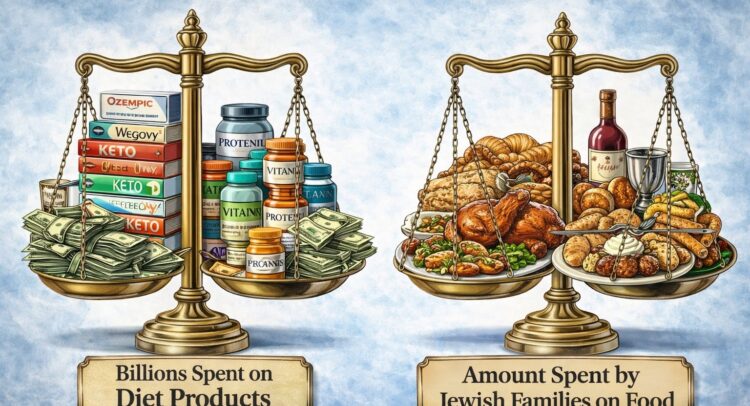
Long before thin was in and dieting became trendy, and zicher thousands of years before the world heard about Ozempic, Wegovy, Mounjaro, or any of their cousins, dieting was already known to the Yiddin. Is that so? And if it is, why are so many Yiddin overweight? Why? Because we eat kugel, kishka, cholent, challah, cake, and lots of sugar. Let’s also shout out pizza. We overindulge weekly because, when it comes to food, we are mamish beheymis, nothing less. We are out of control! Mamish!

The good news: it’s not just us. According to informed sources found on the heylige internet—with help from AI who seems to know everything except how to make a perfect kugel, Americans shelled out an estimated $71 billion on weight-loss drugs in 2023. That’s a 500% increase since 2018, when spending was just under $14 billion. The biggest jump—62% in one year occurred between 2022 and 2023, when Ozempic went viral and became more famous than half the off-the-rail celebrities posting selfies after their first dose.
The emes is this: When compared to what we Yiddin spend on Shabbis company, Pesach, and other Yom tov shopping… it’s not that much. Americans know the emes: 78% are overweight or obese, and 97% of dieters regain the weight within three years, ready to buy the next miracle pill or “revolutionary” diet plan. Yikes!
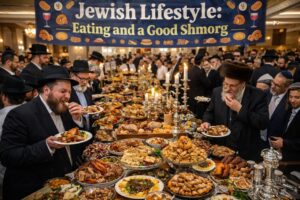
And taka, why do we overeat? It’s simple. We love food. Our lifestyles -brissim, weddings, bar & bat mitzvas, sheva brochis, the weekly shul kiddish, school and organizational dinners, charity fundraisers, Pesach programs, winter break vacations, and stam azoy eating out, all conspire against us and keep us in constant food battles. We load up on food and dessert because that’s what we do. The eyes see and shoin, the battle is lost. It’s not a choice; it’s a lifestyle. In fact, kugil and chulent are so powerful they can forever alter the DNA of shiksas no matter how skinny they were born or how skinny they remained before conversion. Once they attend shul events, Shabbis meals, and adopt our eating lifestyle, they blow up, mamish proving that nurture is more powerful than nature. Only our diets can break and alter DNA; amazing!
The bottom line: when it comes to the kiddish or the shmorg, no Jew has ever beaten the house. As I have mentioned many times over the years, the shmorg is stronger than the yetzer hara himself, and everyone knows the yetzer hara is no slouch.
How did people lose weight before Ozempic? Let’s go back in time and meet William Banting. Before modern medicine, there was William Banting, an English undertaker in 1860 or 1863 (machloikes). He weighed 202 pounds on a five-foot-five frame. Like all dieters, he tried everything: lighter foods, swimming, spas, laxatives… nothing worked. Finally, he invented his own diet, lost 50 pounds, and published “Letter on Corpulence.” The pamphlet sold thousands worldwide. So popular that “I am banting” became Victorian slang for “I’m on a diet.” The bottom line: Dieting, in some form, is here to stay.
Was Banting mamish the first to diet and talk about it? Not! Because long before people -male and female- became diet obsessed, the heylige Toirah given in the year 2448, specifically talks about one diet and the first person to ever try it. Who was this person? Was weight lost? How much? How long was the person on a diet? Did it work? What happened thereafter? Is this topic mamish discussed in the heylige Toirah? And how is this question at all related to our parsha of Mishpotim which describes events just past Matan Toirah (Revelation) and which -according to the Sefer HaChinuch- contains 53 of the 613 commandments? As an aside, other than in similarly mitzvah-laden parshas (such as Re’eh, Shoftim, Ki Saytze, and possibly Kedoishim), it is hard to find a more random list of mitzvis that are not overall thematically connected. The bottom line: Mishpotim is a smorgasbord of mitzvis; we love our shmorgs.
Who was the first to experiment with dieting extreme? Zicher not our own Health and Human Services Secretary Robert F. Kennedy Jr. who recently revealed how he lost 20 pounds in 20 days on a highly restrictive diet focused completely on meats and fermented foods. In an interview with USA Today’s “The Excerpt” podcast, the Secretary revealed that he followed the diet the whole day. “That may not be right for other people, but I lost 40 percent of my visceral fat within a month.” Previous interviews reveal that he eats steak along with fermented vegetables for breakfast daily. Breakfast: steak. Lunch: fermented veggies. Dinner: steak. Shoin, somewhere, a cardiologist zicher fainted.

Nice, ober what has all this diet and fasting talk got to do with our parsha? What’s the relevance? Is dieting or fasting really mentioned in our parsha? The short answer is that it’s not, at least not directly. It is however specifically mentioned later in Sefer Devorim with a reference to our parsha. There, Moishe talks about his diet plan: he did not eat or drink for forty consecutive days. Let’s read the relevant pisukim. I say pisukim because Moishe repeated his diet twice; in posik 9 and again in the posik 18 of the very same chapter- that he did not eat 40 days and nights:
בַּעֲלֹתִי הָהָרָה לָקַחַת לֻחֹת הָאֲבָנִים לֻחֹת הַבְּרִית אֲשֶׁר כָּרַת ה׳ עִמָּכֶם וָאֵשֵׁב בָּהָר אַרְבָּעִים יוֹם וְאַרְבָּעִים לַיְלָה לֶחֶם לֹא אָכַלְתִּי וּמַיִם לֹא שָׁתִיתִי.
“When I went up the mountain to receive the stone tablets, the tablets of the covenant that Hashem made with you, I stayed on the mountain forty days and forty nights; bread I did not eat, and water I did not drink.”
וכן גם בדברים ט׳: י״ח:
וָאֶתְנַפַּל לִפְנֵי ה׳ כָּרִאשֹׁנָה אַרְבָּעִים יוֹם וְאַרְבָּעִים לַיְלָה לֶחֶם לֹא אָכַלְתִּי וּמַיִם לֹא שָׁתִיתִי עַל כָּל חַטַּאתְכֶם אֲשֶׁר חֲטָאתֶם לַעֲשׂוֹת הָרַע בְּעֵינֵי ה׳ לְהַכְעִיסוֹ.
“And I fell down before Hashem, as at the first, forty days and forty nights; bread I did not eat, and water I did not drink, because of all your sins that you had committed, doing what was evil in the eyes of Hashem, to anger Him.”
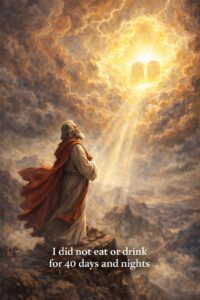
In posik 18 above, he reminds the Yiddin that he fasted because the Yiddin had sinned with the eygel; we will come back to that soon.
In any event, Kennedy’s successful diet notwithstanding, it pales by comparison to Moishe who went 40 days and 40 nights without a bite or sip. No steak. No sauerkraut. Not even a sip of water. No Instagram selfies, no TikTok updates, gornisht. It’s clear that Moishe won the critical tests -spiritual and legacy, but let us also recognize RFK who chapped that humans can survive on steak and sauerkraut without cake and other desserts. That’s big! Then again, Kennedy wasn’t in the presence of the RBSO nor negotiating forgiveness for an entire nation.
Ober, did the RBSO instruct Moishe to fast? To not eat or drink for forty days and nights? Where is this written? We shall address that below but shoin; had you read the entire parsha you might have come across words -mamish from near the very end of the parsha that may connect the dots. Instead, you got stuck mamish in the beginning of the parsha when you came across other words. What words were those? Shoin, let’s digress for a moment and remind you as does the heylige Toirah what your obligations were had you decided to become a slave master. Says the heylige Toirah these words:
שׁמות כא:י אִם אַחֶרֶת יִקַּח לוֹ שְׁאֵרָהּ כְּסוּתָהּ וְעֹנָתָהּ לֹא יִגְרָע.
If he marries another, he [the husband] must not withhold her [his wife’s] food, clothing, or oinah.
What’s happening here? The case is here is that a married man decided to acquire a female slave and the heylige Toirah is laying out his obligations: He must also provide her with oinah. What does the final term mean? What is oinah? Though there is -of course- a machloikes on exactly what the word oinah means, the classical rabbinic understanding of the term is “conjugal rights.” That is correct: along with food -our topic this week and taka he must make sure she is well fed- the slave master cannot withhold conjugal visits from his acquired female slave. And that’s besides properly servicing his existing wife! No wonder you never made it to the end of the parsha. That expanded discussion for another time, but for today let’s stay focused on fasting, losing weight and what Moishe did for forty days and forty nights.
Shoin, we got sidetracked there for a moment -who can blame us- and let’s get back to the question: where in our parsha does the heylige Toirah tell us that Moishe went 40 days and 40 nights without eating or drinking? It doesn’t but it does say these words: Moishe was on the mountain forty days and forty nights.” And what’s that got to with dieting and fasting? Just because the Toirah says he was up there for that period of time, who says he didn’t eat? Moreover, when did these forty days and forty nights, the ones quoted above spoken by Moishe, take place? Not in Devorim, where Moishe was recounting events leading to him receiving the Luchis-Habris (The Two Stone Tablets), but in this week’s parsha, and that’s how we taka tie this topic in so gishmak.
Let’s put it all together now. Moishe, in Sefer Devorim was recounting his days and nights that occurred in Shmois, in our parsha. Says the heylige Toirah mamish in our parsha, towards the very end, azoy (Shmois 24: 16-18), azoy:
וַיִּשְׁכֹּן כְּבוֹד ה׳ עַל־הַר סִינַי וַיְכַסֵּהוּ הֶעָנָן שֵׁשֶׁת יָמִים וַיִּקְרָא אֶל־מֹשֶׁה בַּיּוֹם הַשְּׁבִיעִי מִתּוֹךְ הֶעָנָן׃
וּמַרְאֵה כְּבוֹד ה׳ כְּאֵשׁ אֹכֶלֶת בְּרֹאשׁ הָהָר לְעֵינֵי בְּנֵי יִשְׂרָאֵל׃
וַיָּבֹא מֹשֶׁה בְּתוֹךְ הֶעָנָן וַיַּעַל אֶל־הָהָר וַיְהִי מֹשֶׁה בָּהָר אַרְבָּעִים יוֹם וְאַרְבָּעִים לָיְלָה׃
“And the glory of the RBSO dwelt on Mt. Sinai, and the cloud covered it six days, and He called unto Moishe on the seventh day from the cloud. And the appearance of the glory of God was like a devouring fire at the summit of the mountain in the eyes of the Children of Israel. And Moishe came in the midst of the cloud, and he ascended the mountain, and it was that Moishe was in the mountain 40 days and 40 nights.”
Nice but there is not a word spoken about fasting? What’s pshat? It’s azoy: In Devorim, Moishe tells the Yiddin that he fasted during these first 40 days on Sinai but he was circling back to our parsha when the event took place. How could he go without food and drink for that period? Says the Ibn Ezra: Moishe’s fast of 40 days and 40 nights is a “great, unprecedented wonder.” Ober who told Moishe to fast? Did the RBSO tell Moishe to fast or to get into shape? Was he overweight? Too much mun? We are not told. Did Moishe decide that now was the right time to slim down? Then again, would not we shape up were we summoned up for a series of meetings with the RBSO? Let’s think about that: He was there meeting the RBSO and avada he wanted to look good. What would have changed had Moishe not fasted? Would he still have received the Heylige Toirah? We assume the answer is yes, as it says (24:12),
“Ascend the mountain to Me and remain there and I will give you the Tablets of stone, and the Toirah and the Mitzvah which I have written to teach them.”
There is no mention of Moishe having to fast as a condition precedent. What difference would it make had Moishe received the Tablets, without fasting? Taka great questions. And if Moishe was not required to fast, why did he?
Was this a natural fast, a miracle, or a spiritual transformation? Did he even know he was fasting or dieting at the time? Says Rashi (Devorim 9:9) that it was a supernatural miracle, because a human cannot survive that. Moishe was in the presence of the Shechinah (the RBSO’s Essence), and therefore just as the malochim do not eat or drink, so too Moishe did not eat or drink. This means that his fast was not an act of self-denial, he was not dieting; it was a natural consequence of being in a spiritual realm and that physical needs simply fell away.
Says the medrish (Tanchuma, Ki Sisa; Shmois Rabbah)- “From the splendor of the Shechinah, he was sustained.” Meaning that Moishe did not need food, he was nourished by Divine radiance. This is similar to the idea of Malochim living off spiritual energy. The Ibn Ezra (Devorim 9:9) says that Moishe’s body was transformed. He became like a spiritual being during that time, therefore he had no physical needs. He emphasizes that this was not normal, not a humanly achievable fast. and it was due only to Moishe’s unique prophetic state.
And says the Ramban that Moishe was so absorbed in receiving the heylige Toirah, so close to the Shechinah (Holy Essence), that physical needs disappeared. This is not only a miracle, but also a natural result of being in such an intense spiritual state. When the soul is fully engaged, the body’s needs can recede and that might explain why we are almost always hungry! Moishe was in a state beyond normal human experience, we are not. the bottom line: they all agree.
The Sforno on our parsha (Shmois 24:18) sees the fast as preparation. Moishe needed to separate from physicality. Fasting helped him become more spiritual. This allowed him to receive Divine wisdom. In this approach: The fast has a purpose. It is not only a miracle. It is part of spiritual elevation.
The bottom line: We don’t know with certainty why Moishe fasted without instruction and orders. What we have to share however, are examples of where fasting was undertaken voluntarily and the results. Is fasting -other than on Yom Kippur- and other days enacted by our rabbis- required? Is it healthy to fast? Does fasting help the cause? Does it help the diet?
Fasting to get something from the RBSO is a very old idea, and is found in the heylige Novee over and again. Let’s again look at the Ois’s favorite character Dovid Hamelech (King David) who fasted for his sick son to live: The RBSO [2 Shmuel 12:16-24] afflicted the child that Uriah’s wife had borne to Dovid (recall how they became entangled in some unauthorized entanglement (read: affair), and the baby became critically ill. Dovid entreated the RBSO for the boy. He fasted, and he went in and spent the night lying on the ground… On the seventh day the child died… Dovid asked his servants, “Is the child dead?” “Yes,” they replied. Thereupon Dovid rose from the ground; he bathed and anointed himself, and he changed his clothes. He went into the House of the Lord and prostrated himself. Then he went home and asked for food, which they set before him, and he ate. His courtiers asked him, “Why have you acted in this manner? While the child was alive, you fasted and wept; but now that the child is dead, you rise and take food!” He replied, “While the child was still alive, I fasted and wept because I thought: ‘Who knows? The Lord may have pity on me, and the child may live.’ But now that he is dead, why should I fast? Can I bring him back again? I shall go to him, but he will never come back to me.” David consoled his (now) wife Batsheva; he went to her and lay with her. She bore a son and she named him Shlomo. The bottom line: fasting didn’t work, so Dovid quickly moved on. That was the bad news. The good news? He got another son, destined to succeed him. The bottom line: seemingly, the RBSO wanted Solomon the Wise, and not the older son, to succeed Dovid. The bottom line: Dovid didn’t necessarily get the answer he wanted; he got the answer the RBSO offered; a healthy new son.
Is fasting the right way to ask the RBSO for help? Nu, avada that depends on whom you ask as not all rabbis agree; what else is new? Moreover, the entire tractate of the heylige Gemora Taanis is dedicated to various discussions on fasting. Let’s look at one: Says the heylige Gemora, azoy: Shmuel said: He who fasts is called a sinner… -Rabbi Eleazar said: He is called holy [if he can fast with no harm to his body, because everyone has a duty not to damage his body]… -Resh Lokish said: He is called pious… -Rabbi Sheyshes said: The young yeshiva student who fasts [is not meritorious]… -Rav Yirmeyah bar Abba said that Resh Lokish said: A Toirah scholar is not permitted to fast, because [his fasting] reduces [his strength for the] heavenly service [of Toirah study and mitzvis.] [Taanis 11a-b]. In the Toisefta (Taanis 2:12), we read: Rabbi Yosi said: One has no right to afflict himself by fasting, lest he become a burden on the community, which will then have to provide for him. All clear? Great!
We do know that fasting is practiced by mystics and kabbalists, many stories abound. Chassidic Jews are opposed to it; eating is the way to go. Make a l’chaim and farbreng (party). The bottom line. Fasting for relief may have psychological effects even if it doesn’t work, because it makes people feel they are not helpless, that there is something they can do to control the events around them. Another bottom line: We, most of us, are not on Moishe’s level; we should likely not ever undertake a 40 day and night fast. It can be a death sentence. Moishe was selected to meet the RBSO in person and prepared himself as he thought best. For us common folk -oisvorfs specifically, we are more comfortable waiting to meet the RBSO only after we pass on. Until then, eat, drink and be merry. L’chaim!
The bottom line is simple. Fasting may have worked for Moishe Rabbeinu. It may or may not have helped him gain forgiveness for the Yiddin after the eygel caper. But that doesn’t mean it’s a good idea for the rest of us. Moishe’s 40-day fast wasn’t a diet. It wasn’t intermittent fasting, keto, or some influencer’s new “ancient Toirah cleanse.” It was a completely different matzav -one where, according to Chazal, he was sustained directly by the Shechinah. That kind of fast doesn’t just require the supervision of a doctor or a nutritionist. It requires that the RBSO Himself keep an eye on you, suspend your appetite, and make sure you stay alive. That diet is not for us regulars. In fact, were we ever up there, chances are much greater that we’d be down in a few hours looking for a bagel. Fasting may have been what the RBSO desired from Moishe though he was never so instructed. As to the rest of us, it’s probably safer to stick with smaller portions, less gorging at the shmorg, and maybe -if necessary- a little modern medicine.
We close with this. Over in the Novee we do find what may be the only real “diet” in all of Tanach. Not a fast. Not a kaparah. Not a national tragedy. Not a rabbinic enactment. A diet. A menu. A plan. And who comes up with it? Daniel. Let’s check it out verbatim from Daniel (1:12–16) who was living in the royal palace of Nebuchadnezzar, surrounded by the original all-you-can-eat buffet—royal meats, royal wines, royal desserts, and zicher some Babylonian version of chocolate babka.
| 12. “Now test your servants for ten days, and let them give us some pulse that we should eat, and water that we should drink. | יבנַס־נָ֥א אֶת־עֲבָדֶ֖יךָ יָמִ֣ים עֲשָׂרָ֑ה וְיִתְּנוּ־לָ֜נוּ מִן־הַזֵּרֹֽעִ֛ים וְנֹֽאכְלָ֖ה וּמַ֥יִם וְנִשְׁתֶּֽה: | |
| 13. And let our appearance and the appearance of the youths who eat the king’s food be seen by you, and as you will see, so do with your servants.” | יגוְיֵֽרָא֚וּ לְפָנֶ֙יךָ֙ מַרְאֵ֔ינוּ וּמַרְאֵה֙ הַיְלָדִ֔ים הָאֹ֣כְלִ֔ים אֵ֖ת פַּת־בַּ֣ג הַמֶּ֑לֶךְ וְכַֽאֲשֶׁ֣ר תִּרְאֵ֔ה עֲשֵׂ֖ה עִם־עֲבָדֶֽיךָ: | |
| 14. He heeded them in this matter and tested them for ten days. | ידוַיִּשְׁמַ֥ע לָהֶ֖ם לַדָּבָ֣ר הַזֶּ֑ה וַיְנַסֵּ֖ם יָמִ֥ים עֲשָׂרָֽה: | |
| 15. And at the end of the ten days, they looked handsomer and fatter than all the youths who ate the king’s food. | טווּמִקְצָת֙ יָמִ֣ים עֲשָׂרָ֔ה נִרְאָ֚ה מַרְאֵיהֶם֙ ט֔וֹב וּבְרִיאֵ֖י בָּשָׂ֑ר מִן־כָּ֨ל־הַיְלָדִ֔ים הָאֹ֣כְלִ֔ים אֵ֖ת פַּת־בַּ֥ג הַמֶּֽלֶךְ: | |
| 16. And the steward would carry away their food and the wine they were to drink and give them pulse. | טזוַיְהִ֣י הַמֶּלְצַ֗ר נֹשֵׂא֙ אֶת־פַּת־בָּגָ֔ם וְיֵ֖ין מִשְׁתֵּיהֶ֑ם וְנֹתֵ֥ן לָהֶ֖ם זֵֽרְעֹנִֽים: |
What did he really ask for? In Hebrew he asked for “zera’im” but what are those? The word זרעים (zera’im) literally means “seeds.” That said, in context, most commentators understand it to mean: Vegetables, legumes, grains, beans, lentils, and or simple plant foods in general. Might we then suggest that Daniel was the first ever vegan? Technically yes because during those ten days he ate: No meat, no wine, only plant-based foods, and water to drink. On the other hand, the text never says this was a lifelong diet. His goal was kashrus and spiritual purity, not animal rights or health trends. It was a simple plant-based diet, but not necessarily a lifelong vegan philosophy. Seemingly, Daniel was 2500 years or so ahead of his time. Whatever his motivation, the posik tells that ten days later, they looked better and healthier than everyone else at the king’s table. Not just thinner—healthier. Which means better skin, more energy, clearer eyes. Mamish a walking advertisement for the Daniel Diet—if only he had a website and a discount code, he could have made a fortune.
Let’s review: Moishe fasted forty days because he was in the direct presence of the RBSO, and the normal rules of nature were suspended. Daniel ate natural vegan products, drank only water, and came out looking like the healthiest guy in Bovel. And we? We go to a kiddish, eat four kinds of kugel, two pieces of kishka, a plate of chulent, a slice of cake, and then tell the guy next to us, “I’m starting a diet on Monday.” Maybe what we really need isn’t Ozempic. Maybe we need a little more Moishe on the mountain, a little more Daniel in the palace, and a little less time at the shmorg.
A gittin Shabbis –
The Heylige Oisvorfer Ruv
Yitz Grossman
