Raboyseyee and Ladies,
Last night we attended the Fein / Brody wedding and begin this week with big mazel tov wishes to our dear friends of many decades Shari & Todd Brody upon the marriage of their amazing son to Miri Fein, she the daughter of Tobi and Avromie Fein. Mazel tov to both extended families and especially to the very young and active grandfathers on both sides; wow! May Miri and Josh be zoche to many years of blissful marriage.
Also this week, we attended sheva brochis for Rebecca and Josh Rosen and take this opportunity to wish another mazel tov to them and to both extended families. May they build a beautiful life together; what a wedding it was!
_________________________________
When Moishe Became a Comic‑Book Hero:
Shoin, just last week, the heylige Ois wrote mamish an epic piece about the veracity of various medroshim (aggadic writings) passed down by our sages. We decided that they may have had -at least at times- a purpose when creating alternate versions of the historical record as recorded in the heylige Toirah. We chapped that misdeeds and sins committed by our forefathers and mothers, and their family members -their children to be more specific- taka needed further analysis. We chapped why they couldn’t imagine Reuvain, Yehuda, Yoisef, and others, behaving poorly. Of course not; these folks were our Toirah heroes and superheroes; avada they could not be sullied by sin! We mamish understood the concept of kovod ha-Toirah and we chapped the concept of not embarrassing them. The exegesis was all about damage control; farshteytzich (understood), and it all mamish made some sense. For a moment.
Ober as we begin Sefer and Parshas Shmois, the heylige Ois will once again be left scratching his head and wondering why our sages decided to imagine things that are not in the historical record. Far from it! As Shmois opens, we are introduced to Moishe, he the person the RBSO later selected to lead the Yiddin out of Mitzrayim after several hundred years of slavery. Exactly how many depends of course on which posik in the heylige Toirah talks to you but let’s agree that the Israelites spent some 400 to 430 years in Egypt from the time that Yaakov and his kids came down to live there. How many of those were bad? Ver veyst, as the numbers are all over the place, but most seem to agree that real back-breaking slavery was not endured for more than 210 -or fewer- years. Veyter.
And every year as we read this parsha which seemingly – If you include the backstory (Yoisef’s death → slavery → Moishe’s birth), covers roughly 200–210 years, we hit the same dizzying gap: At some point, Moishe slips out of Mitzrayim and then silence. Mamish crickets! Some decades later -exactly how many is hotly debated- he’s back in town as the leader of the Yiddin. Wow! But that wasn’t enough for our sages, they wanted more. More than the heylige Toirah told us. What to do? They put on their imaginations to work and shoin, just like that, backstories were created to fil in all the RBSO decided not to share with us. To appreciate just how creative they were and to chap the sequence, let’s see what the heylige Toirah does tell us.
Moishe is born, Moishe grows up -apparently in the king’s palace, Moishe goes out among his people, Moishe kills a Mitzri and buries him in the sand, an eyewitness lets Moishe know that he saw the event, Moishe flees Egypt and then…some decades later, Moishe returns.
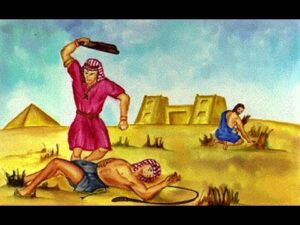
The heylige Toirah tell us that Moishe was 80 years old when he got back. What it doesn’t tell us is how old he was when he left Egypt. Was he post bar mitzvah? In his teens? 20’s? Older? 40ish? Ver veyst? No one knows because the RBSO decided to leave this factoid out of the narrative. Mistama it’s none of our business. Not does the Heylige Toirah tells us anything about the decades between his flight and his dramatic return at age 80 to face Paroy. No journals, no diary entries; gornisht. Bam — the redeemer is standing before the king of Egypt. Of course, that didn’t stop our sages from trying to either guess his age or rationalize one into existence. Let’s see how this all came to be and what we know with certainty.
At some point, Moishe was returned by his wet-nurse (his real mother Yocheved) to Bisya, Paroy’s daughter. Moishe grew up in the Paroy’s palace and was mistama treated as a prince. The heylige Toirah (Shemois 2:10-11) tells us in consecutive pisukim (verses) that Moishe grew up. Let’s read them before asking a question or two.
| 10. The child grew up, and she brought him to Pharaoh’s daughter, and he became like her son. She named him Moishe, and she said, “For I drew him from the water.” | יוַיִּגְדַּל הַיֶּלֶד וַתְּבִאֵהוּ לְבַת פַּרְעֹה וַיְהִי לָהּ לְבֵן וַתִּקְרָא שְׁמוֹ משֶׁה וַתֹּאמֶר כִּי מִן הַמַּיִם מְשִׁיתִהוּ: | |
| 11. Now it came to pass in those days that Moishe grew up and went out to his brothers and looked at their burdens, and he saw an Egyptian man striking a Hebrew man of his brothers. | יאוַיְהִי | בַּיָּמִים הָהֵם וַיִּגְדַּל משֶׁה וַיֵּצֵא אֶל אֶחָיו וַיַּרְא בְּסִבְלֹתָם וַיַּרְא אִישׁ מִצְרִי מַכֶּה אִישׁ עִבְרִי מֵאֶחָיו: |
Nu, those who attended yeshiva and those who have been reading my parsha posts these past 15 years (now in year 16), avada know that there are no extra words in the heylige Toirah. If the Toirah repeats a word or a concept, the rabbis are all over it. They will proffer at least one reason -usually a few- as to why the heylige Toirah found it necessary to repeat that word or thought. In this case, it repeats the word ‘Vayigdal’ (and he grew up) in two consecutive pisukim. If Moishe already grew up in posik Yud (verse 10), how did he grow up again in posik Yud Aleph (11)? Moreover, how old was Moishe -not yet Rabbaynu- when he grew up? Going back a few weeks, we came across the word ‘Vayigdilu’ (they grew up) when the heylige Toirah was describing Yaakov and Eisav. There, Rashi and others, told us that they turned bar mitzvah age, 13. A few weeks later, we came across Shimon and Levi. They too grew up at 13. Ober how old was Moishe? Was he too 13? Did he have his bar mitzvah in the King’s Palace? Taka a nice venue. Nu, Rashi of course took note of this duplication and tells us that its first appearance refers to his physical maturity, while the second citation of ‘Vayigdal’ is meant to convey that Moishe grew up in stature. Nice pshat but how old was he when he grew up and whacked the Mitzri? Nu, the emes is we don’t know. Why not? As mentioned above, we don’t know because the heylige Toirah is silent regarding Moishe’s early years. The holes in Moishe’s resume are huge, very. We know only that he was born, that he left Mitzrayim in a hurry, that he returned as the RBSO’s designated redeemer-agent at 80 years of age following the encounter at the burning bush, and a week of negotiations with the RBSO. We know that he died at the ripe old age of 120. The bottom line: there is a huge lacuna in his resume. And how old was he when he arrived to Midian and subsequently married Tziporah?

Says the Medrish (Shmois Rabbah 2:2): Moishe was not 13; he was 18 when he grew up, hit (killed) the Mitzri and skedaddled out of town. Another medrish tells us he was 20 when he fled. Ober says Rabbaynu Art Scroll that Moishe was already 40. Can both or all three be emes? Was he 18, 20 and 40? According to one chaver of the heylige Ois, who believes that every medrish is literal and of course emes, Moishe was all of the above. How is that possible? He does not know. That however does not at all diminish his belief that every medrish is absolutely emes. Shoin, it’s good to have blind faith, or what the Ois calls, arrested development. How old was he? We don’t know. Oh, and the Ois also found this (Toirah.ORG): one medrish (Rabbi Moishe HaDarshan) suggests that Moishe fled Egypt at either 20 or 40 and then spent a total of about 60 years of wandering and extraordinary experiences before settling with Yisroy at age 60 and then appearing at the Burning Bush at 80. Where was he from the time he fled until his arrival to Midian? Again, the heylige Toirah is silent, mamish. Was he at the famous but perhaps mythical Yeshiva of Shem and Ever? Why not? What were his accomplishments from the time he fled until his selection as the redeemer? We don’t know! Nu, as the Ois told you just last week, it’s all about selection; Moishe was selected; we were not! And since he was, the heylige Gemora wanted more information about him. Inquiring minds (the medrish) wanted to know how our future redeemer kept himself busy while on the run. Where did he go first? How long before he surfaced in Midian? How long before he married Tzipora, and other such questions. What they came up with is mamish astonishing but is any of it true? And for what purpose were all the back stories created? Ober, what’s bothering the Ois and why? It’s this: up until this week’s parsha, when other Toirah figures got into trouble, our Sages did taka “fill in” (make stuff up out of thin air) mostly to rescue reputations. To fix a problem.

Reuven and Bilhah, Yehuda and Tamar, Yosef’s Potiphar saga, Dina, Osnas, and the list goes on as there are of course many others in Sefer Bereishis. In each, the story needed repair, explanation, and moral framing. Our sages mamish took license to re-write, create from scratch, and or modify existing texts to give them new meaning. We chap their logic. Of course, they could not tolerate bad press for the founding families. But Moishe? He didn’t need rescuing, nor a rewrite of the facts. Nowhere in the Heylige Toirah does it state that he sinned or faltered before being selected. Yes, he hit the rock and lost his temper a few times but that’s all later. Dealing with obstinate Yiddin can drive any man -even Moishe- to the brink. We are a tough bunch.

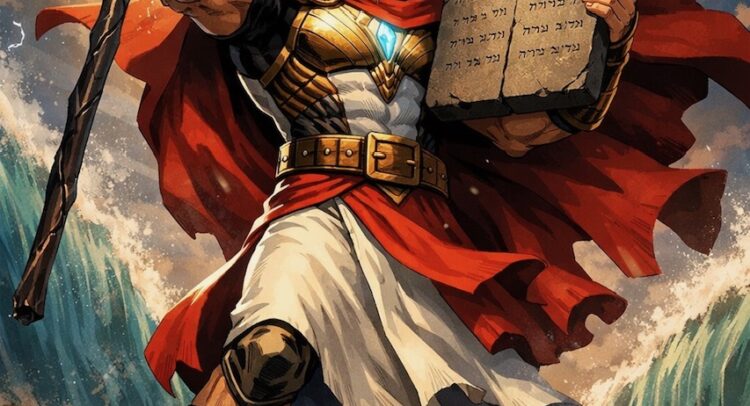
Yet, the medrish took the heylige Toirah’s silence and inflated it into an almost comic‑book biography. So much imagination that a modern reader might well ask this: did someone dip Chazal into a bathtub of Marvel Comics? So happens that it’s mamish farkert and that early comic books about heroes and superheroes were mistama inspired by writers who likely went to yeshiva day school and read a few medroshim about Moishe and others.
In any event, this week, the heylige Ois will explore why our sages -Chazal- decided that Moishe’s backstory needed to be filled in and why they invested much creative energy into his missing years. Let us explore how their stories function, and what it means for how we read aggadah — especially when it feels like comic‑book material. And here raboyseyee and ladies of course, is where the medrish dives head first full fantasy comic book hero mode. Let’s read what they came up with.
If he left at 20 and turned up at 80, that’s ~60 years missing. Our sages looked at that gap and said OMG; let’s fill in the missing years. Not with subtle details but with kings, wars, pits, celibacy, miracles, exotic kingdoms, and some royal intrigue. Mamish? Welcome to fantasyland. Says the Sefer HaYoshor, and the Yalkut Shimoni 168 (echoed as well in Midrash Rabbah), azoy: Moishe fled Egypt, showed up in the country Kush, led their army, was crowned king, and married the queen. Mamish azoy? Wow! The issue with this medrish is that the Ois -after exhaustive research could not find these words verbatim as each source relies on an older source but the translated words the Ois found are these:
…Moishe fled from Egypt and came to the camp of the king of Kush. The king’s warriors and nobles loved him because of his strength and spirit. They made him adviser to the king, then elevated him to the throne and crowned him king, and they gave him the Cushite queen as his wife. But Moishe feared the G-d of his fathers and did not cohabit with her, remembering the oath Avrohom made regarding not taking a wife from the descendants of Canaan…
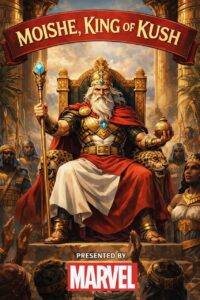
A longer, more detailed version of the story appears in Sefer haYoshor. It reads like this (from Book of Jasher, chapter 72–73): “Moishe was eighteen years old when he fled from Egypt and came to the camp of Kikianus king of Cush …Moishe was nine years in the king’s camp during the siege, and the king and all the men loved him…and they made him king over the children of Cush, and they placed the royal crown upon him. They also gave him the queen as his wife… and Moishe reigned over the children of Cush on that day.”
The bottom line is azoy: these are all midrashic expansions, not literal Biblical texts. They reflect aggressive imaginative storytelling in later rabbinic tradition. They show how later authors filled in the gaps in his biography with idealized hero narratives rather than historical record. All version agree that Moishe refused to have sexual relations with that woman. Was she ugly? This part they did not share with us but the message is clear: The redeemer of the Yiddin must be morally spotless. Think Yoisef 2.0, but even holier. The Ois reminds you that none of this is in the heylige Toirah. The story exists only to sculpt Moishe into a mythic paragon of holiness. It’s what they call hagiography and not biography. For those who never heard the word, hagiography comes from the Greek: hagios = holy +graphia = writing. Originally it meant: a biography of a saint or holy person written to praise, idealize, and inspire, not to record history accurately. Over time the meaning broadened: Any biography that cleans up flaws, exaggerates virtues, and turns a real person into a perfect hero. The bottom line is this: when Chazal move from biography into hagiography, they’re not doing journalism, they’re not writing history. They are building a moral-spiritual portrait and that produces material that feels more “comic-book-hero” than reality. Moishe becoming King, marries the queen, refuses to partake of the royal jewels, if you chap. Is this believable? A kingship without sexual favors at will? And the bottom line is this: the medrish was less concerned with what mamish happened and more invested in who Moishe needed to be. Those who spent time in the yeshiva system zicher heard this medrish before, some even believe it to be mamish what happened. Veyter!
Lest you think that one fantastical story was enough for us to chap Moishe’s greatness, the medrish has more to share: Let’s call this one The Pit and the Secret Feeding Mission. We can find this one in Shmois Rabbah 1:32, and Yalkut Shimoni 168 and the story is this. In this version, Moishe kills the Mitzri, flees Egypt, and arrives in Midian. Yisroy (with 6 other aka’s), once a powerful priest who rejected idol worship, now lives on the outskirts of society. He has daughters including Tziporah and Moishe rescues them at the well. They run home excited: “An Egyptian saved us!” Yisroy invites Moishe for a meal. He senses Moishe is special but he’s cautious. Moishe is a stranger, from Egypt, with a mysterious past. So, he says politely: “Stay with us. Work for me. We’ll see who you really are.” Moishe becomes a shepherd. He’s honest, quiet, spiritual. Tziporah begins to admire him. But the townspeople whisper: “He’s dangerous… a fugitive… don’t trust him.” Yisroy starts to worry. Maybe they’re right. Maybe he brought danger into his home. According to the legend — Yisroy does something drastic. He secretly locks Moishe in a deep pit or dungeon beneath the house, thinking: “If he’s evil, he’ll die and no harm will come to my family. If he’s righteous, God will save him.” He leaves him there. Days pass. No food. No water. Moishe prays, broken: is this my fate? To flee Paroy only to die alone in darkness?” Tziporah notices Moishe is missing. She questions her father. He dodges. Eventually she discovers the truth. Her heart breaks. She argues with Yisroy: “Father — this is cruelty! If he is wicked, cast him away — don’t torture him! If he is righteous, you endanger yourself!” Yisroy refuses to relent. Next: Tziporah takes matters into her own hands. Quietly, secretly, night after night, she brings bread and water to the pit.
ותצא אחותו למרחוק לשמור עליו … וכשלקחוהו ותלהוהו בבור, לא אכל ולא שתה, עד שצפורה הניחה לו מים ולחם בסתר…”
— Shemos Rabbah 1:32 (paraphrased)
She risks being disowned. She risks shame. But she cannot watch an innocent man die. Moishe survives only because of her. Years go by — in some versions of this tall tale, three years, in other versions, seven, and in some, ten years. Moishe remains pure, praying, studying on his own, waiting for the RBSO. Tziporah grows spiritually attached to him. She admires his faith, his gratitude, his refusal to curse God despite suffering. Finally, Yisroy is stunned: “He’s still alive?! No ordinary man survives such a trial.” He opens the pit. Moishe emerges thin, pale, glowing with quiet holiness. Yisroy falls to his knees: “You are a man of God. The fact that you lived proves it. I entrust to you my daughter.” And so Yisroy gives Moishe Tziporah as a wife, not just out of affection but because he believes Moishe has been proven righteous by divine miracle. From there, Moishe goes on to shepherd and eventually encounters the Burning Bush. The end!
What is this story trying to do? This narrative paints Moishe as unjustly imprisoned (like Yoisef), morally tested in isolation (like Yosief), spiritually sustained only by faith (like Yoisef), but unlike Yoisef who was entrapped by a vixen, he’s saved by a righteous woman. And it paints Tziporah as: compassionate, brave, and reward-worthy. She literally keeps him alive before she ever marries him. Ober, Houston we have a problem because this medrish myseh (story) has no clean textual anchor in the heylige Gemora, in Midrash Rabbah or other classical midroshim. Instead, it’s stitched together for moral imagination, heavily influenced by Yoisef narratives, and was likely expanded in later storytelling traditions. It is a beautiful story but who made it up? And if the medrish didn’t make it up, who did? And the answer is ver veyst? Yet, as mentioned above, fake as it is, it’s become part of lore and shoin, here it is. As an aside and as discussed over Chanukah, once something becomes a tradition, it matters little that someone might have created the entire story out of thin air. Once accepted, it’s real! The bottom line: emes or not -seemingly not, it’s another example of how we inflate Moishe into a comic-book saint even when the Toirah is intentionally silent.
Interestingly, this story mamish mimics the Yoisef superhero storyline; it even features a pit. The point seemingly is that the future true leader suffers, the future leader survives injustice, and the future leader is rescued by the RBSO. Like Yosief, Moishe has no sex, no romance, no normal human messiness. Everything was holy, controlled, and symbolic.
Let’s circle back to one more fantasy: we just read that while Moishe was king of Kush, he married the queen whose husband died during the war but Moishe wouldn’t touch the queen. Give me a break! And for years while Tzipoirah was taking care of his needs (he’s in the pit) he didn’t touch her; let’s get real! No shiksa goes 3, 7, or 10 years without. This story would avada be more believable were Tzipoirah presented as Jewish from birth -we all know that Jewish women can taka go for years without- but she was the daughter of Midianite priest, a shiksa mamish. Now it’s emes that the heylige Toirah does tell us that Moishe did get sexually separated from Tzipoirah at some point but that was after they already had a few kids together. That happens in many marriages.
So what have we here? In the medrish, Moishe is half-angel, half-man, not relatable, not earthy. Untouchable. Ober is this the real Moishe? Because over in the part that the heylige Toirah does share with us, Moishe is very much human: he has a speech impediment, loses his temper, and argues with the RBSO. What’s bothering the Ois? As mentioned above, in most parshas, Chazal work overtime to explain away problems, soften rough edges, and clean up scandals. But here in Shmois they do the opposite: They seem to invent wild, over-the-top legends with no problem to solve! There are no contradictions in the text, no posik crying for explanation, and no sin to cover up. Just: “We don’t know what happened — so let’s make Moishe superhuman.” The medrish and seemingly others didn’t cover up; they created. And the question is why? Shoin having laid out the questions, let us see if we can figure out why medrish went down this road and we begin with this:
Nu, we must kler that deep down, Chazal were wrestling with a theological need: The redeemer must be flawless, the prophet must be pure, and the leader must transcend normal life. So instead of Moishe being a complicated human and struggling with real life issues, we get Moishe the king, the saint, the martyr, the miracle worker, and the moral iron-man. Is the image present pure spiritual fan fiction? Did Chazal feel Moishe needed PR help? Was the Moishe the heylige Toirha introduced us to and selected by the RBSO not holy enough?
We already know that the medrish isn’t reporting facts; it’s preaching ideals. It’s theology dressed as biography. We might argue that our sages weren’t rewriting history; in the case of Moishe, they were shaping identity. Why? Because they read the heylige Toirah and asked: “What kind of leader did the Yiddin need Moishe to be?” Then they built stories that answered that need. They created Moishe as morally untouchable, spiritually towering, someone whose life was guided by hashgocha from the womb onward, a person who has already earned leadership through struggle. As mentioned above, this is all hagiography. Not lies, not fiction, plain old moral storytelling.
Ober why the “wild and crazy” elements? Did he have to be the king in Kush? Did he have to refuse the queen sexually? Did he have to wallow in a pit for many years? Did Tzipporah have to watch over him? Couldn’t he live like normal men? What do all his back stories have in common? They all scream that Moishe was not driven by ego, power, or desire. He was offered the throne but didn’t exploit it. He was offered sex but said no. He was humiliated in a prison/pit but didn’t break. Were our sages of the medrish but copying Yoisef’s life? So it seems, at least partially; yes! Yoisef was beautiful, suffered injustice, refused sexual temptation and advances, survived prison, became the ruler and remained loyal to the RBSO. It does appear that Moishe’s midrashic persona mirrors that pattern. Why? Because Yosef is the template of the tested leader: he survived humiliation, temptation and exile. Only then was he worthy of power. It does epes appear that Chazal extended that logic to Moishe. Not only is Moishe a leader, he is a paragon of moral superheroism. Ober, let us remember that these expansions happen without any textual prompt from the Heylige Toirah which is silent. The Sages do not resolve a problem; they create a narrative. Then again, aggadic writings aren’t history; they are mostly moral imagination at its finest. Say the Rambam (Moreh Nevuchim and his Introduction to Peirush HaAggadot):
לא כל אגדה אמרו חז”ל היא דבר שאירע במציאות; אלא לעתים רבות הם דברי משל ודבור הסבר… Meaning: Not every Midrash is literal fact; many of them are allegory or explanatory talk.
So when Chazal describe Moishe rejecting royal sensuality, enduring years of ascetic trial, and ruling a foreign kingdom righteously, they are not saying a historian should open a textbook. They are saying: here is an idea — illustrated with narrative. It’s a story‑form sermon, not a press release. When our exegetes were done, Moishe was a hero, he was our first superhero!
A gittin Shabbis –
The Heylige Oisvorfer Ruv
Yitz Grossman
