Yisroy 2026: Myth Busters
by devadmin | February 6, 2026 1:59 am
Raboyseyee and Ladies,
Myth Busters:
Shoin, another parsha and a few more childhood memories obliterated by facts on the ground. Welcome to Parshas Yisroy, where the Yiddin marry—metaphorically of course—the RBSO and receive the Aseres Hadibros. Unlike today’s affairs, the greatest wedding in history featured no orchestra, no catered shmorg, and no seating charts. No floral arrangements, no tuxedo rentals, and not even a photographer to yell “smile.” It did, however, feature thunder, lightning, a mountain, and a nation saying “naaseh v’nishma.”
In that moment, the RBSO was the chosson, and the Yiddin played the role of the kallah. This week, we will take a closer look at three stories taught to me in yeshiva, all visually inculcated into my belief system. As it turns out, the facts surrounding the wedding are not exactly as they were taught.
Back in the day, when it came to Parshas Yisroy, besides the big event -Revelation on Har Sinai- where the blind began to see and the lame began to walk, we were taught that Yisroy was the first to utter the words “Boruch Hashem.” These and many other inspirational stories were part of my special childhood memories. Ober, guess what? Even these holy and very motivational images may not be emes, as the Ois will demonstrate below. That said, before we get to Yisroy’s famous “Boruch Hashem” moment, let’s deal with the first memory.
Many of us remember being told that just before Matan Toirah, a great national healing took place. The blind began to see, the lame began to walk, the deaf began to hear, and the entire nation was suddenly restored to perfect health. It sounded miraculous mamish. It sounded like a cross between Har Sinai and the grand opening of a world-class medical center.
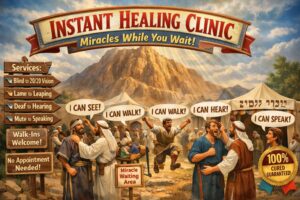
Let’s open the medroshim and see what they actually say. Says the medrish (Shmois Rabbah 5:9) the primary source for the others, azoy:
אמר רבי יהודה ברבי סימון:
כשעמדו ישראל על הר סיני, היו בהם סומים והיו בהם פסחים והיו בהם חרשים והיו בהם אלמים.
אמר הקב״ה: אין זה כבודי שאתן תורה לדור בעלי מומין.
מה עשה? ריפא אותם.
מנין? שנאמר:
“כלך יפה רעייתי ומום אין בך.” (שיר השירים ד:ז)
In English, Rabbi Yehudah son of Rabbi Simon said: When Israel stood at Mount Sinai, there were among them: the blind, the lame, the deaf, and the mute. The Holy One, blessed be He, said: “It is not My honor to give the Toirah to a generation with physical defects.” What did He do? He healed them. From where do we know this? As it is said (Shir HaShirim 4:7), “You are entirely beautiful, My beloved, and there is no blemish in you.”
Let’s check in with the Mechilta d’Rabbi Yishmoel (Parshas Yisro, Bachodesh), another early Midrashic source, to whom we will come back for the second of my memories, who says this:
כל מי שהיה סומא – נתרפא,
וכל מי שהיה פסח – נתרפא,
וכל מי שהיה חרש – נתרפא,
וכל מי שהיה אלם – נתרפא.
שנאמר:
“כלך יפה רעייתי ומום אין בך.”
English translation: Whoever was blind was healed. Whoever was lame was healed. Whoever was deaf was healed. Whoever was mute was healed. As it says: “You are entirely beautiful, My beloved, and there is no blemish in you.”
Medrish Tanchuma (Yisroy 8) a very similar version:
כשבאו ישראל לקבל את התורה,
היו ביניהם סומים, פסחים, חרשים, אלמים.
עמד הקב״ה וריפא אותם,
כדי שיהיו כולם שלמים לקבל את התורה.
English translation: When Israel came to receive the Heylige Toirah, there were among them the blind, the lame, the deaf, and the mute. The Holy One, blessed be He, stood and healed them, so that they would all be whole to receive the Heylige Toirah.
But here is one critical factoid: You will not find the midrashic details of this miracle anywhere in the heylige Toirah, nowhere! Were you to search posik by posik, from the beginning of Parshas Yisroy until the end of Mishpotim, you will zicher find thunder and lightning, smoke billowing, the mountain shaking, the sound of the shofar, and the RBSO coming down to the top of Har Siani to give the Yiddin the Aseres Hadibros. What you will not find it this: a blind man regaining sight, a lame man running up the mountain, or a national miracle clinic at the foot of Sinai. So where do these ideas come from? Fake news? Is medrish the original fake news? Zicher not! We just need to chap its purpose. The medrish is not coming to compete with the Toirah. It is coming to teach us how to read it. Medrish explains that the RBSO said it is not fitting to give the Heylige Toirah to a nation that is blind, lame, deaf, or broken, so He healed them all. Mamish beautiful to read and so very inspiring. It’s perfect sermonic material, but once again, it is not the pshat in the pisukim. It is a medrish with a message. And what might that message be? Perhaps something deeper than a supernatural medical campaign at the foot of the mountain. The medrish may be saying that the blind could not see truth, the deaf could not hear the RBSO’s voice, the lame could not walk in the right path, and that the mute could not speak words of Heylige Toirah. Then came Har Sinai and suddenly, they could see, they could hear, they could speak, and they could walk in the ways of the RBSO. Gishmak! Not because they suddenly had better medical care and coverage, but because they received the heylige Toirah. In other words, Sinai was not only the giving of laws, it was the spiritual healing of an entire nation. And perhaps that was the real miracle. Not a nation that suddenly had perfect eyesight—but a nation that finally saw what it was supposed to look at.
But wait, we’re not quite done as the heylige Ois (who, it appears, still has a few more pages to fill) is back with another myth-buster, yet another story that was taught to me in yeshiva that turns out to be….well, not exactly as taught. Back in the day, when it came to Parshas Yisroy, besides the big event -Revelation- we were taught that Yisroy was the first to utter the words “Boruch Hashem.”
Let’s check out the posik as well as well as what prompted this pagan goy to blurt out words that are on the tips of our collective tongues’ multiple times daily. The heylige Toirah (Shmois 18:10) tells us azoy: וַיֹּאמֶר יִתְרוֹ
בָּרוּךְ ה׳ אֲשֶׁר הִצִּיל אֶתְכֶם מִיַּד מִצְרַיִם וּמִיַּד פַּרְעֹה,
אֲשֶׁר הִצִּיל אֶת הָעָם מִתַּחַת יַד מִצְרָיִם.
English: And Yisroy said: “Blessed is Hashem, who rescued you from the hand of Egypt and from the hand of Pharaoh, who rescued the people from under the hand of Egypt.”
Now, inquiring minds wanted to know what prompted Yisroy, the then pagan goy to cite words that few jews -if any- had spoken before. What caused Yisroy to say “Boruch Hashem”? in the preceding pisukim, the heylige Toirah tells us that Moishe told Yisroy everything Hashem did to Paroy and the Egyptians. About all the hardships along the way, and how the RBSO saved them. In response, we read this: “וַיִּחַדְּ יִתְרוֹ עַל כָּל הַטּוֹבָה…” “Yisroy rejoiced over all the goodness…” Immediately after that joy and recognition, he says: “Boruch Hashem…” In short, he heard from Moishe about the ten plagues, the Exodus, the defeat of Egypt, and the salvation of the Yiddin. He rejoiced and said: “Boruch Hashem.” So far so good until Rashi, quoting the Mechilta, says something quite disturbing:
גנאי הוא למשה ולששים ריבוא שלא אמרו ברוך עד שבא יתרו ואמר ברוך.
“It is a disgrace for Moishe and the six hundred thousand that they did not say ‘Boruch’ until Yisroy came and said it.” Boom!
It’s taka very nice that upon crossing the Yam Suf, the Yiddin spontaneously burst into song led by Moishe. And it’s avada amazing that the women followed that act with one of their own featuring instruments they somehow schlepped out of Mitzrayim. How they had time to pack musical instruments but no time for bread, is for another day. It’s avada admirable that the women wanted to sing on their own so as not to arouse the men with their melodious voices; mistama they were already observing the laws of Kol Isha (women singling live to men). Of course, this all took place following a mixed general swim, oh well!
The bottom line: by the time I left the yeshiva world -and even years before, every child -the future Ois included- walked out of yeshiva with the same takeaway: Yisroy was the first one in history to say “Boruch Hashem.” Ober, is that emes? Seemingly not, and let’s dig further. Let us begin with what Yisroy said, when he said it, what he said, and what the medrish has to say about what he said. His words taka sound nice. They preach well, and they fit on a test. That said, and like many nice neat yeshiva lines, they don’t survive a quick tour through Sefer Bereishis and in other places in Tanach.
Let’s harken back a few parshas to when Eliezer found Rivkah at the well, and where he said: “Boruch Hashem Elokei adoni Avrohom…”
“Blessed is Hashem, G-d of my master Avrohom.” (Bereishis 24:27).
There you have it. A clear, explicit “Boruch Hashem.” And not from a Jew, at least not in the halachic sense, but from Avrohom’s servant. What do we have here? Strike one against the childhood myth. And since we’re rolling backwards, let’s continue back to Parshas Vayero to where Avrohom returns from the war with the kings and meets Malki-Tzedek, king of Shalem, identified by our sages as Shem ben Noiach. And what does he say? “U’voruch Kel Elyon…” “Blessed be the Most High God…” (Bereishis 14:20). Another “Boruch.” What have we so far? That two goyim mamish, Eliezer and Malki-Tzedek, both said Boruch Hashem, or words very close to those, and both times meaning thank you Hashem. Oib azoy, how could the Mechilta suggest that Yisroy was the first? But wait! There’s more.
Let’s check in with Leah, she the beneficiary of Yaakov’s first seed and with whom she had six boys and at least one daughter. When her fourth, Yehudah was born, what did she say? Let’s read the words: “Hapa’am oideh es Hashem.” “This time I will thank Hashem.” (Bereishis 29:35). In fact, our sages -quoting the heylige Gemora (Brochos 7b) says this:
אָמַר רַבִּי יוֹחָנָן מִשּׁוּם רַבִּי שִׁמְעוֹן בֶּן יוֹחָאי:
מִיּוֹם שֶׁבָּרָא הַקָּדוֹשׁ בָּרוּךְ הוּא אֶת עוֹלָמוֹ,
לֹא הָיָה אָדָם שֶׁהוֹדָה לַהַקָּדוֹשׁ בָּרוּךְ הוּא
עַד שֶׁבָּאתָה לֵאָה וְהוֹדָתָה לוֹ,
שֶׁנֶּאֱמַר:
“הַפַּעַם אוֹדֶה אֶת ה׳”
(בראשית כט:לה)
“From the day Hashem created the world, no one thanked Him until Leah came and thanked Him.” Is that so? I don’t think so! Of course, we cannot take these words too seriously or literally, because: Noiach built a mizbeach after the flood to say thank you, Malki-Tzedek said “Boruch,” and Eliezer said “Boruch.” So what do we have here?
What we have here is yet another famous quote that was never meant as an historical statement. It was mistama meant as a moral or thematic one. Oib azoy (if so), this real question emerges. If taka Noiach expressed thanks, Malki-Tzedek said “Boruch,” Eliezer said “Boruch,” Leah said “Oideh es Hashem,” and the Yiddin sang an entire Shira at the sea, then what in the world was so special about Yisroy’s “Boruch Hashem”? Why does the medrish suggest it was a “disgrace” that no one said it until he came along? What’s pshat here? And to add to the question, let’s point this out: if we look carefully, a fascinating pattern appears. Of the early “Boruch Hashem” speakers in the heylige Toirah, at least a few were outsiders. Eliezer was an outsider, so was Yisroy. Ober what about the insiders? The pattern is hard to ignore. The outsiders keep saying “Boruch,” and the insiders keep moving on with their day. While Eliezer knew what to say, Avrohom -the consummate insider, never once uttered the words “Boruch Hashem” in the entire episode. And the Yiddin sang a whole shira, but not once did they say the words “Boruch Hashem?” In fact, neither did Moishe. No “Boruch Hashem.” It is almost as if the Heylige Toirah is hinting at something uncomfortable: Is it because, at times, outsiders see miracles more clearly than the insiders? Were the insiders too close to appreciate the gravity of their special moments? Was the problem that they were living inside and too close to the miracles?
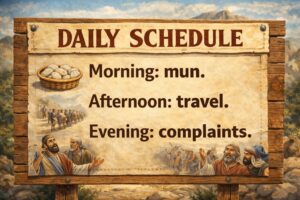
Think about it. Yisroy was sitting in Midian. He heard secondhand about the ten makkos, the splitting of the sea, about Mitzrayim being destroyed, and a nation walking out free. He heard it once, and said what? “Boruch Hashem!” Yet, the insiders who lived through all ten makkos, walked between walls of water, saw the Egyptians drown, ate mun from heaven, and drank water from a rock said nothing?! Not a one thought to say “Boruch Hashem?” Why not? Shoin, let’s give them a break. We can argue that they were inside the miracle and when one lives inside a miracle long enough, it starts to feel like… the schedule.
Morning: mun.
Afternoon: travel.
Evening: complaints.
The greatest wonders in history slowly became normal. The outsider, however, was still capable of being impressed. Yisroy had no mun, no clouds of glory, no sea-splitting, and no daily miracles. He heard the story once, and was blown away. So he said what no one else said: “Boruch Hashem.” So happens that we see this pattern all the time in real life. And the bottom line? Was Yisroy first as the medrish suggests? We can kler that the medrish is not saying Yisroy was the first human being in history to say “Boruch Hashem.” It is saying something far sharper. After slavery, the makos, yam suf, and the destruction of the greatest empire on earth at that time, no one stopped and said two simple words “Boruch Hashem” until the Midianite priest walked in from the desert. And that is the gnai, the disgrace.
Let’s look at one more medrish though the parsha has a few more to give us. We all grew up learning and hearing that the RBSO offered the heylige Toirah to all the nations first. The story was mamish dramatic; we conjured up images of how it played out. The RBSO went to Eisav: “Do you want the Toirah?” They asked: “What’s in it?” The RBSO said: “Don’t murder.” They said: “Sorry, that’s our national hobby.” Then He went to Yishmoel: “What’s in it?” “Don’t steal.” “That won’t work for us either.” And so on, until finally: the RBSO came to the hapless Yiddin who said “Naaseh v’nishma.”
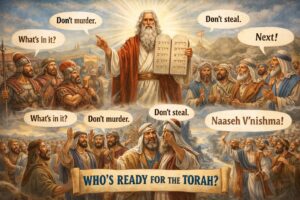
It’s a great story, it’s dramatic. It’s memorable. It’s excellent for children’s books and plays, but here is the problem: You will not find this anywhere in the heylige Toirah. What do we find? What does the heylige Toirah actually say? We find the Yiddin at the mountain preparing for Revelation and to receive the Aseres Hadibros. There is no mention of the RBSO touring the world, any conversations with other nations, or anyone turning down the Toirah. If that’s the case and zicher it is, where did these stories actually come from? You know it; they come from the medrish, mainly from the same Mechilta (Yisro, Bachodesh), the Sifrei (Vezois Habrocho), the heylige Gemora (Avodah Zarah 2b–3a). There, the medrish describes the RBSO offering the Toirah to different nations, each rejecting it because of the mitzvah that conflicted with their national character. Are these stories true? Any part of them? Or are they meant to be read less as history, and more as moral parables? For what purpose? And the answer raboyseyee is this:
Most exegetes -including very well-respected ones- explain that this is not a historical travelogue of the RBSO going from country to country. Rather, it is teaching that the nations were not suited to the Toirah. Each nation rejected the mitzvah that struck at its core weakness: Eisav – murder, Yishmoel – theft, and others – different traits. What this means is that the heylige Toirah demands moral transformation, not just religious affiliation. This medrish is another perfect “Myth Buster” because it fits the exact pattern of what we were taught: The RBSO went door to door like a Torah salesman? What the Toirah actually says is nothing of the sort. It’s a beautiful story; but it’s also not in the Toirah. You can read every posik in the parsha over and again but here is no world tour, no negotiations, and no rejected contracts. The story comes from the medrish where generations before Disney and the world of imagination was even a forethought, our very creative and intelligent sages brought stories to life by adding color and so much more, to allows us to conjure up these fantastical images that would stick with us forever. They have.
Is that the deeper lesson of all these so-called myths? The medroshim were never meant to compete with the pshat. They were meant to complete it. The pshat tells us what happened. The medrish tells us what it means. As children, we remember the pictures. As adults, we are meant to discover the message behind them. And sometimes, the biggest miracle of all is not that the blind saw or the lame walked, but that a nation learned to see truth, walk in the right path, and say two simple words at the right moment: Boruch Hashem.
Shoin, maybe next week we’ll discover that the luchos weren’t even marble—but that’s a myth for another parsha.
A gittin Shabbis!
The Heylige Oisvorfer Ruv
Yitz Grossman
Source URL: https://oisvorfer.com/yisroy-2026-myth-busters/