Vayishlach 2026: EISAV – The Making of a Biblical Villain
by devadmin | November 26, 2026 8:15 pm
Raboyseyee and Ladies,
EISAV: The Making of a Biblical Villain
We begin with big and wholehearted mazel tov wishes to our dear friends Dena and Ben Isaacs upon the wedding -just last night- of their son Jacob who married Ariana Haft, she beautiful daughter of Debra and Joshuah Haft. A big mazel tov as well to Jacob’s grandparents, Linda and Yehuda Isaacs and to the entire extended family. Mazel tov to the entire Haft family. May Ariana and Jacob merit to enjoy many decades of blissful marriage and may they be a source of much nachas and joy as they build their lives tougher. It was an absolute pleasure to participate in the great simcha. The heylige Ois has a special place in his heart for Dena, Ben, Linda and Yehudah.
Unless you’ve been living under a rock or been in a coma, most of the world has been following the saga of Jensen Huang, the CEO and co-founder of Nvidia. On November 12, he resigned amid a storm of allegations and controversy. The company’s board accepted his resignation, appointed an interim CEO, and appeared determined to move on. Then, in a stunning reversal, on November 23, the board reinstated him. What a difference twelve days make! The man who had been shown the door was suddenly back in his perch. The world’s markets were watching, and Nvidia’s stock responded dramatically. Was he guilty? Was he innocent? Had the board acted too quickly? Impetuously? Had it changed its mind? Was he deemed guilty before having the opportunity to prove his innocence? But one thing is clear: public opinion and institutional verdicts can change rather quickly. Ober, what does Jensen Huang have to do with our parsha? And the answer is Eisav!
And since this column arrives just as we celebrate Thanksgiving, one thing is zicher: the turkeys slaughtered and cooked for today’s festivities were mamish innocent. They had committed no crimes, sold no birthrights, deceived no fathers, and certainly never conspired against a brother. Not even the medrish could sully their reputations. Not that it helped them! They were convicted, sentenced, and roasted without so much as a trial. Apparently, being innocent is not always a winning defense. Ask Eisav!
Speaking of, we all know Eisav. Or at least we think we do. He is the rosho, the villain, the man who represents everything that Yaakov and his descendants are not. He is the hunter, the איש שדה, the fellow who sold his birthright for a bowl of lentils. According to Chazal, he was guilty of just about every sin in the book: murder, idolatry, sexual immorality, and more. The heylige Gemora (Buba Basra) tells us clearly that he committed five transgressions on one particular day. Details soon. A real mensch!
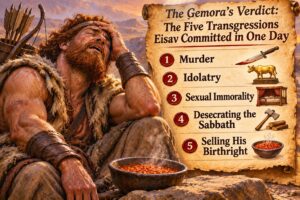
And no wonder he told Yaakov he was tired; he worked very hard that day. But hold on a minute. How bad was Eisav, really? And, perhaps more importantly, who says? And when? Was he born bad? Did he emerge from Rivkah’s womb already predisposed to wickedness? Did he become bad as a child, a teenager, or only when he reached adulthood? At what point did he cross over from being a somewhat unruly fellow to becoming the villain we have come to know and despise? Was he really that different from Yaakov? One was a hunter, the other a tent dweller. One was impulsive, the other considerably more calculating. One sold his birthright for food; the other participated in a rather elaborate scheme to obtain his father’s blessing. Yet one is celebrated as the third of our Avos, while the other has been assigned a permanent seat in the hall of infamy. And why did Yitzchok love Eisav so much? Was the old man blind? He was, but that’s later. Did he not know what his son was allegedly up to? Or did he see something in Eisav that subsequent generations, perhaps less interested in finding redeeming qualities, chose to overlook?
Welcome to Parshas Vayishlach, where we arrive at perhaps the most inconvenient episode for those who have already convicted Eisav. After twenty years apart, Yaakov is returning home. He is frightened. He sends messengers ahead, divides his camp, prays, and sends an enormous gift of animals to appease his brother. He hears that Eisav is coming toward him with four hundred men. Not exactly the sort of welcoming committee that inspires confidence. Then something unexpected happens.
“וירץ עשו לקראתו ויחבקהו ויפול על צוארו וישקהו ויבכו”
Eisav runs toward Yaakov, embraces him, falls on his neck, kisses him, and they both cry.
What are we supposed to make of this? Is this a genuine reconciliation between two brothers who have been separated for twenty years? Has Eisav matured? Has he forgiven Yaakov? Or is this yet another example of Eisav’s alleged wickedness? And the bigger questions on my mind this week follow: Why does the medrish seem so uncomfortable allowing Eisav even one genuinely redeeming moment? Could it be that we have inherited a verdict without ever examining the evidence? Was Eisav Huanged? Guilty first before the chance to prove his innocence? And perhaps the larger question: Are we reading the heylige Toirah, or are we reading the text given to us through the eyes of generations who already knew how the story ended?

Shoin, Let’s go back to the beginning. Let’s put the medrish aside for a moment. Let’s forget Rashi and everything we have been taught about Eisav. Let’s open a Chumish and see what the heylige Toirah itself actually tells us. It introduces the twins and tells us that they struggled in Rivkah’s womb. Rivkah, understandably concerned, seeks an explanation and is told that two nations are in her womb, two peoples who will eventually separate, with the older serving the younger. Already, before either child has taken his first breath, we have a prophecy of conflict and reversal of the natural order. But notice what the heylige Toirah does not say. It does not call either child evil. It does not tell us that one is destined to be a murderer and the other a saint. It tells us that they will become two nations and that their descendants will struggle. Then the boys are born. Eisav emerges first, red and covered in hair. Is that a sin? It’s taka emes that bald babies are cute but are those born with hair bad from the get-go? Yaakov follows, holding onto his brother’s heel. The heylige Toirah describes their respective personalities: Eisav becomes an איש יודע ציד, a man who knows hunting, איש שדה, a man of the field, while Yaakov is an איש תם יושב אהלים, a wholesome man who dwells in tents. One is an outdoorsman, the other a homebody. Different strokes, as they say.
Then comes a rather inconvenient posik for those who would prefer to dismiss Eisav entirely: ויאהב יצחק את עשו כי ציד בפיו. Yitzchok loved Eisav because of the game he brought him. Interesting. The father loved Eisav. Was Yitzchok unaware of his son’s alleged criminal activities? Did he somehow miss the murder, idolatry, and sexual immorality that Chazal would later attribute to him? Or perhaps, just perhaps, there was more to Eisav than the image we have inherited.
Bechoiragate (birthright scandal) follows. Eisav comes home exhausted and hungry. He sees Yaakov preparing lentil stew and asks for some. Yaakov, seeing an opportunity, demands the birthright in exchange. Eisav agrees. The posik concludes the episode with these words: ויבז עשו את הבכורה – Eisav belittled the birthright. He treated something of enormous potential value as though it were practically worthless. Not exactly a wise decision, but is that sufficient evidence to convict him of being a lifelong rosho? And taka, this is hardly a flattering episode, certainly not his best moment. Selling one’s birthright for a bowl of lentils is not exactly a demonstration of sound judgment. Then again, he was but a fifteen-year-old teenager! He was? Says who? Well, this particular timeline is not stated explicitly in the Chumish, but let’s check it out. Yaakov and Eisav were born when Yitzchok was sixty (Bereishis 25:26). Avrohom died at age 175 (Bereishis 25:7). Yitzchok was therefore seventy-five when Avrohom died. The heylige Toirah places the sale of the birthright immediately after mentioning Avrohom’s death. Rashi explains that Yaakov was cooking lentils because Avrohom had just died and Yaakov was preparing the traditional mourner’s meal. And the heylige Gemora (Buba Basra 16b) makes the connection even more explicit: Rebbe Yoichonon says that Eisav committed five transgressions on the very day Avraham died. Therefore, Yitzchok was seventy-five, and the twins were approximately fifteen years old. And we’re judging Eisav for selling his birthright when he was fifteen years old? Wow! A teenager makes an impulsive decision, trades an inheritance for a meal, and generations later is remembered as one of the great villains of Jewish history? What’s pshat? That doesn’t excuse his conduct. But it certainly raises another question: Are we judging a fifteen-year-old boy for a foolish decision, or are we using that decision as evidence of a lifetime of wickedness? And is this incident proof of a lifetime of wickedness? Or is it evidence of an impulsive, shortsighted young man who placed immediate gratification ahead of an inheritance whose value he failed to appreciate? There is a difference.
And now we come to what may be the most extraordinary part of this entire episode. What exactly was Eisav doing out in the field, and why does the heylige Toirah tell us that he returned עיף — exhausted? Rashi, on the words והוא עיף, explains that Eisav was exhausted ברציחה — from murder. Not from a long day of hunting, not from chasing a deer, and certainly not from an afternoon of strenuous exercise. From murder! But let us give the heylige Gemora its proper attribution. In the heylige Gemora (Bub Basra 16b), Rebbe Yoichonon teaches that Eisav committed five transgressions on that very day — the day Avrohom Ovenu passed away. Want more details? According to the Gemora, Eisav had relations with a betrothed maiden, committed murder, denied the existence of the RBSO, denied techiyas hameisim (resurrection), and treated the bechoira with contempt. Quite a day! Some people have a bad Monday. Eisav apparently managed to violate an entire smorgasbord of aveiros in one afternoon.
Ober, why was Yaakov cooking lentils? The Gemora explains that Avrohom had died that day, and Yaakov was preparing the customary food for a mourner — his father Yitzchok. Rashi adds that the RBSO had shortened Avrohom’s life by five years so that he would not have to witness his grandson Eisav going off the derech. Now, let us be precise. Rashi’s explanation of the word עיף is that Eisav was exhausted from murder. The five-transgression list is Rebbe Yoichonon’s teaching in the Gemora. We should not attribute the entire list to Rashi, nor should we confuse the two sources. But let’s get back to the chronology. Fifteen! We are being asked to consider a fifteen-year-old who, according to Reb Yoichonon in the Gemora, managed to commit five serious transgressions on the day his grandfather died. Apparently, he wasn’t just having a bad day. He was having a very, very bad day! Give me a break!
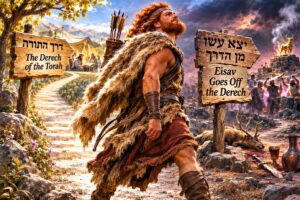
Of course, these events are not individually recorded in the heylige Toirah’s narrative. They appear approximately 1800 years later. To be fair, it’s possible that these Eisav backstories developed earlier but were only reduced to writing 1800 years later. The Gemora reads the clues in the pisukim and develops a much fuller account of what it believes took place. That is precisely the distinction we are examining. Facts on the ground vs what they concocted or maybe politically correct, what they imagined took place. The heylige Toirah subsequently tells us that Eisav married two Chiti (Hittite) shiksa women, Yehudis and Bosmas, and that they were a source of bitterness to Yitzchok and Rivkah. Again, not exactly a glowing endorsement of his judgment in choosing wives. Not everyone marries the girl their parents approve of. Then again, was Lovon Jewish? What about Leah and Rochel? Was anyone really Jewish? But the heylige Toirah still does not give us the extensive criminal biography that later generations would construct.
Then comes the blessing episode. Yaakov, with Rivkah’s assistance, deceives his elderly, blind father and obtains the blessing intended for Eisav. When Eisav discovers what has happened, he cries bitterly and pleads with his father for another blessing. He is devastated. He is angry. He threatens to kill Yaakov after their father’s death. We are certainly not witnessing a model of brotherly love. How many times have you — as a teen — wanted to kill one or more of your siblings? But, are we witnessing the greatest villain who ever lived, or a man who has just discovered that his brother has twice taken something that he believed belonged to him? We know the answer we have been taught. But let’s not get ahead of ourselves. It is when we move beyond the plain text that the portrait becomes considerably darker. Our holy Sages — for reasons we shall discuss below — do not leave Eisav as merely an impulsive hunter who made some questionable decisions. They turn him into a man guilty of the most serious transgressions imaginable.
Let’s return to that reunion between the brothers, because there is one little detail that deserves considerably more attention. The heylige Toirah tells us:
“וירץ עשו לקראתו ויחבקהו ויפול על צוארו וישקהו ויבכו”
Eisav ran toward Yaakov, embraced him, fell on his neck, kissed him, and they both cried. Read the posik again. It sounds like a genuine family reconciliation. Two brothers, separated for twenty years, finally meet again. One runs toward the other, embraces him, kisses him, and they cry together. What’s not to like? Ober, the word וישקהו — and he kissed him — has dots above the letters in the Sefer Toirah. Dots? Indeed so. In fact, these dots appear only ten times in the entire heylige Toirah and when they do, are always an invitation for Chazal to ask questions and take a closer look. Rashi brings the midrashic discussion. One questions whether Eisav kissed Yaakov wholeheartedly. But Rebbe Shimon bar Yochai offers a rather surprising explanation: although it is generally known that Eisav hates Yaakov, at that particular moment his compassion was aroused, and he kissed him with his whole heart. That stated, the medrish (Bereishis Rabbah), offers another that is considerably less sentimental. Rebbe Yannai understands the encounter as an attempted bite rather than a kiss. According to this reading, Eisav tried to bite Yaakov, but Yaakov’s neck became as hard as marble. Eisav’s teeth were hurt, and both brothers cried — Yaakov over his neck and Eisav over his teeth. A family reunion worthy of its own dental insurance policy! And yet, not everyone accepts the darker interpretation. The Ibn Ezra is reluctant to read the kiss as an attempted bite. He understands the encounter as a genuine embrace and points to the fact that the brothers both cried. In other words, perhaps Eisav really did have a moment of compassion. Perhaps he really was happy to see his brother.

So what do we have here? The heylige Toirah gives us an embrace, a kiss, and two brothers crying. The medrish offers competing explanations: one sees genuine affection, another suspects something far less wholesome. And the Ibn Ezra reads the episode as a sincere reconciliation. I ask again: Are we reading the posik, or are we reading the posik through the reputation Eisav acquired over the centuries? Even when the Toirah gives us a moment that looks like reconciliation, are we prepared to accept it? Or must Eisav’s every action be interpreted in the worst possible light? Perhaps the kiss is not proof that Eisav was a tzaddik. But it certainly complicates the case against him. And this big question: How did the people reading the Toirah for over many hundreds of years view Eisav before any of these commentaries were available?
The Gemora, as mentioned above, gives us the five transgressions we just discussed. The medrish and other rabbinic sources develop additional aspects of Eisav’s character, including murder, sexual immorality, idolatry, and other wrongdoing. The three big ones, plus a few misdemeanors on the side. And Rashi, relying on these medroshim, brings some of these interpretations into the very Chumish that we study every week. Suddenly, the man who sold his birthright for a meal has become a thoroughly corrupt individual. The man whose father loved him is now a symbol of wickedness. The fellow who was described as a hunter has become a symbol of evil. But when did all this happen? Where in the heylige Toirah are these crimes recorded? At what point did Eisav supposedly become so depraved? No place! Read that again: no place! And if these things were so important to understanding his character, why did the heylige Toirah not tell us?
The heylige Ois is not suggesting that Chazal had no basis for their interpretations. I am, though, asking questions. How much of what we think we know about Eisav comes from the heylige Toirah, and how much comes from the interpretations subsequently layered upon it? Was he born bad? Perhaps the most extraordinary part of the medrashic treatment Eisav receives is that it doesn’t wait until he is old enough to commit his alleged crimes. It takes us back to the womb. The struggle between the twins in Rivkah’s womb is interpreted as something considerably more sinister. One interpretation suggests that each ran to kill the other. Other traditions connect the prenatal struggle to the verse in Tehillim describing the wicked as estranged from the womb. Now we have a problem. If Eisav was already wicked in utero, what are we to make of free choice? Was he born with a criminal disposition? Was his fate sealed before he had the opportunity to choose between right and wrong? And what about Yaakov? Was he already the tzaddik while still in the womb, with his brother already the rosho?
All the heylige Toirah itself tells us is that the two struggled. The medrish takes that struggle and gives it a moral dimension. The distinction is significant. We should remember that medrish is not necessarily attempting to give us a literal account of prenatal behavior. Let me repeat that: the medrish is not giving us a literal account of what took place in Rivka’s womb; it is imagining what took place. It is communicating the spiritual conflict it sees in the two brothers and, ultimately, in the nations they represent. But the damage is done. The effect on readers like myself and million more is unmistakable. Eisav’s reputation is now established before he has even been born. He’s guilty from conception and will remain so unless proven innocent. Nebech!

Which brings me to this: Why taka was Eisav so hated and vilified by the medrish when the RBSO who certainly know how to express hate and love, tells us nothing that would evoke such hatred? And for that raboyseyee and ladies we need to chap that at some point Eisav became Edom — and Edom became Rome. Shoin, I can sense the confusion and let me explain. Perhaps the answer requires us to step outside the family and look at history.
Eisav was not merely an individual. He was the father of Edom. And Edom was a nation that had a long and often hostile relationship with Israel. Two of our prophets repeatedly condemn Edom for its behavior toward Judah and Jerusalem. Ovadia, in particular, delivers a devastating rebuke for Edom’s conduct when Jerusalem was attacked. Malachi, centuries before Rashi, famously declares: “ואוהב את יעקב ואת עשו שנאתי” — I loved Yaakov, and Eisav I hated. In context, Malachi is speaking about the nations of Israel and Edom, but the language reinforces the larger association. Then history takes another turn. By the late Second Temple period, Rome had become the dominant imperial power in the region. The Hasmonean ruler John Hyrcanus conquered Idumea, the territory associated with Edom, around 125 BCE. Herod, who later ruled Judea with Roman backing, came from an Idumean family. After Rome destroyed the Second Temple in 70 CE, the association between Edom and Rome became increasingly important in Jewish interpretation. In rabbinic literature, Edom became a symbolic name for Rome, the great power that oppressed Israel.
Now consider what this does to Eisav’s reputation. He is no longer simply the brother who sold his birthright. He is the ancestor of a nation that opposed Israel, and eventually becomes associated with the empire that destroyed the Beis Hamikdash. And just like that, many many hundreds of years after Eisav appear as a Toirah personality loved by his father, the biblical family story has acquired a much larger historical meaning. And the Ois ask this question: Could this have influenced the way generations of rabbis read Eisav’s earlier behavior? It is certainly a question worth asking. We should not claim that every medrish about Eisav was invented because of Rome; negative traditions about him existed before Rome became the dominant enemy. But the historical association undoubtedly gave his image a powerful additional dimension.
Shoin, if the history got you confused, let me break it down this way:
- Approximately 700–800 years after Matan Toirah, Edom was already being condemned by the prophets.
- Approximately 1,100 years after Matan Toirah, Jewish writings were already developing a more negative portrait of Eisav.
- Approximately 1,380 years after Matan Toirah, Rome had destroyed the Beis Hamikdash and Edom had become a powerful symbol of Israel’s enemy.
- Approximately 1,800 years after Matan Toirah, we have the major surviving collection of Genesis Medrish.
The bottom line: the transformation of Eisav’s reputation was not a single event. It unfolded over many centuries, from the biblical story to the major collection of exegetes including the medrish.

And I close with this: Do we judge the winners differently? And here is where the discussion becomes considerably larger than Eisav. We know how the story ends. Yaakov becomes the father of the twelve tribes. Eisav becomes the father of Edom. Israel survives, while Edom eventually becomes associated with Rome and the enemies of the Jewish people. Ober, does knowing the ending affect how we interpret the beginning? Are we sometimes inclined to sanctify the winners and vilify the losers? Does the character who becomes the ancestor of our people automatically receive the benefit of every doubt, while the character whose descendants become our enemies loses even the possibility of a redeeming quality?
Think about Koirach. Think about Loit. Think about Yishmoel. Think about Shaul Hamelech. Each has a story that can be read through the biblical text itself, and each has been the subject of generations of interpretation.
On the other hand, we should not automatically assume that Chazal were simply writing history backward or that they were deliberately distorting the heylige Toirah. Their objectives were often theological, moral, and educational, not the production of impartial biographies. The medrish is not a modern police report, nor is it necessarily intended to be one. It often seeks to uncover a deeper moral, spiritual, or national meaning in the text. But that does not mean we should stop asking questions. How did Eisav become the villain we know? Was he always that person? Did the Torah itself give us that picture, or did generations of interpretation gradually fill in the details? And once those interpretations became part of the way we learned the Chumish, did we stop noticing where the original text ended and the interpretation began? Perhaps we have become so accustomed to the image of Eisav as the eternal rosho that we can no longer read the story without seeing him through that lens.
The bottom line: the heylige Toirah gives us the characters. Chazal give us the interpretations. And sometimes, generations later, we can no longer distinguish between the two. Perhaps it is time to go back and read the original story again. Perhaps the greatest trick of all was not one Yaakov played on Eisav, but the one history played on our understanding of Eisav.
A gittin Shabbis!
The Heylige Oisvorfer Ruv
Yitz Grossman
Source URL: https://oisvorfer.com/vayishlach-2026-eisav-the-making-of-a-biblical-villain/