Vayishlach 2025: Double D’s
by devadmin | December 4, 2025 10:08 pm
Raboyseyee and Ladies,
Double D’s:
Parshas Vayishlach is mamish a gold mine of controversy, unresolved debates, shocking midrashim, and early sages arguing sharply. The bottom line: the material is perfect for the heylige Ois’s weekly column; thank you Hashem! That said, what should we discuss in year sixteen? I was thinking to cover the Double D’s: Not the ones you are thinking about, chazerim that you are. So happens that there is some controversy surrounding two women who deserve some coverage, both their names begin with D and none are foremothers. We speak of Devorah and Dina!
As the parsha includes one 12-word posik alerting us to the death of Devora, let’s begin with her, but wait: Who the hec was Devorah and where did she come from? Is she a character we have previously met in our parsha? In any parsha? We did not! That said, quite amazingly the heylige Toirah says this:
“ותמת דבורה מינקת רבקה, ותקבר מתחת לבית־אל תחת האלון, ויקרא שמו אלון בכות.”
“Devorah, Rivkah’s nurse, died, and she was buried below Beis-El, under the oak, and it was named Alon-Bachus.”
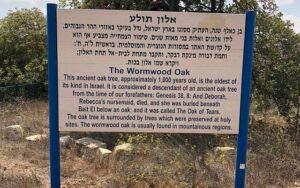
BOOM — no introduction, no role, no story, no explanation. Then suddenly: “ותמת דבורה” — “Devorah died.” No intro. No narrative. Just an obituary. It’s the heylige Toirah’s version of: “Hey remember Rivkah’s childhood nanny? No? Well, she died.” Shoin, you all know the drill: The heylige Toirah is silent on her background -she’s never been mentioned before- and our sages went to town. Grada, as is kimat always the case, this strangeness becomes the engine for her entire midrashic reconstruction. Who is she? Why is she here? Why is her death important? This posik comes upon us right after Yaakov returns to Beis-El. Is there a connection? Shoin, let’s find out: Says Rashi that Devorah was Rivkah’s original wet-nurse:
“זו דבורה שפירשה מן התורה בריש הפרשה… מינקת רבקה.”
She is the wet-nurse who raised Rivkah in Padan-Aram. It seems that she was originally mentioned -albeit indirectly, in Parshas Chayei Soroh, when Rivkah leaves Lovon’s home and travels with Avrohom’s servant. There it says: “וַתָּקָם רִבְקָה וְנַעֲרֹתֶיהָ” — “Rivkah and her maids arose.” Rashi connects the dots and assumes that one of those “na’aros” was Devorah, her personal nurse. If that’s the case and why shouldn’t it be if Rashi thought so, then she’s been part of the family since Rivkah was a baby. She’s like the housekeeper who travels with the family for Pesach -and at times- even marches down the aisle when any of the kids under her watch get married; she’s mamish part of the fabric. And she raised Rivkah.

Gishmak mamish! Later, she probably became a nurse to Yaakov and Eisav in their youth. Why not? Over in the medrish we are taught that Devora was sent by Rivkah to bring Yaakov home. And here is the big midrashic bomb: Rashi, based on the medrish (Bereishis Rabbah) says Rivkah sent Devorah to go bring Yaakov back from Lovon’s house after more than 20 years. Not that Yaakov snuck out -as we learned last week- because he wasn’t getting along with Lovon, but because his mommy wanted him back home. Meaning that Rivkah longed for her son. Says Rashi (35:8) that Rivkah promised: “I’ll send for you when it’s safe.” When she knew Eisav’s anger had cooled, she sent Devorah — the one person Yaakov would trust after 20 years. Due to her advanced aga, she likely couldn’t go herself, and could not send a formal messenger. What to do? She sent her loyal nurse, the person Yaakov trusted most besides his mother. The question is azoy: if Rivka was too old to travel and Devorah was older -old enough to be her wet-nurse- how old, and in what shape was Devora the messenger at this point? Was she superhuman? An excellent question ober the Heyilge Toirah does not tell us. What to do? Our sleuths of the medrish also wanted to know and reconstructed her approximate age as follows: As mentioned above, she -sort of- originally appears when Rivka leaves Aram. When Avrohom’s servant brings Rivka to marry Yitzchok, we read this (Bereishis 24:59):
וַיְשַׁלְּחוּ אֶת־רִבְקָה אֲחֹתָם וְאֶת־מֵנִקְתָּהּ וְאֵת עֶבֶד אַבְרָהָם וְאֶת־אֲנָשָׁיו.
They sent Rivka their sister and her “מֵנִקְתָּהּ” her nurse. That said, how do we know this refers to Devorah? It could well have been anyone? Ober not so fast you wisenheimers because our sages were ahead of you and said, quoting Rashi, azoy: “זו דבורה מינקת רבקה.” “This is Devorah, Rivka’s nurse.” Rashi is telling you that the nurse mentioned earlier (24:59) is the same Devorah who dies in 35:8. And he knows this how and from where? From the medrish of course, (Medrish Rabbah 60:8): where it says so explicitly “זו דבורה.” “‘They sent Rivka and her nurse’ – this refers to Devorah.” In other words: The medrish identifies her by name, even though the heylige Toirah does not. If that’s not enough proof, Targum Yoinoson adds this:
The Aramaic paraphrase expands the verse: “וְשַׁלְּחוּ יָת רִבְקָה… וְיָת דְבוֹרָה מֵינִקְתָּהּ.”
“…and they sent Rivka… and Devorah her nurse.” The Targum explicitly names her דבורה. Ober why taka was her name hidden at first? Why haven’t we met Devorah by name before? Pshat is azoy: The Heylige Toirah often introduces a person later, even though they appeared earlier without being named. And why is that? Because -so our rabbis teach us- the heylige Toirah only names Devorah when her death becomes relevant in Yaakov’s story. Earlier, she is simply “the nurse.” The bottom line: some people take on heightened importance once they have passed. Isn’t that a sad reality?
In any event, if taka Devora was the wet nurse for Rivka, by definition, she was already an adult when Rivka was still a young child. Over in the Seder Olam we find this rough estimate. Rough because the book itself does not give us her age but shares these numbers:
- Rivka’s birth → 2048
- Rivka marries Yitzchak at age 3 (Midrash) or 14 (Ibn Ezra, Rashbam)
- Yaakov’s birth → 2108
- Yaakov’s return and Vayishlach events → around 2185
This means Devorah was with Rivka for at least 137 years, and more likely over 150 years, depending on: how old Devorah was when she began nursing Rivka, and how old Rivka was when she left home. The bottom line: According to many a midrash, Devorah lived somewhere between 130–170 years. And now that we figured out how old Devora was, maybe you’d also like to know just how old Rivka was when she passed. How can we know Devorah’s age but not Rivka’s?
Let’s continue and play along with this understanding and see what happened next: Rivkah dies off-stage -meaning we hear nothing about her passing at all in the heylige Toirah. How is that possible? One of our beloved foremothers dies and we hear about it only from Rashi and or, in the medrish? Shreklich and oy vey! In any event, as the heylige Toirah doesn’t tell us about her passing but only about Devora’s passing, Rivka never gets to see Yaakov return and we can then assume that Devorah becomes her stand-in, and this might explain why Yaakov mourns her so deeply. Says the medrish that Rivka died at the same time as did Devorah, but the heylige Toirah hides her passing (petirah) so the wicked Hittites shouldn’t disgrace her funeral (Baba Kama 93a). Therefore, the Toirah records Devorah’s passing instead, and calls the place Elon Bachus — the tree of weeping — hinting that more than one important person died. More on all that another time but the final bottom line on Devorah is this: If the RBSO decided to give her a one-line shoutout, she must have been important. The Ois wonders aloud if people know where she’s buried and if that tree is visited.
And now raboyseyee and ladies, buckle up as we explore a few incredible medroshim about another woman -prominently featured in our parsha- and let us say hello to Dina who is the volcanic core of Vayishlach. The heylige Toirah’s introductory language already tips us off to some coming danger and adventure: The posik says: “וַתֵּצֵא דִינָה… לִרְאוֹת בִּבְנוֹת הָאָרֶץ” – Dina went out to see the daughters of the land. Oh boy!
She went out to see the “girls.” Not to shop, draw water, or do errands? Interestingly, neither does it state that she went out see boys. That said, our sages labeled her as a “yotzonis” (outgoing), sociable, curious. Not sinful — just social. Not cloistered. Not passive. Mysterious. What happens next: she encounters Shechem who rapes her; oy vey! We all know this part because it’s what they taught us in yeshiva – all of them- and we all paid attention to this story because it was shreklich. Ober, what you might not know is this: does everyone agree that Shechem was mamish a rapist, a sodomizer, and much worse? Or, is it possible that he was but an obsessed boyfriend? Humm… Ok and before to turn our attention to what some very big guns, very well-respected sages had to say -and many have lots to say about Dina- let us address the elephant in the room. There are very respected rabbis -you know them all by name- who say some rather unflattering things about Dina and do not lay all the blame on Shechem. Shoin, I said it! There is no reason to contact me as I’m only quoting and repeating what others said. More on that below but we will begin with the traditional understandings of what went down -as taught in yeshiva world.
Shechem was taka a violent rapist, Dina was the victim, and the act was brutal, degrading, and criminal. This is the standard view in Chazal, and it’s very harsh. Says Rashi: Shechem was the prototypical rapist: “וירא אותה… ויענה” — He afflicted her. “ויענה — לשון ענוי, עשה לה דרך בזיון.” He degraded her; he abused her. In Rashi’s world, he physically violated Dina and humiliated her. He acted with cruelty and treated her as spoils of lust. As an aside, later in Sefer Devorim, Rashi will use the same language used for rape it the case of the captured woman on the battlefield during war times.
According to many well know sages, Shechem used multiple forms of sexual abuse. Says the medrish (Bereishis Rabbah) “רדף אחריה והתעלל בה בכל מיני עלילות.” He pursued her and abused her through every form of coercion. Pretty graphic. Rashi adds that Shechem kidnapped her long-term. And the proof? In posik 34:26, when Shimon and Levi go into the city, we read how they rescued her from Shechem’s house as he was holding her captive. So, in Rashi’s world, this was not a one-time assault. She was being held against her will and her rescue required a commando rescue operation “והוציאו את דינה מבית שכם — שהיה מעכב אותה.” Wow! One more point: Also, according to Rashi, her “going out” didn’t cause the rape. Even though Rashi calls Dina a “yotzonis” (outgoing), he does not blame her. He’s quoting a medrish comparing her to Leah (“vatetzei Leah”): Behavioral inheritance perhaps but not moral blame. Rashi acknowledges her sociability but says nothing that suggests she flirted, invited, desired, or contributed to the assault, and squarely paints Shechem as at-fault. He was a bad guy.
Over in the medrish (Bereishis Rabbah) we read that Shechem was violent. Some of what he did is described as follows: “חטף אותה באונס” — He seized her by force “בל יאמרו עמו אנשי הארץ… מותר” — The locals knew this was illegal even by their standards- “התעלל בה” — He tortured her, and “שפחה קדשה עשאה” — He treated her like a prostitute. The bottom line: most of medrish paint Shechem as a predator, an addict to lust, and a symbol of Canaanite corruption. Yikes!
Here’s a bit more: Radak & Sforno call it classic rape. Shechem “took her by force, not with her consent.” Sforno: “He forced her suddenly, before she could cry for help.” Both are unambiguous: rape, no mixed feelings, no seduction. And the Abarbanel adds this: Shechem destroyed her innocence and calls the act “חמס גדול” (great violence). Dina was left in deep shame, Shechem acted out of pure animal impulse.

The bottom line according to all listed above is that Shechem was a rapist, a kidnapper, and a sexual abuser. He was violent, humiliating, and a captor holding Dina prisoner while Dina was a victim, innocent, trapped and traumatized.
Case closed? Not! Why not? The evidence is clear, is it not? Not necessarily because all this stands in stark contrast to the Ramban, Ibn Ezra, and minority midrashic traditions that downplay force, emphasize seduction, or even allow that Dina had desire. What? Dina had desire? Say that again, or don’t! Yes, indeed Shechem has his own defense team who suggested that in the case of the People vs. Shechem, there is more than physical evidence and even though the evidence stood up, if you chap, it’s lav davka (not necessarily the case) that it rose to rape, and even worse. In fact, the Ibn Ezra, and others will argue the “maybe she wanted it” angle. Well, blow me down! Ok, we need to unpack this further to chap how it’s shayich that very famous luminaries were redescent to lay all the blame on Shechem. It’s mamish amazing to read that famous Sages defended Shechem and somewhat implicated Dina. Let’s go deeper to chap their rationale.

Post their first sexual encounter -or so we think- the next posik uses erotic, emotional language: “ותדבק נפשו בדינה… ויאהב את הנערה… וידבר על לב הנערה”
His soul attached to her… he loved her… and he spoke to her heart. This is the language of seduction, infatuation, persuasion, but not brutal assault. Oh boy, and here we go…
Says the Ramban that it was but a classic case of seduction. “דיבר על לב” = seduction. This is not the language of rape. It’s the language of pitu’i — coaxing, wooing, soft talk. Ramban may be too delicate to say “she was into it,” but he is absolutely saying this was not violent. In the 1200s, that’s already a bombshell. And if that didn’t shock you to your core, let’s read what the Ibn Ezra said because his view will drop jaws at the Shabbis table. “ויש אומרים כי גם היא נתאוה לו.” And some say that she too desired him. Read that again. Some say: Dina wanted it! He doesn’t endorse this pshat but he records it. And if Ibn Ezra records it as a “yesh omrim” -meaning, some say- we must take it seriously. This is the most radical classical source.
And the Ois dug up this amazing medrish: A rare medrish (brought by some acharonim (later sages) says: “לא יגע בה עד שתרצה.” He did not touch her until she agreed. Shechem didn’t touch her until she consented. Is that rape? This medrish is -as mentioned NOT well-known; it appears in some manuscripts and commentaries on Bereishis Rabbah but the Ois dug it up. And if that’s what went down, the whole story must be framed differently and perhaps Shechem should not be framed for rape. Maybe it was a case of Shechem seduces, and Dina responds. Their relationship is dysfunctional but mutual. And the repercussions? If this was emes, if Dina was a willing participant with this goy – and let’s remember that they were all goyim, there were no Jewish people at this time- then Shimon and Levi, when they killed him, mamish killed her lover. Well, blow me down! It’s mamish scandalous. But wait, there’s more:

Says the Medrish Aggadah that Shechem treated Dina with respect. Others emphasize that he spoke kindly to her; he tried to marry her, he refused to let her leave, and that he loved her deeply (“ותדבק נפשו”). These emphasize obsession and affection, not force. Moreover, he sent his father, Chamor, to convey this exact message. No father shows up and says hey, my son just raped your daughter brutally; can he now marry her?! Some commentators use this to argue that Dina’s experience was more complex than pure violation.
And the Radak says azoy: Shechem had emotional attachment after the act. So happens that these feelings after a sexual encounter don’t happen very often. Shechem’s soul “clung” to her and he was willing to do whatever was needed to keep her. Some later commentators take this as implying an emotionally charged relationship, not a purely violent one. The bottom line: the Radak doesn’t quite go as far as the Ibn Ezra who said she wanted it — but the dynamic is not depicted as a one-moment assault.
The heylige Zoihar (Zohar Chadash) famously says this: Dina went out because she was a “yatzanis,” sociable, outgoing. This does not say she wanted Shechem, but it implies she was not a passive, cloistered victim — she interacted socially and was not naive. And the Midrash HaGadol says that Shechem treated her gently. It says even more: it describes Shechem as trying to comfort her and win her affection. Are these the signs of a brutal rapist? Ver veyst?

Wait! There’s still more: If Dina consented (even partially) …then the massacre of Shechem becomes not just revenge, not just justice, but possibly a forced breakup, or even an honor killing and that would be so psychologically and morally provocative that most exegetes avoid it. Did Shimon and Levi then commit mass murder without cause? No wonder Yaakob was pissed off with their behavior even on his deathbed. Most does not -of course- include the Heyilge Ois; this is prime material which is mamish out there as a possibility. Let’s get real: the idea that Dina may have wanted the encounter with Shechem is one of the most explosive, least-discussed, and most text-supported controversies in all of Bereishis that was never taught in yeshiva. And yet, the sources are right there, hiding in plain sight. How is all this possible? How is it that our sages saw things so differently? What would prompt the Ramban and the Ibn Ezra to suggest that Dina was not as innocent as the driven snow? Let’s review what we know. Why did Dina go out?
Rashi: She inherited Leah’s outgoing nature
Zohar: She wanted to socialize
Medrish: She was curious about Canaanite society
Meiri: She was exploring, not sinning
These all suggest that Dina was not clueless, not sheltered, not dragged, not ambushed. She is an active figure. This may have opened the door to Ibn Ezra’s “yesh omrim,” (some say…). Shoin, how to reconcile these two dramatically differing approaches to Dina and Shechem? What looks like an irreconcilable contradiction — rape vs. seduction; monster vs. romance — is actually one of the most important interpretive patterns in all of Chazal and the Rishonim, but are they describing the same “reality?” Shoin, in the case of the People vs. Shechem, how do we rule? Do the readers find him guilty or not guilty? Is the evidence hard? Let’s summarize:
For the prosecution, we have Rashi and his supporters who tell us there is evidence for rape:
- “וַיִּקַּח… וַיְעַנֶּהָ” — classic verb for forced violation
- She was “taken” and “held”
- Later pisukim show Shimon and Levi “rescuing her”
- Medrish builds on these cues and paint him very guilty
And for the defense,
- We have the Ramban opening the door to seduction, not rape.
- Ibn Ezra bringing a shocking “yesh omrim shegam hi nit’avah lo.” (she too may have wanted him)
- Midroshim giving a psychological portrait of Shechem as infatuated, not violent.
- Yaakov allegedly hiding her in a box from Eisav — and that backfires!
- Feminist overtones centuries before anyone said the word “feminist.”
- And the uncomfortable question:
Did Shimon and Levi avenge a rape… or break up a romance?
As well, we have pshat vs. medrish. Our sages (brought by Rashi) operate on a moral-midrashic lens: they teach the danger of Canaanite immorality, show the victimization of Dina, justify Shimon and Levi’s rage, and portray Shechem as a stand-in for predatory culture; think Epstein! All bad! Their goal is ethical messaging, not reconstructing a police report.

On the other hand, Rishonim like Ibn Ezra, Rashbam, and Ramban use textual-pshat analysis: They read the actual wording of the posik and ask: “What does the grammar imply?”
The final bottom lines: Medrish paints the moral message; pshat rebuilds the scene through language and context. And believe it or not, both can stand — just not on the same stage. Medrish gives you the values the story wants to teach; pshat gives you the story as the text actually reads. Shockingly, both can be “true,” each in its own lane. How they coexist without killing each other? Ahh, that deep dive is for another day. Rashi and those he quotes, gives us the family-approved version, while the Ibn Ezra gave us the Director’s Cut. What really happened between Dina and Shechem? Ver veyst?!
A gittin Shabbis –
The Heylige Oisvorfer Ruv
Yitz Grossman
Source URL: https://oisvorfer.com/vayishlach-2025-double-ds/