Vayikra 2026: Six Hundred and Thirteen? Not Exactly!
by devadmin | March 19, 2026 10:31 pm
Raboyseyee and Ladies,
Six Hundred and Thirteen? Not Exactly!
What’s on the heylige Ois’s mind this week as we begin Sefer Vayikra? Yet another issue that’s quietly been bothering him for many years. That famous number of six hundred and thirteen mitzvis. We refer to them as the “Taryag” mitzvis because the word “Taryag” is simply the Hebrew numerical value of the combined letters: ת (400) + ר (200) +י (10) + ג (3) Total = 613.
And who came up with this word? The short answer is that the number 613 is first stated explicitly by one of our Sages of the heylige Gemora (מכות: 23B) where we find thisדרש רבי שמלאי: שש מאות ושלש עשרה מצות נאמרו לו למשה – “Rabbi Simlai taught: 613 mitzvis were given to Moishe…”
Shoin, Taryag mitzvis is simply shorthand for that Gemora. That is all Rav Simlai said about the word which was later systematized and popularized by great medieval authorities. That said, the heylige Gemora does not list the 613 mitzvis, does not define exactly which mitzvis count, and does not explain how the number is calculated. It simply states the number as a tradition.
Oib azoy, (if that’s so), if the Gemora merely refers to a total number, who organized the list that is popular in our times? Which mitzvis were to be included and excluded? And that raboyseyee is where things get interesting and of course controversial. The first major figure to systematically define and count all 613 was the Rambam whom we will be discussing again below, but for now know this: In his Sefer HaMitzvis, the Rambam created rules for what counts as a mitzvah, listed all 613, and divided them into positive and negative commandments. But, and this is key — not everyone agreed with his list. In fact, I might be so bold as to say that there is no single agreed-upon list. Shoin. In fact, other great early Sages (Rishonim) who challenged the Rambam’s count, include Nachmanides, the Baal Halachos Gedolos, and the Sefer HaChinuch (who follows Rambam mostly, but not entirely). They argue about what qualifies as a separate mitzvah, whether certain commands are counted individually or as part of a group, how to treat repetitions in the heylige Toirah (a topic we have recently been discussing without repeating, of course). The bottom line: everyone agrees there are 613 but there is no universally agreed upon list of exactly which ones. The good news: it is possible that one or two that you mamish enjoy violating -a few you regularly engage in, if you chap- may not be on anyone’s list. Wouldn’t that be amazing? Veyter.

That said every yeshiva kid, boys and girls, learn it. Two hundred forty-eight things you must do. Three hundred sixty-five things you must not do. The number is repeated so confidently that one almost imagines the Jewish people walking around with a checklist of 613 daily obligations. Rashi famously tells us that Yaakov -even while living with Lovon- somehow observed all 613. Of course, we’ve all heard how out holy forefathers and mothers observed the entire heylige Toirah though it wasn’t given for many hundreds of years later. How that was possible when hundreds are land dependent -meaning the can only be observed while living in the land, ver veyst- but why argue with Rashi who just wanted us to know that our ancestors were good people. It’s taka very nice and gishmak to read except, of course, there is one small complication. There is no such thing as 613 mitzvis that one can observe. Not today. Not yesterday. And not for nearly two thousand years.
Why is that? Because a massive portion of the heylige Toirah’s mitzvah system depends on something that has not existed since the Romans destroyed it in the year 70, the Beis Hamikdash. Remove the Temple from the equation and entire sections of the Heylige Toirah simply shut down. No korbonis. No Mizbayach. No kitoires (incense) service. No Yom Kippur ritual of the Koihen Gadol entering the Holy of Holies. No korban Pesach brought by hundreds of thousands of Jews crowding the courtyards of Yerusholayim. Nada, gornisht, mamish nothing. And if the Ois may be forgiven for sounding irreverent, the whole thing begins to feel almost mythical. Six hundred and thirteen mitzvis? For whom exactly? Certainly not for the average Jew walking into shul this Shabbis. Not for the Jew without a Beis Hamikdash. Not for the Jew without korbonis. Not for the Jew without a Sanhedrin, without a king, without most of the national structures that the Heylige Toirah takes for granted. Strip away the Temple, the altar, the avodah, and whole neighborhoods of Heylige Toirah simply go dark. Add to that the mitzvis that apply only to Kohanim, only to farmers, only in Eretz Yisrael, only under rare legal conditions—and one begins to realize that the famous number 613 is less a description of present-day observance than of a lost—or perhaps postponed—Toirah civilization. Disclaimer: The heylige Ois does not say this to weaken your commitment -heaven forbid and chas v’shalom, but to sharpen the question: what’s pshat that the Heylige Toirah we live, is only a fraction of the Heylige Toirah we learn? OMG! The good news: the Ois takes comfort that these are not modern questions at all. They are already embedded in various tractates of the heylige Gemora:
מסכת מכות, מנחות, ברכות, יומא, and כריתות. They all discuss the 613 mitzvis while quietly acknowledging a Toirah world in which large portions of that system are not always active. The bottom line: What all this means is that as we open Sefer Vayikra this week—the very book that functions as the operating manual for the Temple service—we are, in a very real sense, studying a system that currently cannot operate. Large portions of the Sefer describe rituals that no Jew alive today has ever witnessed. Not his father. Not his grandfather. Not any ancestor going back almost eighty generations. So perhaps we should ask the slightly uncomfortable question.
If so much of Vayikra cannot actually be practiced, why do we read it at all? Every year as this and a few other parshas roll along, in shuls across the world, the baal koreh chants the intricate procedures for offerings of bulls, sheep, goats, birds, flour, oil, blood, ashes, and fire. The congregants mostly listen respectfully. But none of the korbonis (sacrifices) can be brought, mamish not one. Not today. Not tomorrow. Not until the Beis Hamikdash returns. What happens then is of course the subject a machloikes among many an exegete, one that we have covered in the past. It so happens that other civilizations abandoned their temple rituals the moment their temples were destroyed. Ober, us Yiddin, did something far stranger. We kept studying the instruction manual. Almost as if the nation refused to accept that the korbonis system was gone. Do any of you still study the instruction manual for your fax machines? And Chazal went even further. They made a remarkable declaration: one who studies the laws of sacrifices is considered as if he brought the sacrifice itself. In other words, the korbonis of Vayikra continue to exist—at least in the pages of the heylige Gemora and the many yeshivas that still teach this subject to the unsuspecting kids. What for?
And that raises another fascinating question. Why was the system of sacrifices so central to begin with? Why does the Heylige Toirah devote so much space to bulls, sheep, goats, and birds ascending the altar in smoke? For the modern reader, korbonis can feel foreign, even primitive. But that question, it turns out, was not first raised by modern skeptics. It was asked boldly by one of the greatest Toirah giants who ever lived. The towering medieval Sage we all know, love and follow. It was asked by the Rambam. And his answer was so surprising that it ignited one of the greatest debates in Jewish thought. Said he that the Heylige Toirah did not invent sacrifices at all. It inherited them. What? Mamish? From whom? The Toirah mamish copied rituals already in existence? Say it’s not so but was he right? Who left us this inheritance? The Pagans! Indeed, the Pagan world was -for many centuries before the RBSO gifted us the heylige Toirah, seemingly very attached to sacrifices. You read that correctly. And we Yiddin? It appears that we too were steeped in these practices. What to do? According to the Rambam, the RBSO decided to keep the practice going but did repurpose each sacrifice, each was attached to a different sin or some other rationale for the sacrifice. Well, blow me down! In other words: The RBSO chapped just how the Yiddin operated for centuries and of course knew that telling them to stop sacrifices would not have worked. The newly minted Yiddin were not quite ready for prime time. As an aside, it’s a wonder the Rambam wasn’t stoned to death by the rabbis of his generation for thinking and having to chutzpah to say these things out loud. This is the same Rambam we quote regularly. The same person who is among the most followed of halachic decisors. Wow! According to the Rambam, korbonis were not the ultimate ideal of Judaism. They were in fact a divine concession to human psychology. Well, blow me down! Was he correct?
History taka confirms that the ancient civilizations surrounding Israel—Egyptians, Babylonians, Canaanites and the other nations the Yiddin were to expel -or kill- once they entered the land, were all deeply invested in sacrificial worship. Their temples were filled with smoke from burning animals offered to their gods. Imagine, writes the Rambam, if the Heylige Toirah had suddenly appeared and declared: “From now on, there will be no sacrifices whatsoever.” The people would not have understood such a religion. Sacrifice was the language of worship in the ancient world. It was one thing to instruct the Yiddin about forbidden relationships -no more chapping from your hot aunt, and the list goes on. It was ok to sell them on kosher, shabbis and much more -even spending thousands to make Pesach, but giving up sacrificial rituals was too much to handle. What to do? As an aside, they didn’t do too well with forbidden relationships either; more about those a bit later. Instead, the Heylige Toirah performed a remarkable act of spiritual redirection, mamish astonishing. It took the existing human instinct for sacrifice and redirected it toward the service of the One G-d, the RBSO. The same ritual, now purified, acceptable and even holy. A mitzvah mamish. The same instinct but elevated. Instead of chaotic pagan temples, there would be the Mishkan. Instead of superstition, a carefully structured divine service.
All this avada begs the next question: Will korbonis (sacrifices) be making a comeback when the Moshiach arrives? Are we going back to this ritual? On the one hand, we have been weaned off them for over two thousand years; it could be stated with certitude that zicher sacrifices are out of our systems. Why bring them back? But, will korbonis return? Will the Beis Hamikdash once again become a place where animals are slaughtered and offered upon the Mizbayach? Are we really going back to that system? Let’s get real: The Yiddin have managed quite well without an altar, without smoke rising from sacrifices, without a courtyard filled with sheep and goats waiting their turn. And yet, the strange thing is that traditional Jewish prayer seems to insist that we will. Three times every day we ask the RBSO to restore the Temple service. In the Musaf prayers we describe the korbonis of each Yom tov. On Pesach night we declare that next year we hope to bring the korban Pesach in Yerusholayim. The bottom line: while we Yiddin have grown accustomed to life without sacrifices, it does epes appear that the siddur never got the memo. Which means that the Rambam’s explanation raises a profound puzzle. If korbonis were originally permitted because humanity once needed them, what happens in a future age when humanity presumably no longer does? Will the korbonis return? Return exactly as before? Or will something else happen? The answer to that question depends on whom one asks.
Many authorities assume that korbonis will return exactly as they once were. More on them soon. That said, there were also great Toirah thinkers who entertained a far more surprising possibility. Said the first chief rabbi of modern Israel, Abraham Isaac Kook, that the future Temple service might not look exactly like the one described in Sefer Vayikra. Ok, let’s hear more. He raises the possibility that when the world reaches a more spiritually refined state, many of the animal sacrifices may no longer be necessary. When will the Yiddin be more refined? When the Moshiach arrives! Instead, the Temple service might center primarily around offerings of gratitude—such as the korban Toidah – the expression of thanksgiving rather than atonement. In other words, the Mizbayach might one day become less a place where sins are repaired and more a place where blessings are celebrated. Gishmak!
Can we even imagine the Beis Hamikdash returning but, in a form, somewhat transformed? The Mizbayach standing in Yerusholayim? The avodah still alive? The world itself having matured to the point where fewer sacrifices are needed? A world where people are good and do the right thing? Not because the Heylige Toirah has changed but because humanity has? Whether that vision ultimately proves correct, ver veyst, and no one can say with certainty. But the possibility itself reveals something important and somewhere within that architecture lies the mystery of Sefer Vayikra: a book filled with rituals that we Yiddin have studied for two thousand years without being able to perform them, as if the nation were carefully preserving the blueprints for a building that has not yet been rebuilt.
But is Rav Kook, who suggested that most korbonis will not be making a comeback, a lone wolf? What sayeth the heylige Gemora about daily Beis Hamikdash activities in the days of Moshiach? Will the kohanim have jobs? Interestingly, it does not address this question directly but does address three closely related issues:
- Why korbonis exist
- Whether they will return in the future
- How Toirah study replaces them while the Mikdash is gone
One of the most famous statements appears in the heylige Gemora (מנחות ק״י ע״א) where we read: כל העוסק בתורת חטאת כאילו הקריב חטאת, בתורת אשם כאילו הקריב אשם
“Whoever studies the laws of the Korban Chatas (sin offering) is considered as if he brought a sin offering; whoever studies the laws of the Korban Oshom (guilt offering) is considered as if he brought a guilt offering.”
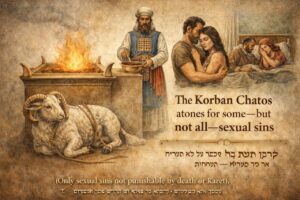
Well, blow me down! Study and you are absolved? This is particularly good news since the Korban Chatos was brought to atone for a number of sexual sins. Is this mamish a get out of hell pass? Now that I have your attention, a complete list of which sexual sins can be wiped away -atoned- with this korban, is for another day. The bad news: a healthy number -including one’s that many of you are guilty of -remain on the books for the RBSO to adjudicate at His discretion. Overall, still gishmak! The implications are big and givaldig for most of you! And me! If this shtikel Gemora is mamish how it is in our times, pshat is azoy: even though the Beis Hamikdash is gone, the spiritual function of korbonis continues through Toirah study. Could that be the reason why we Yiddin still learn Sefer Vayikra and the tractates dealing with sacrifices? They are life savers! Let’s read them over and over please!
Another shtikel in the heylige Gemora explains that the daily prayers correspond to the daily korbonis that were brought in the Beis Hamikdash. Shachris parallels the morning offering, and Mincha parallels the afternoon offering. Meaning azoy: when the Temple disappeared, our brilliant Sages created a temporary substitute. Davening became a spiritual replacement for sacrifice. Notre: The Gemora does not say sacrifices are permanently gone. It treats prayer as a stand-in. The heylige Gemora clearly assumes that the Temple service — including korbonis, will return in the future. Discussions of the future Beis Hamikdash and its rituals appear in in the Gemora and elsewhere when discussing the future korban Pesach. The Gemora simply assumes that when Beis Hamikdash #3 is rebuilt, the sacrificial services resume. There is no sense that the system has expired.
Shoin, let’s chazir (review): Korbonis were a central part of Toirah life. Their purpose was spiritual refinement, not feeding the RBSO who has no needs. When the Beis Hamikdash was destroyed, davening and Toirah study took their place. But this replacement is temporary. When the Beis Hamikdash returns, the system resumes. Our Sages never treated the korban system as obsolete. They treated it as temporarily unavailable. Until the Beis Hamikdash is built -or falls out of the sky fully built (according to some)- Yiddin substitute davening and study. Until then, entire sections of Sefer Vayikra read each year in shuls across the world, studied carefully, analyzed intensely, debated passionately, are but reviews of the instruction manuals while we wait. They might also get us out of jams we got ourselves into, if you chap.
We close with this: All this leads the Ois to another unsettling thought. If the vision suggested by Rav Kook were to come true—namely that in the future era the Temple service might center primarily around thanksgiving offerings such as the korban Toidah—then something curious would follow. Even when the Beis Hamikdash returns, we still would not necessarily find ourselves suddenly observing all 613 mitzvis in the way people often imagine. If most of the animal sacrifices described in Sefer Vayikra were no longer relevant -mamish obsolete- then a large portion of those mitzvis would remain theoretical. Which brings the Ois back to his original uneasiness about the famous number, six hundred and thirteen mitzvis. The number is taught with such confidence that one imagines a fully functioning system in which every commandment is actively lived.
Which raises a provocative possibility. Perhaps the number 613 was never meant to describe the number of mitzvis a Jew performs in any single generation. Perhaps it describes something else entirely. Perhaps it is the complete architecture of the ideal Toirah life—a full blueprint of a civilization in its ideal form, but not in real daily life. In fact, Chazal themselves admit that many mitzvis are not currently applicable, and they actually discuss which ones apply today and which do not. The heylige Gemora explicitly recognizes that many mitzvis are not currently applicable. In fact, there are passages where the Sages essentially do the math.
Let’s go back to the quote from above: “Rabbi Simlai taught: 613 mitzvis were given to Moishe — 365 negative commandments corresponding to the days of the year, and 248 positive commandments corresponding to the limbs of the human body.”
But immediately afterward, the heylige Gemora (מכות כ״ד ע״א) describes something fascinating. Throughout history, later prophets and Sages distilled the heylige Toirah into core principles: Dovid Hamelech to eleven, Isaiah to six, Micah to three, and ultimately Habakkuk to one. Let’s read from the heylige Gemora:
בא דוד והעמידן על אחת עשרה: Dovid came and established them on eleven – “David came and established them on eleven”, as it is written: “One who walks uprightly, works righteousness, speaks truth in his heart…who does not slander with his tongue… does no evil to his fellow…despises a vile person and honors those who fear Hashem…does not lend money with interest… does not take a bribe…” — (Psalm 15)
בא ישעיהו והעמידן על שש – Isaiah (Yeshayahu 33:15–16) “Isaiah came and reduced them to six”, as it is written: “One who walks righteously and speaks uprightly, despises the gain of oppression, shakes his hands from holding bribes, stops his ears from hearing bloodshed, and shuts his eyes from seeing evil…”
בא מיכה והעמידן על שלש – Micah reduced them to three: “עשה משפט ואהבת חסד והצנע לכת עם אלקיך.” Micah came and reduced them to three”, as it is written: “Do justice, love kindness, and walk humbly with your G-d.”
בא ישעיהו והעמידן על שתים – Isaiah reduced them again to two Principles (Yeshayahu 56:1) “Isaiah came again and reduced them to two”, as it is written: “Keep justice and perform righteousness.”
And finally – בא חבקוק והעמידן על אחת – Habakkuk reduced them to one: “וצדיק באמונתו יחיה” – “The righteous shall live by his faith.”
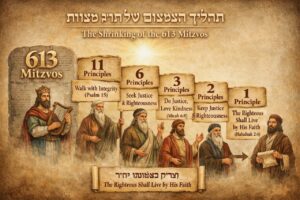
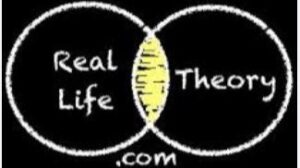
The final bottom line: These great thinkers chapped that it all come down to theory vs reality. In theory and ideally, we have 613 mitzvis. Those quoted above and many others agree that the applicable number is much less. And that number, as practiced by most of us, even smaller.
The month of Nissan is here and let’s close with this most famous quote from the heylige Gemora (Rosh Hashanah 11a): בניסן נגאלו ובניסן עתידין ליגאל
“In Nissan they were redeemed, and in Nissan they are destined to be redeemed again.”
With world events affecting our holy brothers over in the holy land, now would be a good time.
A gittin Shabbis and Choidesh-
The Heylige Oisvorfer Ruv
Yitz Grossman
Source URL: https://oisvorfer.com/vayikra-2026-six-hundred-and-thirteen-not-exactly/