Vayichi 2026: The Great Spinmeisters
by devadmin | January 1, 2026 8:01 pm
Raboyseyee and Ladies
We begin with big and heartfelt mazel tov wishes to our friends of many decades, Malki and Phil Rosen upon the upcoming aufruf this Shabbis, and wedding on Sunday of their amazing son Joseph whom we have known mamish from birth. Joseph -future superstar attorney – will be marrying Rebecca Silber, she the beautiful daughter of Daniel, OBM and Sirena Silber. Mazel tov to both extended families. May Rebecca and Joseph merit to enjoy many decades of blissful marriage.
The Great Spinmeisters
Welcome to Parshas Vayichi where the written words of the heylige Toirah take on new meaning, and where sins -seemingly committed- may be but figments of our imaginations. Your head will surely be spinning from the creativity of our sages. And here we are — the final parsha of Sefer Bereishis. We’ve made it through creation, floods, towers, patriarchs, sibling rivalries, bed switchings, sexual and other scandals, prison time, lies, jealousy, murder plots — and that was just one extended family. Our family. Let’s say it plainly because someone needs to: Vayichi forces us to confront just how messy, human, flawed and complicated the founders of Klal Yisroel really were. I speak specifically about our forefathers, foremothers and their children, and I speak of generation after generation. And yet, despite all the chaos, the RBSO chose them. Could the news be any better for the rest of us?

Two weeks ago, the Ois questioned the moral character of Yoisef’s brothers, the future selected shvotim. Last week, I asked whether or not Yoisef’s own behavior towards his father, brother Binyamin, and the rest of the gang was acceptable? This week, the Ois begins with this big gnawing question: Before Matan Toirah (Revelation), was anyone “Jewish?” Was Yaakov Jewish? And his kids? What was their halachic status? Did any convert? Go to the mikvah? Let’s play it out. If Yaakov’s sons married local Canaanite girls and produced kids -which they avada did- then what exactly were those kids? Jewish? Half-Jewish? Noachides? Spiritual Jews? Let’s ask it this way: Were Yaakov’s grandkids Jewish? Ok, let’s slow down and look for answers.
Is there even the slightest doubt regarding the purity of Yaakov’s grandchildren? Seemingly there is, and it’s Rashi who brings it to our attention. Let’s quickly look at the words which gave rise to the controversy. Let’s set the scene: Yaakov has passed and the heylige Toirah is now describing his levaya. Says the heylige Toirah (Bereishis 50:13) azoy: “His sons carried him to the land of K’nan and buried him in the cave of the Machpela field, the field facing Mamray that Avrohom had bought from Efroin the Chiti as a burial plot.” Ok and? Well, Rashi was bothered by the words “his sons.” He was wondering why Yaakov’s sons carried him and not his grandsons whom we assume were younger, had more stamina and were efsher stronger. Great catch Rashi!
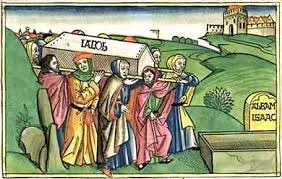
Admission: the heylige Ois had read and learned this parsha dozens of times, maybe more. It was only on this go around that the words of Rashi we are about to read struck a chord. Rashi tells us that Yaakov gave specific instructions that only his boys and not his grandchildren carry his coffin? Why? Was it because Yaakov’s sons were married to Caninities -shiksas mamish, say it’s not so? What? Yaakov’s sons, the holy shvotim to whom we can all trace our lineage, were married to Canaanite shiksas? OMG! How was that possible? And if they were taka shiksas, they were zicher not Jewish. And by extension, the children they bore, too, were not Jewish!?
Ober, isn’t there a pshat which tells us that the boys married their twin sisters and if that’s emes, of course, they married within the clan itself? There is and we have mentioned this possibility several times over the past sixteen years. Nu, let’s learn the Rashi innaveynig (let’s read his words) which tell us (Bereishis 50:13) azoy: His sons carried him but not his grandsons, for that is what he had commanded them. Nu, if they married their twin sisters, why would Yaakov then leave instructions for the grandsons not to carry his coffin? Was Yaakov concerned that the wives were K’nanite shiksas? Not to worry: Says the Nachlas Yaakov so cleverly azoy: both could be true. How? It’s taka maybe emes that the boys married their sisters. Ober they -all the sisters- died prematurely. In fact, if you recall, they were not mentioned when Yaakov moved the family down to Mitzrayim. They were not in the count. Why not? Because they were dead.

Dead people don’t count unless it’s in an election year and the candidate needs their votes. Or, maybe in Minnesota! What to do? The boys arrived to Mitzrayim and found themselves new wives. Shoin! The new (and maybe improved) were K’nanite shiksas of whom Yaakov seemingly did not approve. For that reason, according to the Nachlas Yaakov- they were excluded from carrying his coffin.

Nu, efsher you’re wondering how Yaakov allowed Ephraim and Menashe, both born to Yoisef and Osnas (she certainly an Egyptian or k’nanite) to carry the coffin? Nu, that too has an answer: If you recall, earlier in the parsha Yaakov elevated Ephraim and Menashe, they became his sons. They were no longer considered grandsons and were therefore -even if not Jewish at all – goyim mamish, were still able to carry the coffin. Loophole and so gishmak. Let us not forget Yoisef -who following at least a decade of severe trials and tribulations found himself standing before Paroy who presented him with Osnas as a wife. Was she Jewish? Of course not! That said, of course the medrish could not tolerate this factoid and decided to rewrite her resume and suddenly just like that, she was Yaakov’s fully credentialed granddaughter. The good news: Their two boys — Ephraim and Menashe were then adopted by Yaakov as sons. Elevated, promoted, and included. Not because their yichus (bona fides) was cleaner, but because — again — divine selection overrides everything. As if the RBSO were saying “holiness is not bloodline perfection, holiness is mission.” And mission can be messy. It’s allowed. The RBSO is avada great! As to Osnas and her Jewish credentials, one famous medrish will tell us that Osnas was really the daughter Dina gave birth to from her Shechem sexual encounter. Of course; why not? If that medrish is emes and why shouldn’t it be, aren’t they all? And that raboyseyee and ladies is why Toirah, the heylige Gemora and all medroshim need to be explored. No one ever did it better!
Shoin, speaking of cleaning up Osnas’s background and resume, the big question is this: Why did the medrish and by extension the heylige Gemora feel this terrible need to always do cleanup -some revisionism- in whatever aisle it found facts that were messy? Why rewrite the historical record? Why not embrace the spotty facts on the ground as part of normative behavior by the characters at that time? Why the need to always spin and seemingly concoct scenarios that are at times beyond the pale? Does this not diminish their credibility? Let’s get real: how could Osnas be Yaakov’s granddaughter when the text of the heylige Toirah tells us bifeirush (explicitly) that Osnas was the daughter of Potiphera? Please? What’s pshat here? Why did our Sages feel the need to rewrite history with all sorts of fanciful stories? Why were they always coming up with new alternatives to the truth instead of stating the facts and then letting us know that the RBSO loved them and selected them despite their checkered pasts or backgrounds? Why not tell us -as the heylige Toirah clearly does – that Yoisef married an Egyptian woman, and guess what? The RBSO loved him all the same. Why the charade?
And this is where the conversation gets interesting; the heylige Ois will attempt to unpack these questions and let us begin here. Our sages were zicher keenly aware of the tensions as they were quite blatant. They knew every word of the heylige Toirah. Might we suggest instead that the heylige Gemora was not trying to “cover up” history. Instead, it was doing something very different from rewriting the historical record. Which means what in plain English? Firstly, the heylige Gemora is not a history book and its goal was not to record events “as they happened.” Its goal was/is the proper transmission of Toirah, moral formation, halachic authority, and, pay attention to this last one; the preservation of kavod ha-Toirah. Which means what? In our case and in most, it means not to diminish the luster of the characters, and by extension all they stood for. It means reputation management of the sinners. Because of that last item, facts were filtered, but with purpose. Let’s do that again. Chazal were perfectly aware of the raw biblical narratives but they were asking: What must a תלמיד (student) learn from this, and what must be protected? Is the real story a good teaching lesson? If not, we will make it one! As an aside, that ability already tells us that they weren’t naïve or hiding something out of embarrassment. They knew the facts but chose for the reasons above to present them differently.
We could therefore argue that Chazal were not rewriting history and were not trying to produce a historical biography. What were they doing when they spun fanciful stories and scenarios? They read the heylige Toirah as a divine text layered with symbolism, with moral and theological teachings, not as a chronicle. Accordingly, each and every controversial story we read has -kimat always- at least two tracks:
- Pshat – the straightforward narrative.
- Drash/Midrash – the deeper meaning, message, values, theology, hints.
Let’s bring that home: On the pshat level, it’s true that Osnas is taka identified as “Bas Potiphera, Kohein On.” So the heylige Toirah states emphatically in the text (Bereishis 41:45). יִּקְרָא פַרְעֹה שֵׁם־יוֹסֵף צָפְנַת פַּעְנֵחַ וַיִּתֵּן־לוֹ אֶת־אָסְנַת בַּת־פּוֹטִי פֶרַע כֹּהֵן אֹן לְאִשָּׁה; וַיֵּצֵא יוֹסֵף עַל־אֶרֶץ מִצְרָיִם.
“And Pharaoh called Yoisef’s name Tzofnas Paneach, and he gave him Osnas, the daughter of Potiphera, priest of On, as a wife — and Yoisef went out over the land of Egypt.”
She’s an Egyptian shiksa, period! Our sages don’t deny that pshat exists. Cleverly, they added another interpretive layer by asking and then answering a few questions: How did Yoisef the tzaddik, the son of Yaakov, marry the daughter of an Egyptian priest? How was this possible, and how is it shayich (possible) that shvotim would arise from such a union? In other words, in the world of the medrish, it was impossible for Yoisef to marry a shiksa; there had to be more to the story. What to do? Make it up? Perhaps. So the medrish says: Don’t think -even for a second- that Yoisef married “out” and detached from the covenant. Banish the thought! Even in Egypt, the covenant lived on. Not that medrish was necessarily embarrassed of the facts; it was building a narrative about emunah, exile, survival, kedushah. These require copious amounts of imagination. If Osnas might have -somehow- been Dina’s somewhat Jewish daughter, raised in Egypt, all issues resolved. Givaldig! They made that scenario plausible. The new story birthed into life by the exegetes of the Gemora symbolically solved the tensions of the text. Because our Sages deeply cared about covenant identity, family continuity, and spiritual lineage, the new Osnas fit the mold perfectly and shoin. Crafty!

On the other hand, why not stick to the facts? Let’s be real: we do read elsewhere in Tanach how certain people – good people, leaders- married out. Shimshon married out while Rus married in. The good news: the RBSO stayed with them! And if that’s the case, why change the Osnas’s story? Seemingly, the Yoisef story is seen as a prototype for golus (exile): Yaakov’s clan went to Egypt, but still, somehow, remained steadfast in their belief in the RBSO. The new Osnas becomes a symbol: Jewish identity may be hidden, lost, buried — but not erased. Gishmak! One more point: The medrish isn’t stating that its Osnas narrative definitively happened, and classic Jewish thinkers (Rambam, Maharal, Rashba, Ramban, the Vilna Gaon) repeatedly say that midroshim are not always literal. Many are metaphors, parables, spiritual explanations, moral framing. Says the Maharal so gishmak azoy: When a midrash sounds historically strange, assume it is teaching an idea, not reporting a fact. So instead of “this happened physically” read it as: “This is what Yoisef’s marriage means in the divine story.”
Still the question begs: Why not just say that taka Yoisef married an Egyptian woman and the RBSO still loved him? This question has bothered the Ois for many years and this week he reached out to his close friend Rabbi Benjmain Blech whose extensive resume includes teaching Talmud at YU for the past 59 years looking for some backup for what I wanted to share. Could I express these thoughts without being called an apikoires or worse? His answer -in a long email I read twice- has me on safe footing.
When the Gemora was being codified, our sages were speaking to real communities dealing with early Christianity and Roman assimilation pressures. Intermarriage was not theoretical; it was swallowing communities whole. Midrashic tales acted as a protective educational move. In the world of the medrish, Yoisef stayed inside the covenant and even when everything looked lost; there was Jewish continuity. The bottom line of the medrish stories might be this: It is not truth vs. fairy tale; it’s that history is one layer, and meaning is another layer. Both seemingly co-exist. Think of it like this: the historian might ask “What objectively happened, while the Prophet/Sage might ask this: “What does this teach about the RBSO, the Yiddin, covenant, exile, redemption?” Chazal -at least at times- ignore the first and operate in the second lane only.
Shoin, let’s move onto another example, also from our parsha which tell us that Yaakov died, all about his funeral, and procession which was filled with pageantry. That said, how could our sages -as quoted in the heylige Gemora and elsewhere- tell us that Yaakov didn’t die?” (תענית ה: “יעקב אבינו לא מת”) On the surface, it sounds vild (wild and nuts). We literally read that they embalmed him, cried for him, and buried him in the Me’aras HaMachpelah. Why tell us he didn’t die? What’s happening here? Ershtens, we must know that our sages knew the historical facts: the heylige Toirah says he died. And Reb Yoichonon who is quoted in the Gemora as having famously said “Yaakov didn’t die” was zicher aware of the pisukim. In fact, as the Gemora continues, it says this: The other rabbis basically challenged him with “but they embalmed him and buried him!” Caught! How to slip out in medrish world? Reb Yoichonon answered (paraphrasing) with this: just as his descendants are alive, so too Yaakov is alive. Meaning, this isn’t biology. This is theological language. Let’s go deeper: In Tanach we find the word “life” for meaning, continuity, and covenant. Examples: “וּבָחַרְתָּ בַּחַיִּים” — Choose life. Not oxygen, but purpose and relationship with the RBSO. The wicked are called “dead” even when walking around. Tzadikim are called “alive” even after death. And with that information, the Gemora chaps that death = disappearance, irrelevance, legacy cut off while life is presence, continuity, covenant still active. In that sense, Yaakov — the father of the Jewish people — never disappears. Shoin, assuming we all buy in, the next question is this: Why not just say that Yaakov died but his legacy lives? Wouldn’t that be easier to chap and all would taka believe it? Seemingly it would but the medrish often speaks in bold, shocking language to drive home the point. Had it said “Yaakov died, but spiritually lives on,” we would likely read it, nod politely, and move on. Instead, they say: “Yaakov Ovenu did not die.” And you stop. And you ask as the Ois did: “What does that mean?” Boom — teaching moment. Givaldig! The bottom line: it does appear that medrish loves paradox because it forces reflection.
What about all the yeshiva guys and other learners who argue that when the medrish says Yaakov did not die, it’s a fact and case closed? There are many of them. The answer is that it’s mamish not literal and major Rishonim (early century rabbis) say this openly. Says the Maharal that when Chazal deny something obvious -facts on the ground as the RBSO told us in His Toirah- they mean that on a deeper level, reality doesn’t work the way you think. So yes, biologically — Yaakov died, ober spiritually/nationally, he is the one patriarch whose presence never leaves us.
But wait, like the famous infomercials, the parsha has more to give, and this last example is prime material. Yaakov -on his deathbed- tells Reuvain that he’s still angry and upset about what he did. What did Reuvain do? The Toirah tells us — in language as blunt as a baseball bat: “Reuvain went and lay with Bilhah, his father’s concubine.” Excuse me?! The bechor, the future leader of Klal Yisroel — involved in something like that? And before we can even take this in, Chazal show up and say: “Relax. He didn’t actually sleep with her. He only moved his father’s bed.” Moved a bed? What’s going on here? Are we rewriting history? Cleaning things up? Turning Aveiros Gedolos (major sins) into a moving-company job? Let’s slow down and see what’s really happening — because the story is actually deeper, sharper, and yes efsher more Jewish than any soap opera version. Our sages suggest that No- he did not! Like Clinton, he did not have sexual relations with that woman!

He just moved Yaakov’s bed — and the Toirah treats it as if he slept with her. And you’re thinking: “What?! Why not just say what it says? Does the RBSO not know how to express Himself? Banish the thought! If He said sleep, that’s what happened! Let’s unpack this carefully. Our Sages (Chazal) absolutely knew what the posik sounds like; horrible! But they also noticed something else: Later Yaakov says about his sons: “My children are all pure.” And Chazal say: The heylige Toirah doesn’t lightly accuse one of the shvotim of something incestuous, the kind of sin that literally destroys families. Something else must have gone down besides Reuvain. So they ask: What really happened? What is the Toirah trying to communicate with such intense language? There must be more to the story. Their answer: Reuvain didn’t commit a sexual sin. But he did publicly challenge Yaakov’s dignity and authority — in the most intimate part of his life. And the Toirah expresses that rebellion in shockingly strong wording, because the impact was that severe. Well, blow me down because if he did not sleep with her, what did he do?

This entire Reuvain myseh (storyline) is textbook Rambam-aggadah where the heylige Toirah gives raw text and our Sages guide moral reading; neither is “lying.” Why did Chazal have to reinterpret the story? Because If Reuvain literally mamish slept with Bilhah, he commits incest, he becomes פסול (disqualified) for leadership, Yaakov’s silence becomes incomprehensible, and the shvotim collapse morally. Cleanup needed badly! Their version of the facts is audience-sensitive, kavod-preserving and theologically motivated. Chazal are saying: You don’t need to imagine Reuvain as depraved. Imagine instead a passionate, impulsive bechor and bochur who acted impetuously and paid spiritually for it. That said, pshat still exists, and if someone wants to read the pshat literally — that Reuvain DID sin sexually, one may not find a blue dress, but one will find Rishonim who lean that way. Chazal’s version isn’t a history rewrite; it’s but a way to explain the sin in moral terms rather than tabloid terms. And they base it on clues such as: Reuvain later does teshuva and fasts, Yaakov still includes him among the shvotim, and Yakov emphasizes his impetuousness (“פחז כמים”) — not his lust. Not depravity, only misplaced zeal. They often take a story that looks crude, humiliating, or irredeemable and ask: What deeper spiritual drama is actually happening here? Not to hide the truth but to teach that the Patriarchs were complex, their failures operated on a high plane, and the Toirah speaks in charged, symbolic language. It doesn’t mean midrash is literal history.
In fact, many of our early Sages explicitly warn: don’t read every midrash literally. Says the Rambam (in his Introduction to Perek Chelek), azoy: Some people take aggadah literally and make Judaism look foolish. The wise understand: much of aggadah is parable, symbolism, metaphor. And the Maharal whom we quoted above says this: when a medrish contradicts obvious reality, it is signaling: Stop! And that this is but an idea clothed in story. But why not label them clearly as metaphors? Because aggadah wasn’t meant to be read like an instruction manual. It’s closer to: poetry, parable, a prophetic vision, or Chasidic story. If every time Chazal said something deep they added: “This is only a metaphor,” the power would vanish. The imagination wouldn’t get engaged. The student wouldn’t wrestle. For the writers of the medrish, Toirah learning always involves wrestling. And yet, it feels misleading. Just say clearly what you mean. That frustration is real. Let’s give our sages credit because they did what great teachers, poets, and prophets do: wrapped ideas in dramatic narrative so the ideas last, provoke, and shape how we see the world. You don’t have to pretend the midrash is literal. You also don’t have to reject it as “made-up.” It’s a different language.
And the bottom line on Reuvain? The words in the heylige Toirah say that Reuvain slept with Bilhah. Sleeping means sleeping — not moving beds. If the Toirah wanted to say ‘he moved furniture,’ it should have said that.” And yet, Chazal are saying: “If the Toirah used sexual language, it must be teaching something bigger than furniture.” They’re not denying the word. They are interpreting why the Toirah chose such severe wording. And remember: They NEVER say, “The posik literally means ‘move beds.’” They say: אַל תּוֹלִי בּוֹ עָוֹן — do not attribute to him actual incest.” The final bottom-line on Reuvain is this: Almost all serious mefarshim (exegetes) understand that the moving the bed theory is aggadic, not literal history.
Shoin, we’re mamish on page seven and let us begin to close up with this: After all is said and done, why taka did Chazal go out of their way to spin each and every ugly story that embroiled our heylige Ovis and their children? Why the cover up? Why not tell us the emes: Several reasons are proffered by these very and other sages; let’s see what they had to say. One suggestion is that the “covering up” was really about kavod; they didn’t want to embarrass the bad actors. There is an explicit principle:
אין מקרא יוצא מידי פשוטו — but also — אין דורשין לגנאי
Chazal often refuse to read verses in a way that degrades. In English this means that our sages refused to read pisukim that embarrassed our Ovos, the Neviim, and the heylige Toirah itself. Bad for business and marketing? Not because they denied the flaws, but because public denigration destroys reverence. It was bad for business; brand management above all! They feared something very real: Once foundational figures are reduced to “just messed-up people,” and the covenant itself starts to look arbitrary, what’s next? What to do? They redirected but did not erase. They were careful to limit the audience, control the framing, and tie criticism to spiritual consequences. From their point of view, this is not rewriting history; it’s educational containment. The very uncomfortable truth is this: If Chazal fully embraced the dysfunction language, many Jews would have concluded that the Ovos were no better than us, sin has no lasting consequence, and authority is negotiable.
The bottom line: The heylige Gemora assumes you already know the mess because the heylige Toirah already told the story in painful detail. The Gemora is not correcting the Toirah—it’s answering a different question: “How can these people still be our Ovos if this is what they did?” So….it sometimes softens intent, attributes higher motives, and limits blame. They follow their own rule to למד זכות על האבות – Judge the ancestors favorably — when possible. That’s not denial, that’s theology. The final bottom line: Chazal chose survival over radical transparency. You could argue with their choice—but it was deliberate, not dishonest. And now you know.
Chazak, Chazak, Vinischazake!
A gittin Shabbis –
The Heylige Oisvorfer Ruv
Yitz Grossman
Source URL: https://oisvorfer.com/vayichi-2026-the-great-spinmeisters/