Vayetzei 2026: Fourteen Years in Yeshiva, Twenty Years at Lovon University
by devadmin | November 19, 2026 8:22 pm
Raboyseyee and Ladies,
A big mazel tov to Amy and Yitzy Englander – nicer and finer people very hard to find- upon the wedding this past Monday of their son Shai, who married Rikki Neuhoff, she the beautiful daughter of Malky and Yossi Neuhoff, the family from Brooklyn. Mazel tov to grandparents, Naomi and Moshe Sorscher, whom I have known since 1977 and to both extended families. May Rikki and Shai be zoche to build a beautiful home and life together and may they continue to be a source of much strength, nachas, and joy to their parents, and all in their orbit.
Sadly, the heylige Ois was away, but looks forward to sharing future simchas with the Englanders.
———————————————————————————————————————
Fourteen Years in Yeshiva, Twenty Years at Lovon University
And back to New York I go. Shoin, having consumed all that’s kosher in the lounge and with some time to spare before boarding and heading home after eight days, let’s begin reviewing Parshas Vayetzei, which focuses mostly on Yaakov, Leah, Rochel, and Lovon. But I have a question. As kimat always, I have several, and as usual, they are not necessarily the questions one is supposed to ask. The good news: The flight is somehow much shorter west to east.

Why does the heylige Toirah tell us so much about the questionable behavior of our Avos and Imahos (forefathers and mothers), and seemingly so little about their greatness? Why do we know so much about their family disputes, their deceptions, their disagreements, their jealousies, their marital difficulties, and their less-than-perfect decisions, while knowing so little about the extraordinary spiritual accomplishments that made them the founders of our nation? Has this last question bothered you? It should!
Take Rochel and Leah. These were not two ordinary women who happened to marry Yaakov and produce eight of his twelve sons. They went on to become two of our foremothers. Between them -and let’s shout out Bila and Zilpa for the other four- they gave birth to the Shivtei Koh, the twelve shvotim about whom the Ois will have plenty to say in the coming weeks. Avada, they were women of extraordinary spiritual stature. Yet what does the heylige Toirah actually tell us about them and their goodness? Kimat nothing! We do learn about Rochel’s beauty, Yaakov’s love for her, the seven years he worked for her, the wedding-night switcharoo, the signs Rochel gave Leah, the infertility, the competition over children, and Rochel’s taking of Lovon’s terofim (idols). We learn about Leah’s weak eyes, her marriage to Yaakov, her difficult relationship with her sister, the births, and the names she gives her children.

But where is the spiritual biography? Where are the accounts of their learning, their prayers, their acts of chesed, their daily devotion, their extraordinary relationship with the RBSO? Did they recite some Tehillim daily? Did they volunteer at shul events? We are given a few precious glimpses (are we really?), but hardly the portrait one might expect of women who would become the mothers of the Yiddin. To be fair, the heylige Toirah does give us some positive details. Rochel was beloved by Yaakov, and Leah’s declaration, “הַפַּעַם אוֹדֶה אֶת ה׳” (this time I will thank the RBSO), tells us something profound about her gratitude. But that is precisely the point. We get glimpses, not biographies.
Is the heylige Ois the first to ask these questions? Are such questions allowed? The Ois is not the first! The bottom line is this: The heylige Toirah’s treatment of our Ovos and Imahos can leave a reader scratching his head. Mamish two minutes ago, I came across an essay written by Rabbi Jonathan Sacks titled “How Perfect Were the Matriarchs and Patriarchs?” He examines the moral complexities of Bereishis and discusses the Ramban, who was quite prepared to criticize Avrohom for leaving the one-day-to-be holy land during the famine and Soro for her treatment of Hogor. These are not criticisms from some modern academic looking to make a name for himself. This is the Ramban, one of our greatest Rishonim, reading the heylige Toirah and refusing to pretend that every action of our ancestors was beyond question. He was a relist! Rav Samson Raphael Hirsch writes that the heylige Toirah never hides the faults, errors, and weaknesses of its great men. Farkert! He argues that knowing their struggles can make them greater and more instructive. Rabbi Sacks also brings the Maharatz Chajes, who explains that the Medrish sometimes simplifies complicated human stories to teach a moral lesson. What that lesson is, ver veyst? The bottom line: Were these figures great? I don’t know! I know that the RBSO selected them. The question is why the heylige Toirah, which could have given us pages upon pages describing their extraordinary spiritual accomplishments, instead chooses to preserve so many uncomfortable details of their lives. What’s up with that? And with that introduction and question, let us return to Yaakov Avinu, who spent — so says Rashi, quoting the Medrish — fourteen years in yeshiva, and from the text itself, twenty years at Lovon University.
The heylige Toirah describes Yaakov as “אִישׁ תָּם יֹשֵׁב אֹהָלִים” — a wholesome man who dwelled in tents. Rashi tells us that his mouth and heart were alike. Yaakov was the straight one, the scholar, the man of the tents. Eisav, by contrast, was a hunter, a man of the field, a man who knew how to operate in the outside world. And yet, as we found out in last week’s parsha, when the time came to secure the brochos, Yaakov was hardly standing around waiting for the mailman to deliver them. Rivkah devised the plan. Yaakov was instructed to bring two goats, prepare the food his father liked, put on Eisav’s clothing, and cover his smooth hands and neck with goatskins. Yitzchok was old and his eyesight had failed. Yaakov approached his father, and when Yitzchok asked who was standing before him, Yaakov answered, “אָנֹכִי עֵשָׂו בְּכֹרֶךָ.” There is a lot to unpack here. The mother was directing the operation, the son was participating, and the father was being deceived. One can explain the episode in many ways, and our holy sages certainly and valiantly do. But the heylige Toirah does not erase the uncomfortable details. There is also an interesting possibility concerning Yitzchok’s intentions. Perhaps he understood that Eisav had strengths Yaakov did not possess. Perhaps he saw Eisav as the son who could manage the worldly affairs of the family, while Yaakov would remain devoted to the spiritual mission. This is a thought worth considering, though it is not an explicit statement of the heylige Toirah. Then again, neither are all the nasty things the medrish says about Eisav. Rashi tells us that Eisav knew how to trap his father with questions, presenting himself as a particularly scrupulous son. He was a charmer. Yitzchok may have been impressed by what he saw. But Rivkah saw something else. She knew her sons, and she knew the future that had been revealed to her. She intervened. That was last week; let’s spend some time — as the Ois is about to take off — on this week’s parsha.
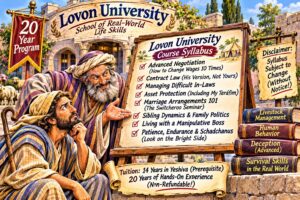
Yaakov, the man of the tents, is about to embark on a very different education. He is sent to Choron, to the house of Lovon, his mother’s brother. Before arriving, Rashi tells us that Yaakov spent fourteen years hidden away in the Beis Medrish of Ever, learning Toirah from him. Fourteen years of Toirah learning. Fourteen years immersed in the world of ruchnius, whatever that meant back then. And then he arrives at Lovon’s house; welcome to Lovon University. The curriculum is somewhat different. No tuition, no textbooks, no student loans. Just one professor, Lovon, who specialized in changing the syllabus after the exams.

But perhaps we should pause here. The fact that the heylige Toirah records questionable behavior does not necessarily mean that these individuals were disqualified from greatness. Perhaps we have been looking at these stories through the wrong lens. Being a great person does not mean being a pushover, and being honest does not mean being naïve. One needs what the Ois likes to call life skills. Yaakov may have spent fourteen years learning Toirah in the Beis Medrish of Ever. But perhaps Toirah learning was only part of the education he would need to fulfill his mission. He was going to encounter Eisav, Lovon, difficult family relationships, not such well-behaved children, changing agreements, deception, and a world that did not always operate according to the rules of the Beis Medrash. Perhaps he needed to learn how to navigate that world as well.
Fourteen years in yeshiva gave him one education. Twenty years at Lovon University gave him another. The first taught him how to live as Yaakov. The second taught him how to deal with Lovon. And perhaps that is the point: one does not have to become Lovon to learn how to deal with Lovon. One can retain one’s integrity, remain committed to the RBSO, and still acquire the wisdom, judgment, and street smarts necessary to survive in the real world. Is that pshat? Ver veyst?

Yaakov meets Rochel, falls in love, and agrees to work seven years for her hand in marriage. The heylige Toirah tells us that the seven years seemed to him like a few days because of his love for her. A beautiful sentiment. A romantic one. And then comes the wedding night. We all know it well: Lovon substitutes Leah for Rochel. Yaakov wakes up in the morning and discovers that he has married the wrong sister. His response is direct: “מַה זֹּאת עָשִׂיתָ לִּי?” What have you done to me? Lovon’s answer is almost comical in its audacity. In this place, he explains, it is not customary to marry off the younger daughter before the older one. A little detail he somehow neglected to mention before Yaakov worked seven years! One can almost imagine Yaakov asking why this local custom was not included in the original employment agreement. Yaakov is now dealing with a professional trickster. Lovon has been at this for years. He is not called Lovon for nothing; he has a reputation to maintain. But Yaakov learns. Actually, the heylige Gemora (Megillah 13b) gives us an important piece of the story that the Ois does not want readers to miss. Before the wedding, Rochel warns Yaakov that her father is a swindler. Yaakov responds, “אָחִיו אָנָא בְּרַמָּאוּת” — I am his brother in deception. In other words, if Lovon is coming to play games, Yaakov is not arriving without preparation. Quite an introduction to married life! The man who spent fourteen years learning in the Beis Medrish of Ever already chapped that he is entering a family business where the rules are somewhat flexible. Let that sink in. Yaakov is discovering that being a good person does not require being an easy mark. There is a difference between integrity and naïveté. There is a difference between being honest and assuming that everybody else is. And there is a difference between being a mensch and allowing someone to take advantage of you indefinitely. Lovon changes Yaakov’s wages repeatedly. Yaakov later tells him that Lovon changed his wages ten times. Ten times! In today’s business world, Lovon would have been a candidate for CEO of the year. His employees, on the other hand, would have needed a class-action attorney. Most of us would have difficulty negotiating a salary increase once. Yaakov is dealing with a boss who apparently considers the employment contract a suggestion. And yet Yaakov prospers. The heylige Toirah describes the flocks, the arrangements involving the rods, the changing circumstances, and ultimately the RBSO’s intervention in Yaakov’s success. The Ois has previously covered all these details; check them out in the archives of Oisvorfer.com. The story is complicated, and it should not be reduced to a simple lesson in animal husbandry or clever business tactics. But one thing is clear: Yaakov has learned how to survive in Lovon’s world. Veyter.
After twenty years, he decides to leave. He does not announce his plans to Lovon in advance. The heylige Toirah uses the expression “וַיִּגְנֹב יַעֲקֹב אֶת לֵב לָבָן” — Yaakov stole the heart of Lovon — meaning he departed without telling him. Again, the heylige Toirah does not hide the details. The man who began as the wholesome dweller in tents has spent twenty years navigating a world of manipulation, changing agreements, and family politics. Fourteen years in yeshiva. Twenty years at Lovon University. Quite an education. But perhaps we should ask whether Yaakov was the only one in this family who understood Lovon. Rivkah grew up in the very household Yaakov was entering. She knew Lovon. She knew the family. She had lived with these people. And yet she sent Yaakov there?! Why? Maybe Rivkah understood that after fourteen years in yeshiva, Yaakov needed an internship. Unfortunately, she found him one with the worst employer in the Middle East. Shoin!
We should not underestimate that background. When Rivkah orchestrated the brochos episode, she demonstrated considerable initiative, planning, and determination. She knew what needed to be done, anticipated the obstacles, and prepared Yaakov for the encounter with Yitzchok. She was not a passive observer waiting for events to unfold. And when Yaakov had to leave, it is Rivkah who sent him away to Choron. Yitzchok then instructs Yaakov to take a wife from the daughters of Lovon, his mother’s brother. What the heck?
Was Rivkah’s upbringing in Lovon’s household part of what made her so perceptive? Could be! Did she understand that the world was not always populated by people who played by the rules? Did she recognize that Yaakov would need more than the skills acquired in the yeshiva tents? Shoin, we cannot claim to know precisely what was in her mind davka because the heylige Toirah does not tell us. But it is worth considering that the woman who understood the danger of Eisav and the importance of Yaakov’s mission also knew exactly what kind of family he was about to enter. Perhaps she understood that Yaakov needed to acquire those life skills, too. Perhaps the trip to Lovon was not only about finding a wife. It was also about learning how to deal with the world.
And then there are Rochel and Leah. Yaakov is not the only person in this story who chapped (understood) what it means to live in Lovon’s household. These two women grew up there. They knew their father. They knew his methods. They had spent their lives watching him operate. Consider Rochel. Before the wedding, Yaakov gives Rochel identifying signs so that Lovon cannot substitute Leah without being discovered. The heylige Gemora (Megillah 13b) tells us that when Rochel realizes what her father intends to do, she gives those signs to Leah so that her sister will not be humiliated. Think about the sacrifice. Rochel knows that the man she loves is about to marry her sister, and she still protects Leah from embarrassment. But be aware: The heylige Toirah itself does not tell us this. It is the Gemora that supplies this extraordinary detail. The heylige Gemora even connects Rochel’s modesty and self-sacrifice to her descendant Shaul, who later demonstrates similar qualities. And taka, if that’s what went down, what a remarkable act of chesed. Yet the heylige Toirah itself does not stop to give us a lengthy description of Rochel’s character. It’s the Gemora and Medrish that supply the emotional and moral dimension. They fill in the lacunas. Later, when Yaakov leaves Lovon’s home, Rochel takes her father’s terafim. Why? The heylige Toirah does not explain her motivation. Rashi, citing the Medrish, suggests that she wanted to wean her father away from idolatry. Other commentators offer different explanations. We should not pretend that the text gives us a definitive answer. It does not! But once again, we are left with a complicated story about a woman whose spiritual stature we know was extraordinary, while the heylige Toirah gives us only a small window into her inner life.
And Leah? Leah’s story is equally difficult. She is brought into a marriage through her father’s deception. She knows that Yaakov loves Rochel. She lives in the shadow of her younger sister’s relationship with her husband. The heylige Toirah describes her eyes as weak, and Rashi brings the Medrish that she cried because she feared she would be destined for Eisav. Yet Leah is not merely a victim in this story. She goes into that tent willingly. She is a woman of extraordinary significance. She names her fourth son Yehudah and declares, “הַפַּעַם אוֹדֶה אֶת ה׳” — this time I will thank Hashem. The heylige Gemora teaches that from the day of Creation, nobody had thanked Hashem in this particular way until Leah did. Wow! The mother of Yehudah, the ancestor of Dovid Hamelech and ultimately Moshiach, is introduced to us through a family story filled with pain, rivalry, and disappointment. Let’s not forget some deception and a bedroom-related story. Dovid Hamelech was merely following the family tradition, why not? Badabeem! Or maybe better stated, Bed-a-beem! And then, almost in passing, we receive this extraordinary glimpse into her spiritual world. Why does the heylige Toirah tell us so little more?

Shoin, one answer given suggest that the heylige Toirah is not writing biographies in the way we might expect. It is not trying to provide a complete account of every saintly act, every prayer, every moment of devotion. It is telling the story of the formation of a nation. And the formation of that nation took place in the middle of real human relationships, with all their complications. The heylige Toirah does not give us a sanitized family album. It gives us the family, and families have stuff going on. Lots of stuff! Apparently, even the first rather large Jewish family had its share of dysfunction. The only difference is that their family disputes made it into the heylige Toirah, while ours are usually confined to the WhatsApp group and avada to shul gossip.
And perhaps there is an even bigger lesson here. Think about how much detail the heylige Toirah devotes to Yaakov’s twenty years with Lovon. We are told about his wages, the changing agreements, the flocks, the negotiations, the family disputes, and the eventual departure. We are given only a brief reference, through Rashi’s account, to the fourteen years he spent learning Toirah in the Beis Medrish of Ever. In fact, the heylige Toirah skips the entire fourteen years. Even the medrish does not dare tell us which masechtos (Tractates) he learned, which blatt he mastered, or which Toisfis he struggled with. The heylige Toirah spends far more narrative time showing us how Yaakov handled life than describing what he learned while sitting in the Beis Medrish. Interesting.
And maybe it’s taka pshat. The heylige Toirah is not telling us that Toirah learning is unimportant. Chas vesholom! Perhaps the Toirah is emphasizing something we sometimes overlook: one needs life skills, too. One needs judgment, street smarts, the ability to negotiate, the wisdom to recognize when someone is taking advantage, and the courage to stand up for oneself without abandoning one’s values. Could the heylige Toirah deliberately be giving us a lengthy education in life skills because it knows that we will need them? It does not spend twenty pisukim telling us which Toisfis Yaakov learned, but it does spend considerable time showing us how he dealt with Lovon. Maybe the lesson is that sitting in yeshiva and learning Toirah is indispensable, but it does not automatically teach a person how to deal with every Lovon who comes along. That education, too, is part of life.
The bottom line: We tend to assume that honesty means telling everybody everything, all the time, regardless of circumstances. But our ver wise Sages taught us otherwise. The heylige Gemora (Yevomis 65b) states: “מותר לו לאדם לשנות בדבר השלום” — a person may alter the truth for the sake of peace. The Gemora brings examples, including the RBSO’s modification of Soro’s words when speaking to Avrohom. Avada, this is not necessarily a license to lie whenever it is convenient. It is not permission to turn deception into a business model, as Lovon seems to have done. But it does teach us that truthfulness and full disclosure are not always identical. There are circumstances in which discretion, compassion, and peace matter. The challenge is knowing the difference. And that is not always simple. Yaakov’s life teaches us that a person can remain committed to the heylige Toirah and integrity while learning to navigate a world that does not always share those commitments. Rivkah teaches us that perception and determination matter. Rochel teaches us that compassion may require a personal sacrifice. Leah teaches us that greatness can exist even when the circumstances surrounding a person are painful and complicated.
And perhaps that brings me back to the question I began with. Why does the heylige Toirah tell us so much about the imperfections, conflicts, and questionable conduct of our ancestors, and so little about the details of their spiritual greatness? Maybe the heylige Toirah is teaching us something far more profound than a collection of stories about perfect people. It is showing us that greatness is not necessarily the absence of struggle. It is what a person does while living through that struggle. It is how one navigates difficult relationships, how one responds to dishonesty, how one protects another person’s dignity, how one maintains faith when life does not go according to plan. Maybe the heylige Toirah never meant to tell us that Yaakov, Rochel, and Leah were great. Their place in Jewish history speaks for itself; they were selected by the RBSO for their roles. But it does show us that their greatness was forged in a world that was anything but simple.
The bottom lines: We should not aspire to become Lovon. That would rather defeat the purpose of fourteen years in yeshiva. But neither should we imagine that being a good Jew means walking through life without our eyes open. There is seemingly a time to be Yaakov in the tents, a time to deal with Lovon, a time to protect a sister, and a time to say thank you to Hashem. The trick is knowing which time it is. And if it takes fourteen years in yeshiva and another twenty years at Lovon University to figure that out, perhaps we should all be prepared for a very long semester.
Shoin, after repeated interruptions to eat, drink, and other essentials, and after a few minutes of FOX (the news is still bad), the plane is landing in 20 minutes.
A gittin Shabbis!
The Heylige Oisvorfer Ruv
Yitz Grossman
Source URL: https://oisvorfer.com/vayetzei-2026-fourteen-years-in-yeshiva-twenty-years-at-lovon-university/