Shovuis 2026: The Yom Tov of Machloikes (Disagreements)
by devadmin | May 21, 2026 1:18 am
Raboyseyee and Ladies,
Let’s begin with this: When it came to Matan Toirah, the heylige Toirah famously declares: “וַיִּחַן שָׁם יִשְׂרָאֵל נֶגֶד הָהָר” “And Israel encamped there opposite the mountain.” The famous point is that the word “וַיִּחַן” (“and he encamped”) is singular, leading Rashi to say they were united “like one man with one heart.” “כְּאִישׁ אֶחָד בְּלֵב אֶחָד”

Finally — unity. Perhaps, says the Ois, for the first and maybe only time in Jewish history, all the Yiddin were actually on the same page. No politics. No factions. No breakaway minyanim. No “I heard a different pshat.” No one storming out of shul because somebody else got an aliya or because someone pissed you off. Absolute achdus. But is that really true? Seemingly not. Because I am about to expose the uncomfortable, perhaps even hilarious naked truth: there may be more arguments, debates, contradictions, and machloikes surrounding Shovuis than any other Yom Tov on the Jewish calendar. And it’s emes!
Think about it. We do not even fully agree on which day the Heylige Toirah was given, what exactly happened at Sinai, how many commandments were heard directly from the RBSO, what the Luchis looked like, what was written on them, whether the letters went through the stone, why we eat cheesecake, or whether staying up all night is even a good idea. Achdus? Let’s get real: The Yom Tov celebrating absolute Divine truth somehow became the headquarters of Jewish disagreement. And maybe that itself is the deepest truth of the entire heylige Toirah.
Because Toirah was not given to robots. Toirah was given to us Yiddin. And we Jews, apparently, argue about everything; including the day we received the Toirah telling us how to argue about everything. So let us open the heylige Gemora, the Midrashim, the meforshim, all while shoveling more than one needs slices of cheesecake into our mouths, and explore some of the great controversies of Shovuis. Let us begin:

Was the heylige Toirah Given on the Sixth of Sivan… or the Seventh? One would imagine that the anniversary of the single greatest event in Jewish history would at least have a clear date. One would imagine wrong. The Heylige Gemora records a major dispute between the Chachomim and Rabbi Yosi regarding when Matan Toirah actually took place. According to the Chachomim, the Toirah was given on the sixth of Sivan, the date we celebrate Shovuis. According to Rabbi Yosi, however, the Toirah was actually given on the seventh of Sivan. Now pause for a moment and appreciate the absurdity. We are not debating some side detail. This is not a machloikes over the proper ingredient or texture of charoisis or even blintzes. This is the actual birthday of the Toirah. Yet Chazal preserve both views.
Even more fascinating is that many point out that while we celebrate on Vav Sivan (the sixth day of Sivan), the actual sequence of days during that original week at Sinai may line up more closely with Rabbi Yosei’s calculation. In other words, the official Yom Tov and the historical chronology may not perfectly overlap. Only Judaism could produce a situation where the anniversary of Revelation itself becomes subject to interpretation. And perhaps that is precisely the point. Toirah did not eliminate disagreement. Farkert! Toirah sanctified disagreement. The moment Toirah entered the world, so did the Beis Medrish. It just took a while -ok- hundreds of years to reduce all the arguments to writing. Veyter; we’re just getting warmed up.
The Toirah never actually says Shovuis is about Matan Toirah. Here is another startling fact many Jews do not realize. The Toirah itself never explicitly states that Shovuis commemorates the giving of the Toirah. Read the pisukim carefully and you will find agricultural language:
- Chag HaKatzir
- Yom HaBikkurim
- Shovuis
Harvest. First fruits. Agriculture. But nowhere does the heylige Toirah openly declare: “This is the anniversary of Har Sinai.” That title — “Zman Matan Toiroseinu” emerges through Chazal. Ober, why would the Toirah itself seemingly avoid saying the main point? Perhaps because Toirah cannot belong to one date alone? Pesach commemorates an event that happened once. Succos recalls a historical protection that occurred once. But the heylige Toirah must be constantly renewed. If Sinai were merely a historical anniversary, Judaism risks becoming a museum. Instead, Chazal transformed Shovuis into something alive. Not merely the day Toirah was once given, but the season in which Toirah is always being re-given. Every year. Every generation. Every Jew. Pshat? Ver veyst?
What exactly was written on the Luchis? At first glance this seems obvious. The Aseres HaDibros (The Ten Commandments) were engraved upon the Luchis. End of discussion? Not. Our Sages begin describing the Luchis in ways that sound almost supernatural. The writing could allegedly be read from both sides. The letters were engraved “mizeh umizeh” – through and through. Some midroshim describe the letters as floating miraculously within the stone itself.
Then comes the famous problem of the Hebrew letters samech and final mem. Here they are: ס and ם Since those letters are fully enclosed shapes, if the carving went straight through the stone, the middle section should have fallen out. Yet it remained suspended miraculously. Suddenly the Luchis stop sounding like ordinary tablets and start sounding like something from another dimension entirely.
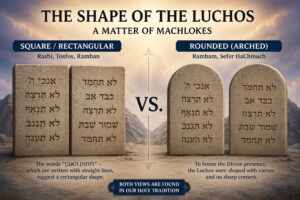
And then the arguments begin. Were there five commandments on each tablet, or all ten repeated on both? Were the words written horizontally or vertically? Did the letters appear as black fire on white fire? Were the Luchis rectangular or square? At some point the standard kindergarten image completely collapses. Which may be exactly the lesson. The Luchis were never meant to be ordinary objects. They represented the meeting point between physical matter and Divine infinity; stone behaving like spirit.
The shape of the Luchis may also be wrong. Most people picture the Luchis with rounded tops, almost like two upside-down letter “U”s sitting side by side. There is just one problem. That image may have little basis in traditional Jewish sources. Many historians trace the rounded-Luchis image to later artistic representations, especially Christian and Renaissance-era depictions. Say it’s not so please, but is it? Earlier Jewish descriptions often imply square or rectangular tablets. Meaning that one of the most iconic Jewish images in history may actually come from non-Jewish art? Yikes! Somewhere, a very frustrated rebbe is fainting.
Did the Yiddin hear all Ten Commandments directly from the RBSO? Here comes another foundational debate concerns the actual revelation itself. Did the Jewish people hear all Ten Commandments directly from Hashem? Some opinions say yes. Others maintain that only the first two commandments were heard directly, after which the experience became too overwhelming and the nation begged Moishe to serve as intermediary. Others understand the experience in more layered or symbolic ways.
Again, it’s mamish astonishing. The single most public revelation in human history — witnessed by millions according to Jewish tradition — is itself preserved through multiple understandings. The bottom line: Judaism is not afraid of complexity. It preserves complexity. It seemingly thrives on it.
And why in the world are we eating cheesecake? Ver veyst and the bottom line is this: No Jewish Yom Tov can survive without food confusion. Why do we davka eat cheesecake, blintzes, and enough dairy on Shovuis to bankrupt the lactose-intolerant – including me? The explanations are endless.
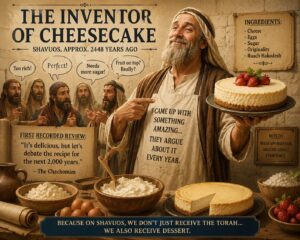
Some say Toirah is compared to milk and honey. Others explain that after receiving the laws of shechitah and kashrus, the Yiddin temporarily could not eat meat -their dishes and utensils- weren’t kosher and therefore they ate dairy instead. Others find hints in gematrias and symbolic verses. And perhaps all are true. Or perhaps a Toirah inspired entrepreneur discovered cheesecake and then retroactively assembled theological explanations to justify continuing? Would that really be so shocking?
One of the best-known Shovuis customs is staying awake the entire night learning Toirah. The reason usually given is that Bnei Yisrael overslept on the morning of Matan Toirah and needed to be awakened. We therefore “correct” that mistake by remaining awake in eager anticipation. Beautiful idea. Is that real pshat? Maybe, except for one slight complication. Many people now spend Shachris unconscious. Others cannot function for two days afterward. Some learn beautifully through the night; others spend several hours staring at the Heylige Gemora while quietly negotiating with death. Which raises another question: Does the tikkun (fix and corrective measure) for the sins of that generation create a new problem? Some gedolim strongly encouraged staying up. Others warned that if it harms one’s davening or learning quality, the entire point may be defeated. And yet every year the coffee flows, the bbq’s resemble Memorial Day, the sushi is endless, the cookies and cakes disappear, and thousands of exhausted Jews heroically attempt to discuss Abaye and Rava at 4:12 in the morning. And somehow that too, becomes part of the holiness of Shovuis. And perhaps that is the entire point: Maybe the deepest irony of all is that the Yom Tov of unity became the Yom Tov of disagreement. Or perhaps those are not opposites at all.
People assume unity means sameness. Toirah teaches otherwise. Real achdus does not mean everyone thinking identically. It means arguing within a shared covenant. The shul is noisy for a reason. Toirah lives through questions. Through debate. Through challenge. Through countless Jews across thousands of years refusing to stop wrestling with Divine truth. And maybe that is why Shovuis contains so few physical symbols. No shofar. No sukkah and no menorah. Because the true symbol of Toirah is not an object. It is the conversation. The argument. The endless sacred noise of Yiddin learning, debating, questioning, answering, and beginning again. That noise began at Sinai. And it has never stopped.
And now this bombshell: Did Moishe become wealthy from the Luchis? And just when one thinks the controversies of Shovuis cannot become any stranger, Chazal arrive with what may be the most unexpected discussion of all: Did Moishe become wealthy from the Luchis? Yes. Wealthy. The heylige Gemora famously states “לא נתעשר משה אלא מפסולתן של לוחות”- “Moishe became wealthy only from the leftovers of the Luchos.” Well, blow me down? Moishe became rich from the “pesoiles shel Luchis” — the leftover chips and fragments from carving out the second Luchis? We will address the second set in a moment. According to our sages, the RBSO instructed Moishe to carve the second set himself: “פְּסָל לְךָ”- Moishe chapped the instructions. Our sages darshened azoy: “פסל לך — הפסולת תהיה שלך” The leftover material would belong to Moishe.
Now here is where things become fascinating. Some Midrashim and commentators describe the Luchis as being made from sapphire-like stone — an extraordinarily precious material. Meaning that Moishe essentially received the world’s holiest mining rights. Perhaps says the Ois, this was history’s first insider-trading controversy. One-minute Moishe was a shepherd. Forty days later he came s down glowing, carrying sapphire tablets, suddenly wealthy from leftover heavenly stone. Naturally the murmuring starts. “Interesting…” “Very convenient.” “Only Moishe had advance access to the information?” Somewhere in the back of the Midbar a few began envisioning membership in Congress (shoutout to Nancy Pelosi).
Imagine the scene. The man who separated from his wife to avoid physical indulgence, lived on Har Sinai for forty days without food or drink, and became the greatest prophet in history, walked down the mountain carrying both the Toirah and, according to Chazal, a fortune in heavenly gemstones? Yup! And naturally, the questions begin immediately. “So only Moishe had advance access to the mountain materials?” Was there oversight? Did anybody else get in on this deal? Somewhere in the back of the camp there was probably already a fellow yelling: “FOLLOW THE SHARDS!”
But, were the Luchis literally sapphire? Symbolically sapphire? Was Moishe actually rich in a conventional sense? Why did the RBSO specifically want Moishe to benefit financially? Why should the transmitter of Toirah possess wealth at all? Some explain that Toirah leadership requires dignity and independence. Others suggest that Hashem was demonstrating that spirituality and material blessing need not contradict one another. The bottom line: Toirah needs the wealthy. Wealth helped build the Mishkan. The wealthy Nesiim came through. Still others see it as compensation for the unimaginable burden Moishe carried on behalf of Klal Yisrael.
And then comes perhaps the most delicious irony of all. The very same Moishe who shattered the first Luchis upon seeing the Golden Calf may have unknowingly created the world’s most valuable pile of rubble. Only among the Jewish people could smashing the holiest object in history potentially produce a financial windfall. And perhaps there is an even deeper lesson hidden here. The broken pieces mattered. In Judaism, even fragments of holiness retain value. The shattered Luchis themselves were later placed inside the Aron alongside the complete second tablets. Judaism does not merely preserve perfection; it preserves brokenness as well. Wow, mamish deep! Perhaps, that’s why Moishe’s “leftovers” became precious. Because in the heylige Toirah, nothing holy is ever truly discarded.
And perhaps the greatest Shovuis question of all is one almost nobody asks. Why are we celebrating the first Luchis altogether? After all, they were destroyed. Shattered. Smashed by Moishe at the foot of the mountain after the sin of the Eigel. The first Luchis did not survive forty days. So why is Shovuis centered around them? Why are we celebrating the Toirah of catastrophe instead of the Torah of reconciliation? Seemingly, the real happy ending occurred on Yom Kippur, when the second Luchis were brought down. Those are the Luchis that endured. Those are the Luchis that entered the Aron permanently. Those are the replacement tablets after forgiveness was achieved. What’s taka pshat?
If anything, perhaps Yom Kippur should be known as “Zman Matan Toiraseinu.” That is when the relationship was rebuilt. That is when the marriage survived. That is when the Yiddin discovered that even after betrayal, failure, and spiritual collapse, the RBSO still wanted us back. So why does Judaism eternally commemorate the first Luchis — the broken ones?
Perhaps the answer is deeply Jewish. Because the first Luchis represented perfection. Pure Divine Toirah descending into a perfect world. Except the world was not perfect. And neither were the Jews. (One could argue they were but the best of the worst, maybe.) the bottom line: it appears that the first Luchis could not survive reality. The second Luchis, however, emerged after sin, struggle, repentance, tears, forgiveness, and rebuilding. That concept is clearly relatable. The first were given entirely by Heaven. The second required human participation — “פסל לך” — Moishe himself had to carve them.
The first Luchis represented the Toirah of angels. The second represented the Toirah of human beings. And yet — astonishingly — we still celebrate the first revelation. Why? Efsher we can kler azoy: Because Judaism never gives up on ideals, even when they shatter. We celebrate not only what survived, but also what could have been. And perhaps even more importantly: the broken Luchis were never discarded. Chazal famously teach that both the complete and broken Luchis rested together inside the Aron.
In other words: In Judaism, brokenness itself becomes holy. The shattered pieces were not thrown away as embarrassing evidence of failure. They remained permanently beside the whole tablets. Because Toirah is not merely the story of perfection. It is the story of recovery. Of second chances. Of rebuilding after collapse. Perhaps that is why every Jew secretly relates more to the second Luchis than the first. Very few people live lives of unbroken perfection. Most of us are carrying around some (or a lot of) shattered pieces; real life. And the message of the heylige Toirah is that broken pieces still belong in the Aron. Maybe even especially there.
The final bottom lines: K’ish Echad B’Lev Echad, real unity..… yes, that lasted for about seven minutes! Even Matan Toirah became a machloikes. Two Jews, Three Luchis. Who ordered up the Cheesecake? Ver veyst! Perhaps Har Sinai was the first, and the first Jewish argument, zicher not the last.
Wishing all my readers and those who get this second or third hand, a joyous Yom Tov ahead and a gittin Shabbis.
The Heylige Oisvorfer Ruv
Yitz Grossman
Source URL: https://oisvorfer.com/shovuis-2026-the-yom-tov-of-machloikes-disagreements/