Pinchas 2026: When Not to Hold a Press Conference
by devadmin | July 2, 2026 11:17 pm
Raboyseyee and Ladies,
When Not to Hold a Press Conference
In a few hours, we will be attending the Shiva Osor B’tamuz bris of baby Schwartzman, born to Sarah and David Schwartman, Sarah being the daughter of our good friends Autumn and Bruce Mael. A very special mazel tov to the excited parents, the grandparents, to great grandmother Phyllis Lido and to the entire extended family. May your new arrival bring you all much nachas and joy. Having made a Yom Kippur bris some 34 years back, I feel you.
This past Friday and one day too late to include in last week’s shoutouts, we had the pleasure of attending two bris ceremonies for twins -not identical- born to Elisheva and Binny Freundlich, he the son Rabbi and Rebbetzin Yechezkel and Rivki Freundlich, and she the daughter of Rabbi and Rebbetzin Shmuel and Malka Ismach. The joy was even more heightened as both rabbis and their wives became first time grandparents. Welcome to the world מיכאל עקיבא and שמחה זימל Freundlich, he named after שמחה זימל Freundlich, a man and Holocaust survivor I remember quite well from my youth. May both boys bring much and only nachas to their parents, grandparents, great grandparents and to both extended families.
This is my sixteenth review of Parshas Pinchas, a parsha that features the well-known reward bestowed upon Pinchas by the RBSO Himself for killing two people in broad daylight, the appointment of Yehoshua as Moishe’s successor, the war against Midian, and of course, the famous story of the daughters of Tzelofchod. One might be thinking that the heylige Ois has run out of new material but one would be wrong! The Ois is back with mamish brand-new information.
Of course, you call recall that Pinchas -in a moment of rage at the chutzpah of Zimri and Cosbi- killed them both with his spear which he expertly directed at their genitalia while they were fornicating in public. That’s not me talking, it’s the medrish. Well, that’s what we all remember, but what most of you don’t recall or never learned, are the details filled in by the heylige Gemora. Of course, our sages were not going to let a story with promiscuous daylight sex go by without additional color and what a job they did imagining what went down. Did you really think Chazal were going to let a story involving a prince, a princess, public chutzpah, forbidden romance, a spear through two people, and the RBSO handing out a peace prize end in just eight pisukim? Avada not! The heylige Gemora couldn’t resist filling in the details.
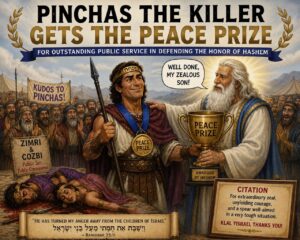
When most of us learned the story of Pinchas as children -even as adults- we pictured Zimri and Cozbi committing their immoral act in the middle of the camp while the entire nation stood around watching. An act of public lewdness. That was the legal concept Pinchas relied on when he took action while they were in the midst of other action, if you chap. And what legal concept might that have been you ask? What law did Pinchas rely on when he decided it’s ok to kill two people? Who was he? Who deputized him? Does halocho mamish authorize private citizen zealots (like Pinchas) to kill people just because there are fornicating in public? Where is this written?
As it turns out, this is one of the most fascinating sugyos (topics) in all of Shas (the heylige Gemora) because Pinchas is not the source of the halocho; he is the precedent. The actual halocho is discussed in the heylige Gemora and codified by the Rambam. Let’s learn the Mishneh. הבועל ארמית — קנאין פוגעין בו
One who has relations with an Aramean (non-Jewish) woman—zealots may strike him.
In plain English: fornicate with any shiksa and a zealot may strike you! Notice what the Mishneh doesn’t say. It doesn’t say that Beis Din executes the man, that he’s sentenced to s’kila (stoning), that he dies from chenek (strangulation), or that he’s subject to malkis (lashes). It simply says: קנאין פוגעין בו – a zealot may harm him (read: kill). This is a completely unique halocho. Then the Gemora immediately identifies the source: הלכה למשה מסיני היא. It is a Halocho l’Moishe mi’Sinai. In other words, Moishe knew this rule but, according to the Gemora, he forgot it at that critical moment. Pinchas reminded him with these words:
אחי אבי אבא, לא כך לימדתני ברדתך מהר סיני: הבועל ארמית קנאין פוגעין בו?
“My master’s brother! Didn’t you teach me when you came down from Har Sinai that one who cohabits with a non-Jewish woman—zealots may strike him?”
Moishe famously replied: קריינא דאיגרתא איהו ליהוי פרוונקא – “The one who reads the letter should be the one to deliver it.” In other words: If you remember the halocho, then you carry it out.
Well, blow me down: Pinchas killed two people and instead of being charged with murder, the RBSO rewarded him with the peace prize? Yes! The heylige Mishneh and Gemora filled in the back story and tell us that Pinchas was authorized because he remembered some ruling that the RBSO taught Moishe during his visit to Mt Siani where the RBSO taught Moishe all the oral laws not recorded in the heylige Toirah? Wow! But Wait! There’s more Gemora: Immediately thereafter mamish, the Gemora begins restricting the rule. It almost takes the halocho away. It tells us this: הלכה ואין מורין כן – “it’s the law—but we do not instruct people to do it.” And then this: If the zealot asks first, “May I kill him?” The answer is effectively: No instruction is given. In other words: no! What kind of a law is that?
Then comes perhaps the most astonishing ruling: Had Pinchas arrived one minute later—he’d be deemed a murderer. Had Zimri stopped one minute earlier, Pinchas would be guilty of murder. Had Pinchas asked Moishe for permission, Moishe would not have instructed him to act. And finally: If Zimri had turned around and killed Pinchas first while Pinchas was coming to kill him… Zimri could claim self-defense, because Pinchas was not acting as an officer of Beis Din (an officer of the court) but under this extraordinary, narrowly confined halachic exception. There may not be another halocho in the entire heylige Toirah whose window of application is measured in seconds.

Aside from Pinchas striking Zimri and Cosbi, the Mishneh’s wording is itself striking. It does not say: מצוה לפגוע בו – It is a mitzvah to strike him. Nor does it say: חייבים להרגו – He must be killed. It merely says: קנאין פוגעין בו – Zealots may strike him. It is describing what a genuine kana’i (zealot) may do in an exceptional circumstance, but not issuing a general instruction to the public.
Why did Chazal choose the expression “קנאין פוגעין בו” instead of “מצוה להרגו”? The answer seems to be that the Toirah is not encouraging vigilantism. Rather, it recognizes an extraordinary, fleeting circumstance in which an authentic zealot, acting solely for the sake of Heaven and within extremely narrow halachic boundaries, may intervene. The Gemora then immediately fences that exception with so many restrictions that it becomes almost impossible to apply outside the singular episode of Pinchas. We might be thinking that the Gemora read how Pinchas was rewarded instead of being charged with murder, and created this back story to make it fit the narrative. Ver veyst?
The bottom line: based on what the Gemora says, Pinchas caught Zimri and Cosbi in the act acted with zealotry. Is that what went down? Not! because that’s not quite what is described. It’s not? The heylige Toirah (Bamidbar 25:6) tells us:
וְהִנֵּה אִישׁ מִבְּנֵי יִשְׂרָאֵל בָּא וַיַּקְרֵב אֶל אֶחָיו אֶת הַמִּדְיָנִית, לְעֵינֵי מֹשֶׁה וּלְעֵינֵי כָּל עֲדַת בְּנֵי יִשְׂרָאֵל…
“And behold, a man from among the Children of Israel came and brought the Midianite woman before his brethren, before Moishe, and before the entire assembly of Israel…”
Imagine the scene. Moishe, Elozor, and the Sanhedrin. The leaders of every tribe. Thousands of Jews crying because twenty-four thousand people are already dying in another related plague brought about by a wild sex orgy involving Midianite and Moabite shiksa whores. Into that gathering in walks Zimri…..holding the hand of Cozbi.
But look at this: The heylige Gemora (Sanhedrin 82b) fills in the astonishing details. It tells us that Zimri seized Cozbi by the hair and marched her before Moishe. Then, in an act of breathtaking audacity, he challenged Moishe:
בן עמרם, זו אסורה או מותרת? ואם תאמר אסורה, בת יתרו מי התירה לך
“Son of Amram! Is this woman forbidden or permitted? And if you say she is forbidden, then who permitted you to marry the daughter of Yisroy?”
He grabbed her by the hair? Was she a willing participant? I thought not until another shtikel Gemora told me that Cosbi was also one of the women involved in enticing the men into the mass orgy combined with avoido zoro which is more fully described in the last few pisukim of Parsha Bolok. I’ve told you many times over these past sixteen years that the RBSO mamish abhors that combination. The bottom line: It could well be that the entire plague could have been avoided had the orgy participants simply stuck to fornicating. Ver veyst!?
Zimri’s argument went azoy: that if Moishe could marry a shiksa (Tzipora was the daughter of Yisroy, a Pagan Priest), then avada he could be with Cosbi. Of course, that argument was false because (we were also taught) that Tzipporah had converted and was fully permitted to Moishe. Why Moishe, who may or may not have known he’s Jewish -whatever that meant many years before Matan Toirah would have Tzipoirah convert, ver veyst, and what conversion looked like before Revelation, also ver veyst, but let’s play make believe.
But Zimri wasn’t looking for a halachic ruling. He was staging a public confrontation. The Gemora then continues with critical words that are often overlooked:
תפשה בבלוריתה והביאה אצל משה
“He grabbed her by her hair and brought her before Moishe.”
Only afterward does the Gemora relate:
הלך שבטו של שמעון אצל זמרי… נכנסה עמו לקובה.
“…he went, together with his tribe… and he entered with her into the qubbah.”
What the hec is a qubbah? A qubbah is generally understood to mean a private chamber or tent. And that detail raboyseyee, changes the entire picture because the actual act did not necessarily take place in the middle of the public square. And yet, we were always taught that Pinchas was innocent of murder davka because Zimri and Cozbi were consorting in public. Es vyst zich ois (it appears from the text of the heylige Gemora) that this was not the case; Zimri was in fact doing a private placement and not a public offering! He went long, his life cut short.

Let’s chazir: We were taught that Pinchas was permitted to kill Zimri because he was mamish committing an act of public immorality. I always pictured Zimri and Cozbi standing in the middle of the camp, engaging in the act before thousands of horrified spectators. But if you read the Heylige Gemora carefully, that’s not exactly the picture it paints. The sequence appears to be:
- Zimri publicly brings Cozbi before Moishe and all of Klal Yisrael.
- He publicly challenges Moishe’s authority.
- He announces, in effect, what he is about to do.
- He then enters the קובה (tent/chamber) with her.
- Pinchas enters the קובה and kills them during the act.
Ah-ha! So, the act of bi’ah (he inside her) itself appears to occur inside the קובה. The heylige Gemora places the actual act inside a קובה—an enclosed chamber or tent—not necessarily in the middle of an open public square.” Indoors! Oib azoy, what was so terrible, and how could Pinchas take it upon himself to kill them? What’s pshat? And the RBSO rewarded him? Zimri was seemingly not fornicating in public! Didn’t we just learn that he entered the qubbah, some tent and was therefore not in public? We did. What’s pshat?
It does then appear that the sin was the public nature of the entire confrontation with Moishe. The publicity lies in the fact that the entire episode was staged as a public act of rebellion. What exactly was public? Seemingly it wasn’t the location of the sin that made it public. It was the defiance. Zimri intentionally transformed a private aveirah (sin) into a national spectacle. He paraded Cozbi before Moishe, before the Sanhedrin, and before the people. He publicly declared his contempt for the Toirah’s prohibition and for Moishe’s authority. Only afterward did he enter the tent. The public chilul Hashem (desecration of the RBSO’s Name) had already occurred.
As an aside, before some of you Gemora experts start complaining, let me put this out there: the Heylige Gemora’s use of קובה certainly indicates an enclosed place, though some exegetes discuss whether it was a private tent, a specially erected canopy, or another type of chamber. So…while the act itself took place inside the קובה, the rebellion and defiance were unmistakably public.
The bottom line: if one is going to have sex with a shiksa, be she a princess or anyone else -Jewish or not- do it privately; you may be punished from above for misbehaving with what’s below but your privates will remain intact and you will live to see another day. That’s because the heylige Toirah does not authorize zealots to hunt this person down. Farkert! Had Zimri quietly committed the same sin behind closed doors, without making a scene, Pinchas could not have touched him. Had he done so, he would have been a murderer. What was unquestionably public was the rebellion. Zimri intentionally marched Cozbi before Moishe, before the Sanhedrin, before the leaders, and before the masses. He publicly announced exactly what he intended to do. He challenged Moishe’s authority. He mocked the Toirah’s prohibition. He transformed a private sin into an act of national defiance. Only then did he retire to the tent. And that distinction is critical because the halocho of קנאין פוגעין בו applies only under these extraordinary circumstances.

The big news in town is not that the Toirah condones vigilantism. It is that the heylige Toirah carved out one exceedingly rare, almost impossible exception when the sin is transformed into a brazen, public rebellion against the RBSO and His Toirah. In other words, it wasn’t the immorality alone that sealed Zimri’s fate. It was the spectacle. It was the challenge. It was the public desecration of the RBSO’s Name. Strip away the public defiance, and Pinchas loses his spear. The halachic takeaway is almost ironic. If one is determined to chap a shiksa, one should not hold a press conference first. Boasting to your friends after, is ok! Veyter…
A gittin Shabbis –
The Heylige Oisvorfer Ruv
Yitz Grossman
Source URL: https://oisvorfer.com/pinchas-2026-when-not-to-hold-a-press-conference/