Netzovim – Vayeilech 2026: What If Failure Was the Plan & The Original Prediction Market
by devadmin | September 3, 2026 8:02 pm
Raboyseyee and Ladies,
A big mazel tov to Miriam and Yonatan Kerstein upon the birth of a baby girl, their first (more to come Im’h). Sorry, no name till Shabbis. A big mazel tov to our friends Malki and Phil Rosen, to great grandmother Sara Leifer and to the entire extended Rosen and Leifer families. Mazel tov as well to the entire Kerstein family, parents, grandparents and great grandparents. Special shout-out to great grandfather Phil and his eishes chayil. May baby Kerstein bring much light, joy and happiness to the entire world.
———————————————————————————————————————
What If Failure Was the Plan & The Original Prediction Market:
Apparently, we’ve reached a point in civilization where people will bet on just about anything. Actually, let me correct that. In 2026, we’re not supposed to call it betting; that’s so yesterday. That would sound crass. It’s now known as the ‘prediction markets.’ Much more sophisticated. You don’t gamble. You trade event contracts. You don’t bet on whether something will happen. You express a probability. You don’t lose money. You simply made an incorrect forecast. Nu. Whatever helps people sleep at night.
The big names are now Kalshi and Polymarket, with Robinhood and other mainstream financial and sports platforms getting deeper into the business. Prediction markets have exploded into a serious financial and cultural phenomenon, with enormous volumes being traded on everything from politics and sports to economics and weather. Robinhood alone reported 13 billion prediction-market contracts traded in the second quarter of 2026. And what exactly are these prediction markets doing? They’re asking a very simple question: What do you think is going to happen? Will something happen? Won’t it happen? Will somebody win? Will somebody lose? Will some event occur before a particular date? And instead of sitting around the shabbis table arguing about it like normal people, you can now put actual money behind your opinion. If arguing with your son-in-law wasn’t expensive enough, now you can lose money doing it. The basic idea is actually fascinating. If a “yes” contract is trading around 70 cents, the market is roughly expressing a 70% probability that the event will happen. The market price is supposed to reflect the collective judgment of everyone participating. Shoin, as they say in Yiddish, it’s a-naya-velt (a new world) and yet another industry born to help thin out our wallets.

But is it? Or, have prediction markets been around before we ever heard of them? We shall explore that below. Because while Kalshi and Polymarket may have turned prediction into a business, the idea of predicting what people will do is not exactly new. In fact, the Ois is making the case -and a strong one- that the Yiddin were hearing about predictions approximately 3,300 years before Wall Street discovered the concept. Who were the original predictors? The RBSO and Moishe Rabbaynu! That’s right. And how many times over these past seventeen years has the heylige Ois told you that Toirah is de-beste-s’choira (loosely translated: there’s nothing like Toirah). Looking for a new business opportunity? Read the heylige Toirah over and again. Study each word and soon enough you too will find a business opportunity. It so happens and these are mamish facts: before there was Kalshi, before Polymarket, before there was an app, before there was some guy sitting on his couch with three screens trying to determine whether a politician will say something stupid by Friday—way before all that, Moishe was already making predictions about the Yiddin. Find them in this week’s double header parshas. And unlike the prediction markets of 2026, Moishe had something even better than an algorithm. He had forty years of data. Moishe knew his market and his people.
Welcome to Parshas Netzovim–Vayeilech, the last parshas we will read before Rosh Hashona. Moishe has been watching the Yiddin for four decades. And what a dataset. He watched them leave Mitzrayim. He watched them cross the Yam Suff. He watched them receive the Munn. He watched them complain about the munn. He watched them complain about the water. He watched them complain about the food. He watched them complain about Moishe. He watched them complain about leadership. He watched them build the Eigel. He watched them listen to the meraglim. He watched them panic. He watched them rebel. He watched them get punished. He watched them do teshuvah. And then, because they were the not-yet-ready-for prime-time-Yiddin, he watched them screw something else up. Again and noch-a-mol (yet again). Had Moishe opened a prediction market on Jewish behavior, he wouldn’t have needed Bloomberg. He had the historical data. He had the track record. He had the sample size. A big one!
And in Vayeilech, mamish the smallest parsha in the entire heylige Toirah with but 30 Pisukim, we get one of the most remarkable predictions in the heylige Toirah. “The RBSO tells Moishe (Devorim 31:16) that after he dies, the nation will turn away from Him, violate the covenant, and worship foreign gods.” The RBSO even says that He knows their inclination before bringing them into the Land. And then Moishe says:
כִּי יָדַעְתִּי אֶת־יִצְרוֹ אֲשֶׁר הוּא עֹשֶׂה הַיּוֹם, בְּטֶרֶם אֲבִיאֶנּוּ אֶל־הָאָרֶץ אֲשֶׁר נִשְׁבָּעְתִּי
“For I know your rebelliousness and your stiff neck” —
כִּי אָנֹכִי יָדַעְתִּי אֶת־מֶרְיְךָ וְאֶת־עָרְפְּךָ הַקָּשֶׁה
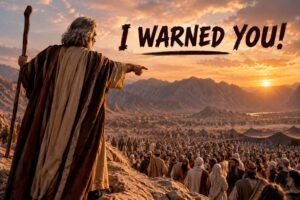
Not: “I have a feeling.” Not: “The market is leaning toward rebellion.” Not: “According to the latest polling, we’re seeing troubling numbers. “Moishe says: “I know you. “And that is where the Heylige Ois starts getting suspicious. Was Moishe just making a prediction? Or was he doing something else? Because here’s the Ois’s thinking: Maybe Moishe was using reverse psychology. Shoin, before the rabbis start sharpening their pencils, relax. I’m not claiming this is the pshat. I’m not claiming Rashi said it. I’m not claiming Chazal sat around the Beis Midrash and announced: Moishe was a master of psychological manipulation. I’m saying that after forty years of dealing with the Yiddin, perhaps Moishe chapped something that modern psychology would eventually give a fancy name: Reverse psychology. You want somebody to do something? Don’t tell him to do it. Tell him you don’t think he’ll do it. Tell him the opposite! Tell a three-year-old: “Don’t touch that” and his hand is already halfway there. Tell a teenager: “You’re probably not mature enough to handle that. “Now she’s prepared a 45-minute presentation explaining why she’s the most responsible human being since Soro Imeinu. Tell any Jew: “You won’t be able to get that deal. “Suddenly he’s calling six stores, three brokers and his brother-in-law’s wife’s cousin who supposedly knows somebody. Why? Because now it’s not about the deal. It’s about proving you wrong. And maybe Moishe knew that. Maybe he chapped that telling the Yiddin to behave and be good wasn’t going to get the desired result. Maybe telling them: Don’t abandon the RBSO wasn’t enough. Maybe he chapped that the more powerful challenge was: “I know you. You’re going to screw this up.” And somewhere in that crowd, perhaps one Yid was thinking: “Excuse me? Who are you talking about?” And another was thinking: “Moishe, with all due respect…” Watch us! The bottom line: Moishe chapped that Yiddin will always do the opposite of what’s being asked or demanded of them. Could that be pshat? Ober….if it is pshat, we have a shtikel issue, a problem mamish, because Moishe wasn’t making this prediction alone. The RBSO knew too. That’s what makes Vayeilech so uncomfortable. The RBSO tells Moishe exactly what is going to happen. The Yiddin will turn away. They will violate the covenant. They will worship other gods. And trouble will follow. The heylige Toirah tells us that when the troubles eventually arrive, the song Moishe is commanded to write (next week’s parsha), will serve as a witness because the people will have been warned in advance.
This leaves the heylige Ois with a much bigger question. If taka, the RBSO already knows we’re going to fail, why are we punished for failing? Think about that one. If the RBSO knows today that tomorrow I will make a particular decision, can I really make the opposite decision? If I can choose differently, then the RBSO’s knowledge could be wrong. Say it’s not so, please. And if I can’t choose differently, then what exactly does free will mean? Oy vey. Shoin, we started with Kalshi and somehow ended up in the Rambam. It’s mamish the classic pandora’s box. These are questions I should likely not be asking days before the RBSO gets ready to decide my fate; oy vey.
Shoin let’s unravel this but before we go veyter. Let us first differentiate between KALSHI and the RBSO. A prediction market doesn’t actually know the future. It calculates. It aggregates. It estimates. If the market says 70%, there is still a 30% chance it will be wrong. That’s what makes it a market. But the RBSO? We’re talking about Divine knowledge. No probability. No 63%. No 82%. No “the market moved five points overnight.” The RBSO knows, case closed. It’s 100%.

And now we’re staring directly into one of the oldest theological problems in Judaism: How can Divine foreknowledge coexist with human free will? As expected, many exegetes take this problem seriously. The words of our parsha have forced generations of commentators to grapple with the difficulty of the RBSO’s knowledge of future events that depend on human choice.” All that said, says the Rambam -very emphatically- that we humans have free choice. He writes that a person has the ability to choose the path of good or evil and that nobody forces him into one path or the other. What about the apparent contradiction between The RBSO’s knowledge and human choice? Says the Rambam that the RBSO’s knowledge is fundamentally beyond our comprehension—but human responsibility remains real. In other words: Both concepts are emes. How they fit together, ver veyst? Where is it written that we are to understand everything? Nowhere! Do you understand half the stuff your wife says and does? Or, she you? Shoin! Taka a very Jewish idea and that’s just how it is. Go prove otherwise.
And that said, were the Yiddin set up to fail? Let’s make the question even more uncomfortable. The RBSO created human beings. He gave us a yetzer horo. He gave us desires, egos, jealousy, anger, ambition, and appetites. Along with the remarkable ability to convince ourselves that whatever we want to do is actually a very reasonable thing to do. Then He gave us the heylige Toirah. 613 mitzvis. Warnings. Consequences. And teshuvah (repentance). And He already knew we’re going to screw up. So what’s the expectation? Perfection? Clearly not! Because if perfection were the standard, the RBSO could have saved everybody a lot of time. The heylige Toirah seems to understand something we sometimes forget: Human beings fail. Failure is built into our DNA; it’s how we are programmed from the Master Programmer. The question is what they do afterward. And here’s where maybe the prediction was the test. Here’s where our reverse-psychology theory gets really interesting. What if Moishe’s prediction wasn’t intended to tell the Yiddin: You’re doomed. What if it was intended to tell them: I know your tendencies. Now prove me wrong. That’s very different. Because there are two ways to hear: You’re going to fail. One person hears: Why bother trying? Another hears: The hell I am. And if you know the Yiddin, which reaction would you expect? Exactly. The second one. Mistama Moishe chapped that. We may kler (think) that after forty years he understood that the Yiddin did not respond particularly well to being told what to do. Heck, they didn’t respond after 30 days; remember that eygel? They did however respond much better to being told what they couldn’t do. We should efsher not dismiss the possibility that Moishe’s final prediction was also a challenge. Think about how much of Jewish history is powered by this attitude. Someone says: “You can’t” and the Yid answers: “Watch me.” Someone says: “That won’t work.” Watch me. Someone says: You’ll never make it. Watch me! You people won’t survive. And 3,300 years later…Well, let’s just say the prediction didn’t age particularly well. Maybe that’s the Jewish superpower. We’re stubborn. We’re argumentative. We’re impossible. We ask too many questions. We don’t always listen. We occasionally drive our leaders crazy. But we also refuse to accept somebody else’s prediction about who we are. And perhaps that is exactly what Moishe was counting on? Why not?
And with that, let’s dig tiffer (deeper). Maybe the RBSO didn’t create a nation that was expected to be perfect. Maybe He created a nation that would struggle. A nation that would fall, a nation that would argue. A nation that would complain. A nation that would sometimes rebel. And also a nation that would return. That’s why teshuvah is so central. It’s part of the cycle. Because if human beings were expected to be perfect, we wouldn’t need teshuvah. The existence of teshuvah itself tells us something profound: The system anticipated failure. Thankfully, most of you (to include the Ois himself) are not disappointing the system!
The question was never whether people would screw up; the question was whether they would stay down. And perhaps Netzovim–Vayeilech is being read at precisely the right time of year to remind us of that. We know our patterns. We know where we’re likely to fail. We know what makes us angry. We know what makes us jealous. We know where our patience disappears. We know what promises we made last Rosh Hashono; some of us even remember them. And some of us have been making the same promises for so many years that they’ve now become family traditions. But here’s the point: Knowing your history doesn’t mean your history owns your future. The RBSO may know us better than we know ourselves. Moishe knew the Yiddin. But neither fact means that we are excused from trying. The Rambam makes the point very clearly: human choice is real, and people are judged according to their actions. So perhaps the challenge isn’t to become a completely different person tomorrow. That’s not realistic. Fuhgeddaboudit! Perhaps the challenge is: Know where you usually fail—and do something different this time.
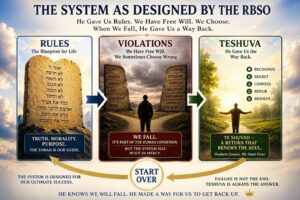
It’s gantz shayich (likely) that we’ve been looking at the Toirah’s system backward. We’ve been asking why the RBSO created a people He already knew would fail. Maybe the better question is: What if He created a system specifically because He knew we would fail? Think about that for a moment. If the RBSO knew from the beginning that human beings would screw up, and taka, the words from our parsha make it pretty damn clear that He did, then perhaps the expectation was never perfection. Perhaps the expectation was teshuvah (repentance). The system comes with its own reset button. We sin. We screw up. We make bad decisions. We hurt people. We disappoint ourselves. We sometimes disappoint the RBSO. And then comes the remarkable part: We get another chance. Not once. Not twice. Every year. Rosh Hashono arrives and suddenly we’re back at the starting line. Then comes Aseres Yemei Teshuvah. Then Yom Kippur. We stand in shul for hours, beating our chests, confessing sins that we may have committed, sins we may have forgotten, sins we committed accidentally, sins we committed deliberately, sins we committed knowingly and sins, we do so often and with such regularity- that we probably convinced ourselves weren’t really sins at all. And then, somehow, we walk out the door and the slate is clean? Or at least we’re told that it can be. Mamish gishmak.
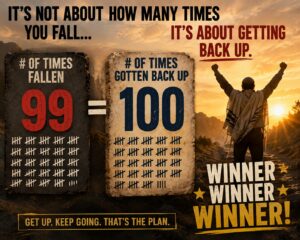
That’s not a minor feature of Judaism. That’s the system. Maybe the RBSO doesn’t expect us to spend seventy, eighty or ninety years without screwing up. Maybe He expects us to spend those years learning what to do after we screw up. Suddenly Moishe’s words sound very different. The RBSO tells Moishe that the people are going to fail. Moishe knows they’re going to fail. And yet G-d doesn’t say: “Therefore, there is no point. Farkert! The Toirah continues. The covenant continues. The Jewish people continue. And eventually, so does teshuvah. Maybe the message is not: “Don’t ever fall. “Maybe the message is: “When you fall, get the hell back up.”
And that may be one of the most remarkably glorious aspects of our beautiful religion. The RBSO and His heylige Toirah understand something about human beings that we sometimes forget: People are complicated. We can sincerely love G-d and still screw up. We can know something is wrong and do it anyway. We can make the same mistake twice. We can promise ourselves that this year will be different and discover three months later that apparently it isn’t. We can stand on Yom Kippur and make promises that we genuinely mean—and then remain imperfect human beings afterward. The Toirah doesn’t seem shocked by any of this. It anticipated it. It did?! The Ois admits: When I began writing this, I mamish thought I was on my own and would field a bevy of complaints, but guess what? I have proof that I may be correct. According to our very wise Sages, even before the RBSO created the world, teshuvah was already there. What? Before there was a human being to sin, there was already a mechanism for returning from sin. Before Odom ate the forbidden fruit, before Kayin screwed up, before the Dor HaMabul, before Avrohom, Before Mitzrayim, before Sinai, before the eygel, before Moishe, and long before us, teshuvah was already waiting. It was there awaiting our sins. Mamish amazing! Says who? So says the heylige Gemora (Pesochim 54a) —and I checked the actual text.
“Seven things were created before the world was created: Toirah, teshuvah, Gan Eden, Gehinnom, the Kisei HaKavod, the Beis HaMikdash, and the name of Moshiach.”
“תשובה… נבראת קודם שנברא העולם”
“Teshuvah was created before the world was created.”
Wait, there’s more because the heylige Gemora gives its proof from Tehillim 90:2–3: “Before the mountains were brought forth, or ever You had formed the earth and the world… You return man to contrition; and You say: Repent, children of man.”
And read this: Pirkei DeRebbe Eliezer 3 describes the RBSO planning creation and says the world could not stand until G-d created teshuvah.
It’s taka emes that Chazal do NOT say that the RBSO created teshuvah before the world because He knew the Jews were going to sin. That’s the Ois’s interpretation/application of the Gemora. Nu, I ask you this: Why would teshuvah need to exist before there was anybody around to sin?
And the bottom lines: Maybe taka the RBSO didn’t create a perfect world and then have to invent a solution when humans ruined it. Maybe the possibility of failure—and the possibility of returning from failure—was part of the architecture of creation from day one. If teshuvah was created before the world, was sin also somehow part of the plan? Now that’s a question worth asking a few days before Rosh Hashono.
Teshuvah doesn’t require us to pretend we were never broken. That we stumbled and fell. It asks us to acknowledge that we did. The bottom line of the system may be this: Fail. Repent. Reset. Begin again. Perhaps that’s not a flaw in the system; it is the system.
Grada, many many years ago, I heard the great Mordy Davis of D.H. Blair, say these words: “The difference between a winner and a loser is that the winner gets up one more time than he falls down.” I never thought I’d be connecting that piece of Wall Street wisdom to the prediction markets and Moishe in our parsha but perhaps that’s exactly what the Toirah is teaching us. We all fall. Some of us fall harder than others. Some of us make bigger mistakes. Some of us repeat the same mistakes so many times that even we get tired of hearing ourselves apologize for them. The question isn’t whether we fall. The question is whether we get back up. And suddenly teshuvah looks a lot less like a religious punishment and a lot more like the ultimate Jewish version of what Mordy taught me. You fell? Get up. You screwed up? Own it. You hurt somebody? Make it right. You disappointed yourself? Try again. You promised last Yom Kippur that you’d do better and didn’t? Fine. Yom Kippur is coming again. That’s not permission to keep screwing up. It’s something much more powerful: It’s permission to refuse to be defined by the screw-up. Maybe that’s why the heylige Toirah can tell Moishe, before he even dies, that the Jewish people are going to fail. Failure is not the end of the story. The end of the story depends on what you do next. The winner isn’t the person who never falls; the winner is the person who gets up one more time than he falls down.
A gittin Shabbis –
The Heylige Oisvorfer Ruv
Yitz Grossman
Source URL: https://oisvorfer.com/netzovim-vayeilech-2026-what-if-failure-was-the-plan-the-original-prediction-market/