Mattos – Massei 2026: The First Shiksa in the House?
by devadmin | July 9, 2026 8:45 pm
Raboyseyee and Ladies,
The First Shiksa in the House?
It is mamish well known that many (kimat all) Jewish households – especially those with children, grandkids, guests every Shabbis, twelve bedrooms, three kitchens, multiple freezers, and a laundry room that looks like a commercial operation, have at least one shiksa in the house to help out. Some in Lakewood and Tom’s River are more machmir; they have two.
Some come every day. Some come twice a week. Some live in. Some only appear before Pesach, when the kitchen suddenly requires a staff larger than the crew that built the Mishkan. Some help with cooking, cleaning, laundry, children, shopping, beds, dishes, folding, organizing, and locating things that the husband swears were “right here a minute ago.”
As the heylige Gemora would say, Kilu alma loi פליגי. And taka, no one is arguing: help in the house has become part of modern Jewish life Families have gotten used to it. Very used to it. Ober where did this all begin? Is having a shiksa in the house merely a minhag? Is it a modern necessity? Is it a luxury? Is it, by now, a din? And more importantly: does the heylige Toirah have anything to say about it? Mistama you are thinking: Of course not. The heylige Toirah has plenty to say about korbonis, kashrus, Shabbis, tumah, taharah, marriages, divorces, damages, lost objects, oxen that gore, pits that swallow, and what happens when your neighbor’s animal eats your crops. Ober cleaning help? A shiksa who comes Tuesday and Thursday and leaves just before Shabbis? What could that possibly have to do with Parshas Mattos–Massei?
Nu, hold onto your dustpans and mops. Because this week’s parsha may contain the first mass arrival of non-Jewish female help into the Jewish camp. Not one Egyptian shifchah (maid) like Hogor in Soroh Imeinu’s home. Not Bilhah and Zilpah in Yaakov Ovenu’s tents. Not a lone woman helping with laundry in Chevron or Shechem. I’m talking Thirty-two thousand! Yes, raboyseyee: Our parsha describes how and when 32,000 Midianite females were brought into the Jewish camp after the war with Midian. They were counted, divided, and distributed between the soldiers, the nation, and the Levi’im. As mentioned, you can of course read all about them and how they got there in the parsha and of course the heylige Ois will refresh your memories as if you learned this sugyo just yesterday.
Were the Midianite shiksas the first helpers in Jewish homes? The answer is: not exactly. The heylige Toirah did not invent domestic help in Parshas Mattos. As mentioned, our forefathers had servants long before the Midian war. Hogor was Egyptian. Bilhah and Zilpah were shfachos. Ober 32,000 at one time? En masse? Were they illegal immigrants? That’s not help; that’s a labor force. That’s an entire defeated female population suddenly entering the Jewish camp after a war. And here is where the jokes end, because the questions become serious. What happened to them? Were they servants? Slaves? Captives? Converts? Future wives? Sex toys? Workers in Jewish homes? If they were assigned to soldiers, to families, and to the Levi’im, there must have been some purpose. Did they remain Midianite? Did they later convert? Become second wives? Pilagshim? Did anyone explain Shabbis, kashrus, or that Baal Pe’or was no longer an acceptable topic of conversation at the dinner table? Shoin, now that your collective curiosities have been piqued -of course when you read about 32k shiksas, you must be wondering- let the Ois do some chazoro before we go veyter.
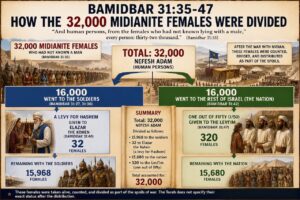
Here are the relevant pisukim. Says the heylige Toirah in Bamidbar 31:35, azoy: וְנֶפֶשׁ אָדָם מִן־הַנָּשִׁים אֲשֶׁר לֹא־יָדְעוּ מִשְׁכַּב זָכָר כָּל־נֶפֶשׁ שְׁנַיִם וּשְׁלֹשִׁים אָלֶף׃ “
And human persons, from the females who had not known lying with a male—every person: thirty-two thousand.” We will soon address what this “had not known lying with a male” means.
Note the Toirah calls them נֶפֶשׁ אָדָם — nefesh odom, human persons. What happened next? Half went to the fighting soldiers; they became war booty. Let’s read Bamidbar 31:36, 40–41
וַתְּהִי הַמֶּחֱצָה חֵלֶק הַיֹּצְאִים בַּצָּבָא… “The half, the portion of those who went out to the army, was…” Then the Toirah lists the animals and concludes: וְנֶפֶשׁ אָדָם שִׁשָּׁה עָשָׂר אָלֶף׃ “And human persons: sixteen thousand.” From that military half: וַיִּתֵּן מֹשֶׁה אֶת־מֶכֶס תְּרוּמַת יְהוָ לְאֶלְעָזָר הַכֹּהֵן כַּאֲשֶׁר צִוָּה יְהוָ אֶת־מֹשֶׁה׃ “ – Moishe gave the levy, the offering to Hashem, to Elazar the kohen, as Hashem commanded Moishe.” The specific human levy is stated in posik 40:
וְנֶפֶשׁ אָדָם שִׁשָּׁה עָשָׂר אָלֶף וַיְהִי הַמֶּכֶס לַיהוָ שְׁנַיִם וּשְׁלֹשִׁים נָפֶשׁ׃
“And human persons: sixteen thousand; and the levy for Hashem was thirty-two persons.” The other as described in 41:42-47 went to the congregation וּמִמַּחֲצִת בְּנֵי יִשְׂרָאֵל אֲשֶׁר חָצָה מֹשֶׁה מִן־הָאֲנָשִׁים הַצֹּבְאִים׃ “
And from the half belonging to the Children of Israel, which Moishe divided off from the men who went out to war…” That half also contains: וְנֶפֶשׁ אָדָם שִׁשָּׁה עָשָׂר אָלֶף׃ “And human persons: sixteen thousand.” Then: וַיִּקַּח מֹשֶׁה מִמַּחֲצִת בְּנֵי־יִשְׂרָאֵל מִן־הָאָחֻז אֶחָד מִן־הַחֲמִשִּׁים מִן־הָאָדָם וּמִן־הַבְּהֵמָה וַיִּתֵּן אֹתָם לַלְוִיִּם שֹׁמְרֵי מִשְׁמֶרֶת מִשְׁכַּן יְהוָ כַּאֲשֶׁר צִוָּה יְהוָ אֶת־מֹשֶׁה׃ “
Moishe took from the half of the Children of Israel, from the portion taken—one out of fifty—from the people and from the animals, and gave them to the Levi’im, guardians of the charge of Hashem’s Mishkan, as Hashem commanded Moshe.”
So the math is azoy:
32,000 surviving Midianite females’ total.
16,000 were allocated to the soldiers. From these,
32 people were a one-in-500 levy for Hashem, given to Elazar the Kohen.
16,000 were allocated to the rest of the Jewish people. From these, 320 people were a one-in-50 allocation given to the Levi’im.
Ok, let’s review what happened here? The pisukim unmistakably tell us that the females shiksas were taken alive, then divided as part of the spoils, and that portions of the 16,000 not given to the soldiers, were given to the Koihen and Levi’im. Note that the pisukim do not share with us the precise legal or domestic status of the females after that distribution. The Toirah is mamish silent. What became of them? And all the other questions we asked above? The Ois asks these detailed questions davka because this week’s double-header of Parshas Mattos–Massei are mamish overflowing with material. We have nederim (vows), shvuos (similar), tribes negotiating real estate deals before the Yiddin even cross into the Promised Land, cities of refuge, accidental killers, border disputes, land distribution, zoning issues, and the daughters of Tzelofchod getting the first major inheritance ruling in the heylige Toirah. And then we have hundreds and hundreds of pages filled with commentary from the heylige Gemora, medrish and so many others. Ober, when it comes to the 32,000 shiksas now distributed, roaming about among the Yiddin, kimat not one word about their lives once divvied up? That’s the strange part. The Yiddin took captives, brough them back and then dispersed them among those listed above. And no one has anything to share? Let’s further investigate.
Shoin, to chap this subject, we need to review the war the RBSO declared against the Midianites when He told Moishe: “Nekiom nikmas Bnei Yisroel mei’es haMidyanim.” (Take revenge for the Bnei Yisroel against Midian). Ober, Moishe tells the people something slightly different: “Laseis nikmas Hashem b’Midyan.” (To carry out Hashem’s revenge against Midian). Which is it? Jewish revenge or the RBSO’s revenge? The answer, says the medrish, is that Midian had managed to offend both parties. The Yiddin had plenty to be angry about. Twenty-four thousand of them had died after the disaster at Baal Pe’or. And the RBSO was, avada, not thrilled that Midian had helped entice the Yiddin into the toxic combination of immorality and avoido zoro. The Midianites did not merely throw a bad party. They helped engineer a national catastrophe. A mass orgy with many thousands of Jewish participants. And taka, this creates a side question. Last week we learned about Moav and the Moabite women who appeared in the story. Weren’t they the whores? So why is Midian getting the full military treatment? Noy to worry because our sages explain that the Midianites were the driving force behind the plot. Moav had its own interests, its own fears, and its own problems. Midian, says the medrish, was more ideological. They were not merely looking to trip up the Yiddin; they wanted to detach them from the RBSO. They were not content with ordinary temptation. They wanted the full package: desire, idolatry, and humiliation. They go that! They almost got national collapse until Pinchas did what he did.
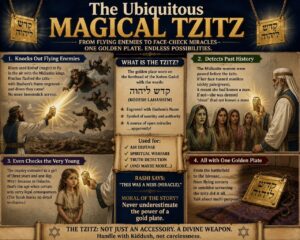
Nu, the war begins. Moishe sends one thousand men from each sheyvet. Twelve thousand soldiers. Another 12,000 sated back to learn and daven, and in case you didn’t know, the entire debate about Charedim serving in the army harkens back to this week’s parsha. That for another day. Moishe sends Pinchas ben Elozor hakoihen with them, together with klei hakoidesh (holy vessels) and the trumpets for sounding. Was Pinchas the general? The heylige Ois has so referred to him in the past ober the posik does not exactly say so. Moishe is clearly directing the campaign. But Pinchas is there in a very special role. He is now the newly appointed koihen who had just stopped the plague after he speared and killed Zimri and Cozbi. He goes to war carrying sacred vessels and trumpets. In other words, this is not your ordinary desert skirmish over grazing rights; this is a war with religious baggage. The Yiddin win. Of course they won; no one loses a war when the RBSO is on one’s side. They killed the five Midianite kings. They killed Bilam with the sword. They captured livestock, property, women, and children. They burned the cities. They returned to the camp with what appeared to be a complete victory. And then the story becomes very strange. Before getting there, however, we need to discuss Bilam’s exit from the war, because the heylige medrish is never content to let the rosho (bad guy) die in a normal manner. Says Rashi, quoting the Medrish Tanchuma, that the phrase “u’klei hakoidesh”—the sacred vessels that Pinchas took along, refer to the Aron and the tzitz, the golden plate worn on the forehead of the Koihen Gadol. Why did Pinchas need the tzitz? Was he the koihen Godol? He was not! Nu, it’s medrish; not every question needs a legit answer. For this medrish to work and tickle the imagination of young yeshiva boys, he was the koihen godol; why else would he have access to the tzitz? Veyter! In any event, the tzitz was in play because, says the medrish, Bilam was there using kishuf (magic). He made himself and the Midianite kings fly in the air. Think Harry Potter and earlier broomstick flying characters like the Wicked Witch of the West, and Baba Yaga. Bilam was apparently attempting the first recorded airborne escape from a Jewish military operation. Pinchas then flashed them the tzitz, upon which Hashem’s Name was engraved, and they fell from the sky onto the slain below.
The bottom line: Beware of the flashing tzitz! And anything that sounds like it. Some have taka fallen upon such a sighting, others have risen, if you chap. Ober the Targum Yoinoson -he with the most vivid imagination of all exegetes the Ois reads regularly- gives us an even better version. Bilam sees Pinchas pursuing him and takes off into the air using drone like magic. Pinchas then pronounces a Divine Name, flies after him, grabs him by the head, pulls him down, and prepares to kill him. Bilam begins negotiating. He promises never again to curse the Yiddin. Pinchas replies, in effect: “Too late. You were Lovon, you tried to destroy Yaakov, you went down to Mitzrayim, you stirred up Amolake, you tried cursing us, and when that did not work, you advised Bolok how to destroy us through Pe’or. You are done, over, and kaput.” And then Pinchas kills him. Pinchas is good at killing. Did Bilam really fly? Did Pinchas really fly after him? Was the tzitz the forerunner of the anti-sorcery missile-defense system? Of the first drones? Ver veyst? The medrish is certainly telling us that Bilam’s danger was never merely his mouth. He was a man who used every weapon available in his armamentarium —prophecy, manipulation, sorcery, seduction, and politics—to weaken the Yiddin. It worked! Shoin. The war is won. The troops return. And Moishe is not pleased. The soldiers had killed the Midianite men. They had captured the women and children. Perhaps they thought that women and children who had not fought were innocent bystanders. Plausible. Perhaps they thought they had done the decent thing; maybe they were tired of killing. Maybe they thought the war was over. Ober, Moishe sees the captives and says: “Hachiyisem kol nekeivah?” (Did you keep all the women alive?) He then explains that these were the women who, on Bilham’s advice, had caused the Yiddin to betray the RBSO at Pe’or by joining the mass orgy combined with some idolatry. He orders the killing of every male child and every woman who had known a man. The females who had not known a man were to be kept alive. As an aside, which women really does know her man?
And before anyone rushes through those pisukim with a quick vort and a glass of schnapps, know ye that the words are difficult. They are supposed to be difficult. The heylige Toirah does not tell us that every adult Midianite woman personally participated in Pe’or. It tells us that the women had been involved in the catastrophe and that Moishe gave an order that no modern reader can comfortably glide past. The boys are killed. The women who had known a man are killed. And those who had not known a man are spared. But then comes the one question which our Sages themselves had to ask: how did anybody know which women knew a man?
The posik does not say that soldiers conducted inspections. It does not say that relatives testified. It does not say that someone checked birth certificates, assuming Midian had a local DMV branch in the desert. It simply gives a category: women who had not known mishkav zachar—sexual relations with a male, would live to see another day or many. Shoin, the heylige Gemora (Yevomis) gives an answer so bizarre that it makes the whole story even more unsettling. Says Rav Chana bar Bizna in the name of Reb Shimon Chasida: the Midianite women were passed before the tzitz. The woman whose face turned morikos—a sickly pale or greenish color—was identified as one who had known a man. The one whose face did not change was deemed not to have known a man. (On that day, it was good to be a lesbian.) In other words, the tzitz was not merely used to knock flying Bilam and his kings out of the sky. It was now being used as a miraculous detector of sexual history. Rashi says plainly that this was a miracle. No kidding. And if that weren’t enough, the heylige Gemora adds a line which should make every reader stop. The inquiry extended even to a girl of three years and one day. Why? Because in halacha, that is the age at which intercourse can carry certain legal consequences. Below that age, the act does not have the same halachic status for particular laws. How three-year-olds were sexually active and perhaps involved with other Midianite girls at the orgy scene, ver veyst? Shoin, it’s only the remora quoting a medrish. OMG! Let the Ois be very clear: this is not a joke, not a loophole, and not an invitation for you oisvorfs to say something clever; I am quoting the heylige Gemora and other reliable sources. The Gemora is confronting a terrible reality. In the aftermath of war, even very young girls may have been subjected to things no child should ever experience. They all need Tzitz clearance. Chazal were not naïve about what armies and conquerors do to captives. They understood why the question had to be asked.
And yet, after the tzitz has done its work, the parsha becomes even more haunting and let’s get back to the 32,000 shiksas who had not known a man. The heylige Toirah gives us the number. It gives us a division. It gives us a miraculous procedure for determining which females were spared. They are counted as part of the booty. Along with sheep, cattle, donkeys, gold, and property, there are 32,000 human beings. Half go to the soldiers who fought. Half go to the rest of the nation. From the soldiers’ half, thirty-two are taken as a levy for Elozor hakoihen. From the nation’s half, three hundred and twenty are given to the Levi’im. Read that again slowly. The heylige Toirah tells us they lived. It does not tell us how they lived. Were they servants? Captives placed into Jewish households? Converts? Future wives? Domestic workers? Were they freed after some period? Did any of them become part of Jewish nation? Did any of them marry? Did any of them live out their years in a Levite city? Did any Midianite girl grow old and tell grandchildren that she once lived in a place called Midian, before her entire world disappeared?
The heylige Toirah does not say. And taka, perhaps this is the strangest part of all. The war against Midian was launched because Midianite women had become the vehicle through which the Yiddin were pulled toward Pe’or, immorality, and avoido zoro. The Yiddin win the war, destroy Midian’s cities, and then bring 32,000 surviving Midianite females inside the very camp they had allegedly tried to corrupt. If they became servants in Jewish homes, and the posik gives us no other clear picture, who made sure they were treated properly? Who made sure they did not remain captives forever? Who made sure the Jewish camp did not import the very spiritual danger it had just gone to war against? The heylige Toirah tells us about purification from tumah after the battle. It tells us how to divide the spoils. Ober it gives us no social-integration manual, no domestic-help handbook, and no follow-up report from the first Jewish household that suddenly had a Midianite girl doing the laundry. Our many exegetes who typically tell us so much about so many things, have remarkably little to say about what became of them. They tell us that Bilam flew. They tell us that Pinchas flew after him. They tell us that the tzitz made a woman’s face turn pale. They tell us the precise halachic age at which the inquiry mattered. They tell us that the thirty-two given from the soldiers’ portion were not human sacrifices, chas v’shalom, but were assigned to sacred service through the kohanim and Levi’im. Imagine that: they had jobs assisting the kohanim and levi’im; wow! Ober after that? Almost gornisht.
This is mamish the gevaldige kasha. Our sages were never shy. Give them one extra letter, one missing vov, one strange word, one anonymous person walking down a road, and within ten minutes they know his name, his mother’s name, what he ate for breakfast, what he was thinking, and which gilgul he came back from. Bilam flew? They tell us how. Pinchas flew after him? They tell us which Shem (holy name) he used. The tzitz detected a woman’s sexual history? They tell us whose face turned green and why. A girl three years and one day? They give us the exact halachic cutoff. Ober thirty-two thousand Midianite females are taken captive, brought into the Jewish camp, divided between soldiers and civilians, with thirty-two handed to Elazar hakoihen and three hundred and twenty to the Levi’im—and what happened next? Crickets. No Medrish about the first Midianite girl who learned to light Shabbis candles. No Medrish about the one who became the best cook in the tribe of Zevulun. No Medrish about the one assigned to a Levi family who asked what the Aron was. No Medrish about conversion, marriage, freedom, servitude, children, grandchildren, or even where they slept on night one. Mamish nothing. Thirty-two thousand Midianite girls enter the Jewish camp. They are counted. They are divided. And then they vanish from the literature. No names. No stories. No medrish about the first one who converted. No story about the one who became a righteous Jewish mother. No description of where they slept that first night. No happy ending. Is that the point? Ver veyst?
We often say that the Toirah has an answer for everything. Maybe it does. But not every answer comes packaged with a comforting ending, a neat explanation, and a children’s-book illustration. War is not clean. Even a war described by the Toirah as nikmas Hashem -the RBSO’s revenge, leaves behind bodies, captives, grief, terror, property, paperwork, and human beings whose futures are no longer their own. The Toirah does not hide the inventory. It makes us count it. Thirty-two thousand. Not “many.” Not “a group.” Not “some survivors.” Thirty-two thousand nefashos. Might we kler that the heylige Toirah gives us the number precisely because it refuses to allow us to turn war into a heroic movie with trumpets, flying villains, and a happy ending. Yes, there were trumpets. Yes, according to the medrish, there was even a flying Bilam. But after the supernatural excitement ends, there are still thirty-two thousand girls whose lives have been reduced to a line item in a military report.

The bottom line: The Toirah describes a divinely commanded and exceptional war in an ancient world. It does not give any modern person permission to use Midian as a license for cruelty, collective punishment, captivity, or exploitation. Nor does it likely give Charedim a free pass in our times. There is no contemporary Pinchas with a sword, no private army with a magic tzitz.

Chazak, Chazak, V’nischazake and a gittin Shabbis!
The Heylige Oisvorfer Ruv
Yitz Grossman
Source URL: https://oisvorfer.com/mattos-massei-2026-the-first-shiksa-in-the-house/