Lech Lecha 2026: Who Converted the First Convert?
by devadmin | October 22, 2026 3:00 pm
Raboyseyee and Ladies,
Who Converted the First Convert?
This week’s heylige Toirah is being written in flight.
Nu, if you spend any time on Instagram, you know that these days privacy is practically a character flaw. Someone gets engaged, buys a house, loses ten or more pounds, has a baby, or decides to become Jewish, and before you can say mazel tov, the whole world has been informed. There are photographs, videos, emotional announcements, and hundreds of comments from people, many of them complete strangers. The bottom line: Why have a private life when you can have followers?
And lately, we have been seeing some remarkable stories of people who were not born Jewish, but have chosen to become Yiddin. Have they fallen on their heads? Ver veyst? In a world where being Jewish can invite hostility, choosing to join the Jewish people is no small matter. One can be cancelled and worse! These are not decisions to be treated lightly, and zicher the heylige Ois has no intention of making fun of anyone’s sincere journey. Farkert! Ober, the stories raise a fascinating question: What makes someone look at the Jewish people—with our history, our obligations, our arguments, and our more-than-occasional mishpocho dysfunction—and say, “I want to be part of that”? Shoin, one can only imagine what they’re coming from!

One recent example – and there are many- is Adriana Fernandez, known online as the “Non-Jewish Nanny.” Her videos about life with observant Jewish families introduced viewers to a world she eventually chose to join. After completing an Orthodox conversion, she became Adina Shoshana, and her online identity changed to the “Now-Jewish Nanny.” Interestingly, the conversion process itself had been private. The announcement was public; the work that led to it was not. Her story does not prove that Instagram is producing a nationwide stampede toward conversion, but it does demonstrate that exposure can lead to curiosity, and curiosity can lead somewhere unexpected. In her case and mistama in others to follow, conversion to an orthodox lifestyle also came with instant parnoso (livelihood). In very short order, she figured out the Jewish way: Get free stuff and get paid as well: Good for her! But some of the benefits of a frum Jewish lifestyle for a talented individual. Opportunities await those willing to enter. Her story, and others like it, bring us to this week’s parsha, Lech Lecho, and a question that predates Instagram by a few thousand years: Who was the first convert?
If you spent any time in the yeshiva system, you will mistama answer immediately: Avrohom Oveinu! The heylige Gemora calls him techilah la-gerim, the beginning of the converts. Yes, convert number one. Excellent! Give yourself a pat on the back. Something survived all those years in yeshiva; your parents should feel some relief over all the tuition monies spent on your education. That said, most of the monies spent remain aroisgivorfine gelt (money in the toilet)!

Ober, not so fast. If Avrohom was the first convert, who converted Avrohom? Did he fill out an application? Did he appear before a beis din? Were the officiating rabbis Orthodox? RCA-approved? Was there a mikveh? And who signed the certificate? More importantly, when Avrohom was 75 and left Choron, the heylige Toirah had not yet been given. Yetzias Mitzrayim was still generations away. There was no Jewish nation as we would later know it, and no established conversion system as we understand it today. Avrohom himself would not receive the commandment of bris milah (circumcision) until he was 99. Read all about the instruction and actual bris in next week’s parsha. So, what exactly was happening during those intervening years? And what did our sages mean when they called him techilah la-gerim? Surprisingly, no medrish has him sitting in a classroom at the famous Yeshivas of Shem and Ever during those 24 years taking notes and preparing for his final.
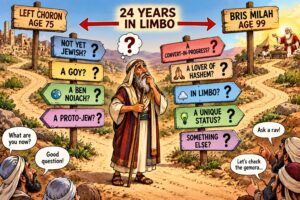
But that’s only kasha number one. Here comes another, perhaps even more interesting: Who wrote the conversion manual? Who took the RBSO’s commandment to Avrohom to perform a bris, and how did we get from there to the process we recognize today, with its learning, acceptance of mitzvis, beis din, mikveh, and, for a male who has not been circumcised, a bris? Who decided what had to be learned, what had to be accepted, who had to supervise, and what had to happen before someone could officially join the Jewish people? Was there an original committee? Who appointed them? And where, for heaven’s sake, are the minutes of the first meeting? Who made all this up? When?
Before we answer, let’s address the terminology. What was Avrohom’s status between the time he left Choron at 75 and his bris at 99? Was he still a Ben Noiach? A Ben Noiach literally means a “son of Noiach,” and the term refers to a non-Jew who is obligated to observe the Seven Noahide Laws. After the Mabul, the RBSO established a basic framework of obligations for humanity: justice, the prohibition against blasphemy, the rejection of idolatry, prohibited sexual relationships, the prohibition against murder, the prohibition against stealing, and the prohibition against eating a limb taken from a living animal. These are the Sheva Mitzvis Bnei Noiach.
Now, does that settle Avrohom’s status? Not quite. Avrohom lived before Matan Toirah, before the Jewish nation came into existence as a nation under the RBSO’s guidance, and before the later halachic framework of geirus was fully articulated. He recognized the RBSO, rejected avodah zoro, and devoted his life to teaching others about the RBSO. We must avada be careful about taking the rules that Chazal later discuss and applying them mechanically and retroactively to Avrohom as though he had walked into a modern conversion office. The heylige Gemora (Yevomis) discusses conversion by looking back at the Avos (our forefathers) and the events surrounding Matan Toirah. The status of the Avos before Sinai is a subject of differing approaches among many an exegete. Some discussions connect the bris and immersion of the Avos to the requirements of later conversion. That doesn’t mean we can simply issue a definitive ruling that Avrohom was a Ben Noiach until age 99 and that he became Jewish the moment he underwent bris milah. It’s more complicated than that, and all that for another day.
So, was Avrohom a goy with a Jewish outreach program? Was he bringing people under the wings of the RBSO while he himself was still waiting to join the club? Interesting! And if he was not a convert in the later halachic sense, why does the Gemora call him techilah la-gerim, the beginning of the converts? Taka, this is a genuine kasha. The safest way to understand the phrase is that Avrohom stands at the beginning of the story of people who leave their former beliefs and join the spiritual family he established. He was the trailblazer, the original outreach director. We should not assume that he went through the same process that a prospective convert undergoes today. That process has had at least several iterations. Whether and precisely when his own status changed is a separate question, with more than one approach. Veyter!
Let’s open the heylige Toirah to Bereishis 12:5. Avrom—before his name was elongated and his member somewhat shortened—is leaving Choron with Sorai, Loit, their possessions, and something rather curious. The Toirah tells us that they took along “ve’es hanefesh asher asu beCharon”—the souls that they had made in Choron. They made souls? What’s pshat? Did Avrom and Sorai open a soul factory? Was there a production line? A quality-control department? Were finished products inspected and shipped out with the rest of the household belongings? And if someone failed inspection, did they get sent back for repairs? Rashi, quoting the medrish, explains that Avrohom brought the men under the wings of the Shechinah, while Soro brought the women. The heylige Toirah describes the people they influenced as if Avrohom and Soro had made them. Nu, what does it mean to bring someone tachas kanfei haShechinah, under the wings of the Divine Presence? What was the Shechinah doing in Choron, and how did Avrohom get people to take notice? Avrohom and Soro lived in a world where idol worship was the norm, where people accepted the religious assumptions of their surroundings without giving much thought to the possibility of one Creator. Avrohom came along and challenged that world. He taught people to recognize the RBSO, abandon their old beliefs, and live according to a different understanding of why they were here. He was not merely giving a lecture and handing out brochures. He was trying to change how people understood the world and their place in it.
Why, then, does the Toirah use the word asu, “they made”? Because, explains the medrish, whoever brings another person closer to the RBSO is considered as if he created that person. Gishmak! Physical birth creates a human being. Helping someone discover a purpose and a way of life can amount to a second kind of creation. Avrohom and Soro had not manufactured souls. They had helped people discover what to do with them. Avrohom was their new daddy!
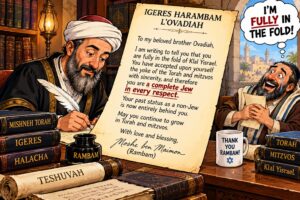
The heylige Zoihar also discusses the people who accompanied Avrohom and refers to them as am Elohei Avrohom – the people of the G-d of Avrohom. They were not merely people who happened to attend one of his lectures and then went home to worship their old idols. They were associated with his mission, with the G-d, he taught them to recognize. But what about those who came much later? Could someone born a goy, with no Jewish parents, grandparents, or relatives to invite him for Yom Tov, call Avrohom Ovenu, his father? Could he really say “our father” when he had no biological connection to the man? So happens that this is not a theoretical kasha invented by the Ois over a second cup of tea (Ois does not drink coffee). And it so happens that the Rambam addressed precisely this kind of concern in a remarkable letter to Ovadia the Convert. Let’s meet him:
Ovadia lived in the Rambam’s time, in the twelfth century. He had embraced Judaism but was troubled by a practical question. When he davened, could he use the same language as Jews born into the faith? Could he say Elokeinu v’Elokei avoseinu—our God and the God of our fathers? Could he refer to Avrohom, Yitzchok, and Yaakov as our forefathers? And what about the references to Hashem taking us out of Mitzrayim, when his own biological ancestors had not been among the Jewish slaves? Farkert: for all he knew, they could have been on the other side of the transaction!
Ovadia wanted to daven honestly. He did not want to claim a biological history that was not his. We know his question through the Rambam’s response; the original letter from Ovadia is not preserved in the source the Ois found. The Rambam’s answer, however, is clear and powerful. Avrohom taught people to recognize the RBSO and brought them closer to the truth. Those who subsequently accept Judaism are counted among Avrohom’s disciples. Avrohom is therefore not merely the biological father of his descendants. He is also the spiritual father of his disciples and of converts throughout the generations. He’s their daddy!
The Rambam tells Ovadia that he may say “our G-d” and “the G-d of our fathers,” because Avrohom really is his father in this spiritual sense. As for specific references to the Exodus and miracles performed for the Jewish people, the Rambam says Ovadia may change the wording if he wishes, but he is not required to do so. The convert is not standing outside the family, hoping someone will let him use the family name. He belongs.
Very gishmak, ober, we still have not answered our second kasha. Who wrote the conversion manual? How did we get from Avrohom and Soro bringing people closer to the RBSO to the formal process we recognize today? Nu, let’s put the history in order, because there is a difference between bringing someone under the wings of the Shechinah and establishing the halachic requirements for becoming a Jew. The major turning point was Matan Toirah. The Jewish people entered the covenant at Sinai, and Chazal subsequently derived the requirements for future generations of converts from that experience. Says the Rambam (Hilchos Issurei Bi’ah, chapter 13), that Israel entered the covenant through three elements: milah, tevilah, and a korban. A korban (animal sacrifice)? Yes, an offering. Before anyone starts looking for the nearest kosher butcher, the Rambam explains that in our time, without a Beis Hamikdash (temple), the korban cannot be brought. The requirements applicable today are different in that respect.
So who established the rules? The heylige Toirah laid the foundation; our holy sages discussed and derived the requirements; and the halachic decisors (poskim) organized and codified them. The heylige Gemora (Yevomis 46b–47b) discusses circumcision, immersion, acceptance of mitzvis, and the role of the beis din. Centuries later, the Rambam systematized the laws in his Mishneh Toirah. No single rabbi sat down one morning, opened a laptop, and invented the entire process. It just developed through the Toirah, later discussions of Chazal, and the halachic authorities who followed. The bottom line: though the framework is rooted in classical sources, it’s still evolving and one should avada go rabbi shopping before taking on this journey. Rabbi shopping will also affect the associated fees.
The bottom line: Did the rabbis invent the current curriculum and conversion process? Yes and No. Did the process become more formally defined over time? Absolutely. The spiritual mission we associate with Avrohom and Soro and the formal halachic process are related, but they are not identical. Avrohom may have been the original outreach director, but he was not running a modern conversion office. No application packet, no appointment calendar, no study syllabus, and no mikveh reservation system. No committee meeting to debate how many introductory classes should be required, and no one asking whether the prospective convert had completed the required reading. The spiritual mission began with Avrohom; the formal halachic framework took shape through the commandments of the heylige Toirah. The expanded requirements and all else came after our Sages and other with voices and authority out their names to it.
And that brings us back to the modern conversion stories. Someone may begin by watching a reel about Jewish customs. Someone else may spend years learning, studying, changing habits, and working toward conversion, all without announcing a thing. Eventually, a new Hebrew name may be revealed, a photograph may be posted, and thousands of people may write mazel tov. Instagram may document the journey, but it did not invent it. There is, however, another side to this story, and it may be the most uncomfortable part for those of us who were born Jewish. We – Ois included- are often fascinated by the person who chooses to join the tribe. We admire the effort, the learning, the questions, and the willingness to take on a new life. But do we ever stop to consider what we ourselves inherited? We were born into the family. We did not have to apply, interview, study, or persuade anyone to let us in. For many of us, Yiddishkeit, aka: the Jewish lifestyle, was there from day one. And sometimes, because it was there from day one, we take it for granted. Consider the contrast.
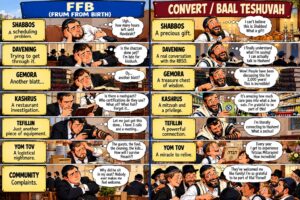
The prospective convert spends months learning the rules of Shabbis, carefully studying what is permitted and what is prohibited. The FFB Yid wants to know whether the Shabbis clock can be adjusted without getting out of bed. The convert asks the rabbi how to make sure the challah is properly separated. The born Yid asks whether the bakery is still open ten minutes before licht bentching. The convert studies the laws of muktzah. The FFB Yid studies the floor plan of the house to figure out where he can put his phone so that he will not have to look at it but can still hear it vibrate. The convert is thrilled someone saved him a seat in shul; the FFB is furious that someone sat in his seat. The convert wants guidance from his rabbi; the FFB wants a second opinion that agrees with him. The convert wants to know the meaning behind the minhogim (customs). The born Yid wants to know whether this year’s minhag can be shortened because the game starts at eight. The convert is learning the zemiros for the Shabbis table, the born Yid is itching to sing them quickly enough to get to the cholent. The convert asks what time davening begins; the FFB times his arrival to make sure he’s timely for the kiddish club. On a Sunday morning, when the rabbi announces that he will be giving a quick 5-7minute shiur after davening, the convert may take out a notebook while the born Yid suddenly remembers an urgent appointment with his car. The list is endless. Nu, we all know people like this. Some of us may even recognize ourselves.
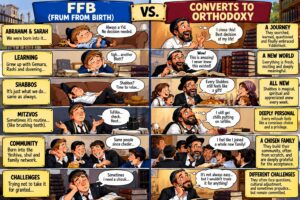
Of course, these are exaggerations, mostly not! Zicher, there are converts who struggle with observance and born Yiddin who are deeply committed to heylige Toirah and its mitzvis. We should never turn sincere converts into saints or born Jews into villains. But the contrast is worth thinking about. Sometimes the person who had to work hard to enter the family appreciates what the rest of us received without filling out a single form. Sometimes the newcomer is the one asking the questions, while the veteran has long since decided that he already knows the answers.
Ovadia was worried that he might not be entitled to say “our fathers.” The Rambam reassured him that he belonged to the family of Avrohom. Meanwhile, some of us who have been saying Elokei Avoseinu since we were old enough to talk may not have given much thought to what those words actually mean. Ovadia was worried about whether he had the right to claim the heritage. We, who have inherited it, sometimes need reminding that it is a heritage worth claiming.
And the final bottom lines? How was the first convert converted? The sources do not give us a beis din protocol, a list of witnesses, or a certificate signed by the original rabbis. The Gemora calls Avrohom techilah la-gerim, the beginning of the converts, because the story of people choosing to join this spiritual family begins with him. Avrohom and Soro were not counting likes. They were bringing people closer to the RBSO. As mentioned, they get credit as if they had created those people themselves. The next time we hear about someone who has chosen to join the tribe, let’s give that person more than a heart emoji and a mazel tov. Let’s appreciate the effort, the questions, the learning, and the seriousness of the decision. And perhaps we should ask ourselves a question as well: If someone who was not born into our world is willing to work so hard to enter it, what are we doing with the privilege of having been born here? Instagram can announce the newest member, but it cannot manufacture the commitment that brought that person here. And the family tree of Avrohom has branches that no DNA test will ever find. Perhaps that’s the real difference. The convert is still amazed that he was invited into the palace. The FFB has lived in the palace so long that he complains about the plumbing. The convert looks at the mezuzah and sees a connection to the RBSO. The FFB looks at the same mezuzah and wonders who installed it crooked. Nu, maybe the convert doesn’t need to learn how to become a Yid as much as some of us need to remember why we became one in the first place.
A gittin Shabbis!
The Heylige Oisvorfer Ruv
Yitz Grossman
Source URL: https://oisvorfer.com/lech-lecha-2026-who-converted-the-first-convert/