Koirach 2026: When the Dream Died
by devadmin | June 18, 2026 9:44 pm
Raboyseyee and Ladies,
When the Dream Died
Mazel Tov to the Knicks! All has been said and written; we shall not repeat but hope they do. Let’s go veyter.
Mazel Tov to the Mayor and Village of Lawrence Trustees who were up schvitzing all night awaiting the results of the local election; they won. They ran unopposed! Note to Trustees: Voting took place in the main ballroom of the Country Club. This room is typically associated with bar/bat mitzvah celebrations, vorts, sheva brochis, or even a third wedding. When I and many others walk in the front door, we’re anticipating food, and in Pavlovian fashion, we’re instantly hungry. The hec with democracy: We want FOOD! You owe us! Veyter!

———————————————————————————————————————
What if I told you that a bunch of Yiddin suspected Moishe Rabbaynu of having illicit relations—adultery mamish—say it’s not so please- with married women? Having kiddish in restricted arears, if you chap. Would you believe me? Or would you think the Heylige Ois has finally gone off the rails?
And what if I told you that not only did this happen, but that the heylige Gemora itself says so explicitly? It describes a situation in which husbands were warning their wives about Moishe Rabbeinu. They should not find themselves secluded with him. Would you believe me then? Shoin. It all goes down in this week’s parsha of Koirach which features the great matchup and feud between Koirach and his followers on one side and Moishe on the other. We will zicher circle back to that astonishing Gemora. But before we do, let us begin somewhere else entirely.
This past Sunday, on President Trump’s birthday, the South Lawn of the White House was transformed into something it was probably never intended to become: a giant cage. Thousands gathered for a UFC event, complete with fighters, referees, spectators, and all the pageantry that accompanies two people entering a ring to settle a dispute the old-fashioned way. The idea, of course, is hardly new. For as long as human beings have disagreed, we have been fascinated by showdowns. The heavyweight title fight. The championship game. The presidential debate. The courtroom drama. The cage match. Put both sides in the same arena, let the better man win, and the matter will finally be settled. At least that’s the theory.
Ober long before Madison Square Garden, Las Vegas, or the White House lawn, the heylige Toirah recorded what may have been the most dramatic public showdown in history. Koirach versus Moishe Rabbaynu. Perhaps the first real duel. Ver veyst? The challenger assembled his supporters. The incumbent accepted the challenge. The rules were established. A date was set. The entire nation gathered to watch. And unlike every sporting event in history, there would be no controversy regarding the outcome. No judges. No scorecards. No instant replay. No disputed decision.
The earth opened beneath Koirach and his followers. Fire descended from Heaven and consumed the two hundred and fifty men offering ketoires (incense). If there was ever a contest with a clear winner and a clear loser, this was it. Case closed. Or so one would think. Because the most astonishing part of the story is not the duel itself. The most astonishing part is what happened the next morning. After witnessing one of the most overwhelming displays of Divine judgment ever recorded, the nation gathered once again and confronted Moishe and Aharoin.
“You have killed the people of Hashem.” Those words should stop every reader in his tracks. Killed the people of Hashem? What exactly did they think they had witnessed the day before? The earth opening on command? Fire descending from Heaven? Was that Moishe’s doing as well?
How could anyone possibly observe those events and still arrive at the conclusion that Moishe was the villain? What’s taka pshat? Hadn’t the Yiddin seen enough by now to scare them straight? Was this not the same group that witnessed Makas Mitzrayim, Krias Yam Suf, Matan Toirah, the manna, the Clouds of Glory, and now the earth literally opening beneath a rebellion? Indeed it was! Is it any wonder that the RBSO, on more than one occasion, contemplated wiping out the nation and beginning again? We might, or should be asking what the RBSO saw in them in the first place? Were the other candidates for the “Chosen People” title so much worse? Hard to believe.
But perhaps we are asking the wrong question. Perhaps the question is not why the miracle failed to convince them. Perhaps the question is why they were in any mood to be convinced by Koirach and his cohorts in the first place? Was he promising free rent and groceries in the midbar? To tax the millionaires?
To chap how Koirach came about, how he rose to prominence, we have to go back one parsha. Back to the Meraglim. Back to the moment when an entire generation was told that it would never enter Israel. Think about what that must have felt like. For more than a year, the Yiddin had been living inside a dream. They had watched Egypt crumble. They had crossed the sea. They had stood at Har Sinai. They got passed the eygel caper and built the Mishkan. Every step, every journey, every sacrifice was moving toward a single destination; the Promised Land. That was the promise. That was the dream. That was the future. And then, almost overnight, it was gone. Not delayed. Gone. Fartig and case closed!
The generation that left Mitzrayim was informed (last week’s parsha) that it would never enter the Land. Their children would cross the Yarden. Their children would build homes. Their children would inherit the promise. But they would die in the wilderness. Imagine hearing that decree. Imagine discovering that the great mission of your life would be completed by somebody else. Imagine realizing that the future you had imagined would never arrive. What do people do when they lose hope? When the diagnosis is terminal? History provides a fairly consistent answer. They look for someone to blame. We can certainly kler that is why Koirach appears immediately after the Meraglim. Not because the stories happen to be next to each other -which they are- but because they are the same story. The rebellion did not begin with Koirach. The rebellion began when the dream died. Koirach merely arrived to capitalize on it.
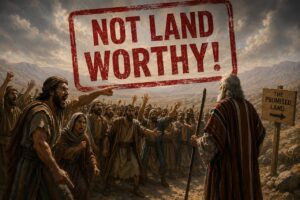
A skilled demagogue knows exactly when to launch a revolt. Not when people are hopeful. Not when confidence is high. Not when everyone believes tomorrow will be better. You strike when people are disappointed. You strike when trust has been weakened. You strike when people feel they have been robbed of their future. And suddenly the impossible becomes possible. The same nation that once sang at the sea begins listening to Koirach. The same nation that once believed in Moishe begins questioning Moishe. The same nation that once trusted its leadership begins suspecting its leadership.
In fact, the heylige Toirah itself highlights how dramatic the fall was. Just over a year back, following Krias Yam Suf, the heylige Toirah tells us: ויאמינו בה’ ובמשה עבדו– “They believed in Hashem and in Moishe His servant.”
Think about those words. The heylige Toirah itself testifies to their faith. Not merely that they respected Moishe. Not merely that they followed him, they believed in him. The nation was full of hope and confidence. Yet a year plus-some later, Chazal describe a completely different atmosphere. The heylige Gemora (Sanhedrin), commenting on the posik in Tehillim, “Vayekan’u l’Moishe bamachaneh”—”They were jealous of Moishe in the camp”—makes a startling statement: מלמד שכל אחד ואחד קינא את אשתו ממשה
“This teaches that each person warned his wife because of Moishe.”
Moishe now an accused adulterer? Mamish shreklich and breathtaking. What a precipitous decline. Not in Moishe. In the people. Moishe is the same Moishe. The sea-splitter. The Toirah-giver. The prophet. What changed here? Each person warned his wife about being secluded with the great Moishe? OMG! What is going on here? What’s pshat here? Where did the Gemora take this from? Whose imagination ran so wild to believe that the Yiddin suddenly suspected Moishe of having his way with married women?
Let’s check out the heylige Gemora (Sanhedrin 110a) which is incidentally the main source for this entire controversy. The Gemora quotes a posik in Tehillim 106:16) which says this: ויקנאו למשה במחנה לאהרן קדוש ה
The Gemora then says:
מלמד שכל אחד ואחד קינא את אשתו ממשה
“This teaches that every individual warned his wife because of Moishe.”
Says Rashi: אמר לה אל תסתרי עם משה
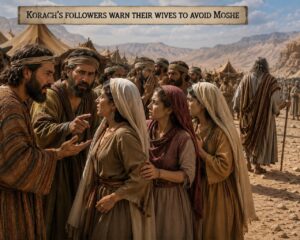
“He told her: Do not seclude yourself with Moishe.” The Gemora does not elaborate further. It does not claim Moishe did anything improper. It is describing the suspicions and slander circulating among the people. And says Rashi (on Sanhedrin 110a) that the language of “קינא” is borrowed from Soita terminology, where a husband warns his wife not to be alone with a particular man. Avada we must chap that Rashi is not describing an affair; he is describing suspicion. In modern terms: Husbands were being influenced by rumors and warnings regarding Moishe.
Says the Kli Yokor that jealousy blinds people and leads them to suspect even the most righteous individuals. The remarkable point is the collapse of trust. The sources are showing that once a society decides someone is the problem, the accusations multiply. They need not be consistent. They need not be logical. They simply need to reinforce the conclusion already reached. Chazal repeatedly emphasize that people suspected Moishe despite overwhelming evidence of his righteousness. Elsewhere, Midroshim describe people standing behind Moishe and commenting on his appearance, his wealth, and his conduct. The medrish (Tanchuma and others) paint a vivid picture: When Moishe would walk through the camp, people would say:
Look at his neck. Look at his legs. Look at how healthy he looks. And others would answer: Of course he looks good. He controls all the work of the Mishkan. The insinuation being: He’s getting rich from public funds. This is one reason why, later, Moishe gives a full accounting of the Mishkan funds. Not because he owed anybody an explanation. But because leaders must be above suspicion. The bottom line: our Sages built a portrait of many accusations against Moishe. Different accusations. Contradictory accusations. The picture emerging is of a society that has decided Moishe is the problem. Once that happens: his wealth is suspicious, his appointments are suspicious, his behavior is suspicious, his family is suspicious, his motives are suspicious. Everything becomes suspicious. To a point where – mistama for some hot gossip- they also suspected him of adultery. Mamish a Shanda!
Read that again. We are talking about Moishe. The man who spoke with the RBSO face to face. The man who gave them the heylige Toirah. The man whom the heylige Toirah itself calls the humblest of all men. And now husbands are warning their wives about him? How does such a thing happen? How could the Yiddin go from “ויאמינו בה’ ובמשה עבדו” versus “מלמד שכל אחד ואחד קינא את אשתו ממשה.”
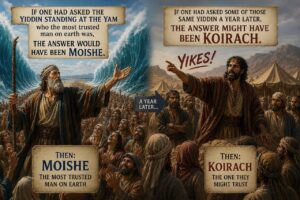
If one had asked the Yiddin standing at the Yam who the most trusted man on earth was, the answer would have been Moishe. If one had asked some of those same Yiddin a year later, the answer might have been Koirach. Yikes!
How does a nation travel that distance in little more than a year? The answer, so believes the heylige Ois, is that by this point the issue was no longer Moishe. The only thing that changed was the nation’s emotional state. The issue was disappointment. Moishe had become the symbol of a future that would never arrive. The miracles had not disappeared. The sea had not unsplit. Sinai had not vanished. The Mishkan still stood. Moishe had not changed. The people had changed.
Or more precisely, their emotional state had changed. When people lose faith in the future, they often begin losing trust in the people who led them there. And once trust begins to collapse, suspicion rushes in to fill the vacuum. First come the complaints. Then come the accusations. Then come the rumors. Then come the conspiracy theories. Then come the personal attacks. The accusations become more and more outrageous. Why? Because once a society decides that someone is the villain, every fact begins to look suspicious. And perhaps that explains one of the strangest statements in the entire parsha.
Doson and Aviram (two of Koirach’s cohorts) refer to Mitzrayim as “a land flowing with milk and honey.” Egypt? The place of slavery? The place of beatings? The place from which they cried out for redemption? How could anyone possibly describe Egypt that way? Because disappointment rewrites memory. When the future disappears, the past suddenly looks beautiful. When hope dies, nostalgia is born. Now we can finally chap what happened the morning after Koirach’s defeat.
The earth opened. Koirach disappeared. Fire descended from Heaven. The contest was over. Yet the next day the people complained: “You have killed the people of Hashem.” At first glance the statement seems irrational. After everything they had witnessed, how could they possibly think such a thing? But perhaps they were no longer processing events through logic. They were processing events through pain. And pain sees differently. A disappointed person can witness a miracle and remain unconvinced. A grieving person can watch the impossible occur and still remain angry. The issue was no longer evidence. The issue was heartbreak. The miracle did not restore their future. The miracle did not undo the decree. The miracle did not heal the wound left by the Meraglim. And therefore, the miracle changed very little.
Is that why the heylige Toirah devotes so much space to the Koirach story? Efsher! This is not merely the story of a rebel. It is the story of what happens when a nation loses hope. It is the story of what happens when people feel that the future promised to them has been taken away.
The bottom line: at different times in our lives, we all eventually experience a version of that moment. The business that fails. The diagnosis that arrives. The dream that dies. The future we imagined disappears. At that moment we face the same choice that confronted the generation of the Midbar. To become bitter. To become cynical. To search for villains. Or to continue following the cloud even when it is no longer leading where we expected. That may have been the true test of the wilderness generation. Not whether they believed after miracles. The real test was whether they could continue believing after disappointment. Because the greatest challenge to faith is not always doubt. Sometimes the greatest challenge to faith is grief. The bottom line: That generation failed and were not land worthy.
A gittin Shabbis!
The Heylige Oisvorfer Ruv
Yitz Grossman
Source URL: https://oisvorfer.com/koirach-2026-when-the-dream-died/