Emor 2026: The Counting Crisis
by devadmin | April 30, 2026 3:53 pm
Raboyseyee and Ladies,
The Counting Crisis
When Jews Went to War Over Sunday
Shoin, welcome to yet one more weekly parsha review, inspired -as so many of these pieces tend to be- not by months of preparation, carefully indexed notes, a repeat of something I wrote years ago, or a peaceful Shabbis afternoon surrounded by open seforim, but by yet another spirited conversation I had with my son-in-law as we were driving into the city for an event honoring kidney donors. A beautiful cause, an uplifting evening, and a chance to celebrate people who quite literally give life to others.

Naturally, instead of discussing gratitude, kindness, or whether the citybound traffic would ruin our mood, we spent kimat the entire ride debating Toirah Sheba’al Peh, the Oral Tradition. By the time we crossed the Triborough Bridge, we had solved nothing, but both sides felt victorious. As has become the custom, we agreed to disagree on a few main points. Each of us defended our positions; even SIRI politely requested to remain neutral. Such is the Jewish way. Jewish debates are unique: nobody changes their mind, yet everyone leaves exhausted. Put two men in a car, one topic of substance on the table, and before long the conversation resembles a small Sanhedrin. Shoin, we arrived at the event honoring kidney donors mamish exhausted after donating pieces of our patience. So happens that as we approached the city and Mt Sinai (not the mountain), we were discussing the role of the Nevi’im (Prophets) vs our Sages of the Mishneh and heylige Gemora. Who had higher authority? The Novee whose moniker translated to some form of direct communication with the RBSO? Or, our sages, bright humanoids who claimed authority on the transmission of pshat in the Toirah’s words? And since the topic was already opened, let’s dig a bit further because authority to interpret what the RBSO meant when he gifted the Yiddin the heylige Toirah is mamish relevant to a few words in our parsha.

It’s crystal clear that the Prophets (Nevi’im) had authority of revelation. A Novee received a message directly from the RBSO through nevuah. That gives them authority in matters where the RBSO chose to communicate: warning the people, calling for teshuvah, guiding the nation, and at times, temporary directives. By way of example, If Judaism had a Mt. Rushmore of Prophets, we would likely see carvings of Moishe, Shmuel, Eliyahu and Yeshayahu. They and others to include Isaiah and Jeremiah, were not making policy because they were merely clever; they were the RBSO’s messengers. On the other hand, our sages of the Mishneh/Gemora had -or took for themselves- authority of Toirah interpretation and legal transmission. They did not claim prophecy. Their authority came from: the heylige Toirah’s command (Devorim 17) to follow the authorized judges/sages (“according to the law they teach you…”). It came, they claim, from mastery of mesorah (tradition), legal reasoning, consensus / Beis Din authority, and preservation and application of the Oral Toirah. So, Rabbi Akiva, Rav Ashi and all the others, were not prophets. That said, in halachic authority, they were the system the Toirah itself empowered. They became the decisors of halocho.

Ober, which is a “higher” connection to the RBSO? Shoin, that seemingly depends on the category. If asking, who knows the RBSO’s current message? The Novee. If asking: Who decides halocho? The sages. They argue the famous principle of לֹא בַשָּׁמַיִם הִוא – Loi bashomayim hi, meaning “It is not in Heaven.” Famous from where? From the Heyilge Gemora itself where its iconic use can be found in Buba Metzia 59b, and where, after miraculous signs in a particular dispute, a Heavenly voice supported Rebbe Eliezer. Rebbe Yehoshua stood and said לֹא בַשָּׁמַיִם הִוא. Once the Toirah was given, halachic decisions are made through the rabbinic legal process, not by prophecy. Meaning, even if a prophet had a heavenly message, he could not permanently overturn Toirah law through prophecy. Some prophets were great sages; some sages were spiritually greater than many prophets. The heylige Gemora (Bava Basra 12a) -of course- says that in some ways a sage is greater than a prophet אָמַר אַמֵימָר: וְחָכָם עָדִיף מִנָּבִיא. (Ameimar said: A sage is superior to a prophet) because wisdom in Toirah can exceed prophetic function. Naturally, the people writing the Gemora found much to admire in sages. A shtikel self-serving, you think?! The bottom line: The Novee has authority from hearing from Heaven. The sages have authority from the Toirah system Heaven established. Or, better said, the prophets delivered the RBSO’s messages while the sages determine the RBSO’s laws. Veyter.
Yet, as lively as our exchange became, it dawned on me afterward that our debate was hardly original. We were not inventing anything new. We were merely continuing an argument that has raged among us Yiddin for more than two thousand years. It’s in our DNA; we must argue; at least disagree vehemently. In fact, the very issue that animated our drive into the city was already fiercely contested during the days of the Second Beis HaMikdash, and it centered around two deceptively simple words found in this week’s parsha of Emor. Two words that sound harmless enough to the casual reader, two words that most people might pass over without a second thought, yet two words that once divided camps, challenged authority, impacted the calendar, and raised one of the greatest questions in Jewish life: Who gets to explain the heylige Toirah? And to implement rules?
Just last week, the Heylige Ois wrote about the customs of Sefira—haircuts, weddings, music, mourning practices, and the annual Jewish search for the exact hour one may again look civilized. We spoke of the seven weeks between Pesach and Shavuis, those peculiar days during which some Jews are counting upward with spiritual longing, others are counting downward toward cheesecake, and many are simply counting until the barber can get them cleaned up. But where did all of this begin? Where did this period, with all its halochos, customs, debates, and calendars, first enter our national consciousness? The answer raboyseyee lies right here, in Parshas Emor, where the RBSO commands the still newly minted Yiddin to begin counting the Omer, and He does so with the phrase:
וספרתם לכם ממחרת השבת – “And you shall count for yourselves from the morrow after the Shabbis.” There they are. The words that launched a controversy.
Let’s find out what the fuss was all about; it’s mamish amazing. To chap, we need to zero in on but two of the four words:
ממחרת השבת — Mimochoras HaShabbis.
Now to the average Jew leafing quickly through his Chumish between laining and cholent at the kiddish club which -as an aside- used to start at the last aliya or even at maftir but in recent weeks has gotten going by shlishi and is in full throttle by chamishi, the meaning appears obvious. Mimochoras HaShabbis means “The day after Shabbis.” That’s Sunday. We begin counting the sefira on Sundays, always just as the heylige Toirah spells out. What could be simpler? Or clearer? Ahh, but whenever something in Heylige Toirah appears too simple, it is usually a warning sign. What happened next?
One group in ancient Israel said exactly that: Shabbis taka means Shabbis. Therefore, the Omer offering must always be brought on Sunday, the counting begins Sunday night, and Shavuis must therefore always fall on a Sunday as well. Another group insisted that in this context the word “Shabbis” does not mean the weekly Sabbath at all, but rather the first day of Pesach, a festival day of rest. According to them, counting begins on the second night of Pesach, regardless of which day of the week it falls. From that moment on, the matter was no longer merely about counting days. It became a battle over authority, interpretation, tradition, and the very structure of Judaism itself.
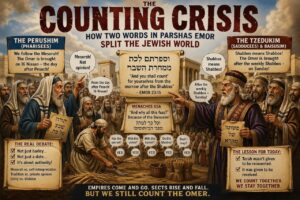
And from that moment forward, the issue was no longer merely when to count. It became:
- Is the Written Toirah enough on its own?
- Do we need an Oral Tradition to explain it?
- Can every verse be read literally?
- Who decides Jewish practice?
- And perhaps most important: who is driving the bus, and why are they yelling?
The debate between me and my son-in-law, you see, was simply a continuation of an argument already fought by the Perushim, the Tzedukim, and other factions in Temple times. They argued over these very words. They argued over the calendar. They argued over Shavuis, argued over authority. Apparently, factionalism did not begin with shul board politics or elections. Even then, the Yiddin could not form one group without first splitting into four subgroups and a committee. If there were ten Jews in Yerusholayim, historians found twelve opinions. Shoin, it’s how the RBSO programmed us. And we, heading toward Midtown Manhattan, merely kept the mesorah alive. So, before we discuss how one phrase split a nation, we first need to meet the players:
To understand why this issue became explosive, we must first meet the players. The late Second Temple period was not one unified, peaceful religious landscape where everyone davened alike and agreed on the weekly bulletin. Of course, not and was it ever? Who would expect otherwise? Remember our DNA! We are built to disagree.

It was an age of factions, schools, ideologies, sects, and rival visions of Judaism. There were the Perushim, the Pharisees, who are the spiritual ancestors of what would become rabbinic Judaism. They believed in both the Written Heylige Toirah and the Oral Toirah. They held that Moishe Rabbaynu received not only text, but explanation; not only commandments, but their application. And that he passed it down orally from generation to generation until it got to them, the codifiers of the Mishneh and Gemora. They taught that Toirah is lived through tradition, transmitted teacher to student, and interpreted through accepted methods. They believed in resurrection, reward and punishment, angels, and a Judaism that could sanctify not only the Temple but the home, the marketplace, the kitchen table, and daily life. Without them, there would likely be no Mishneh, no Gemora, no halachic continuity, and perhaps no Judaism as we know it after the destruction of the Beis HaMikdash.
Opposing them were the Tzedukim, the Sadducees, often associated with priestly elites, wealthy circles, and those whose religious power was tied closely to the Temple establishment. They generally rejected the authority of the Oral Toirah and favored a more literal reading of scripture. If the verse says Shabbis, then it means Shabbis. Why complicate matters? Why add layers? Why depend on rabbis to explain what appears plain on the page? On the surface, theirs sounds like the common-sense position. It is always attractive to say, “I’m just reading what it says.” But the Heylige Toirah has never functioned that way. The very same people who insist “Shabbis means Shabbis” must also explain what “totofois” means in the commandment of tefillin, what fruit qualifies as “pri etz hadar,” – how the esrog came to be- what counts as melocho on Shabbis, or how “an eye for an eye” (also mentioned for a second time in our parsha) was understood in practice. The written Heylige Toirah without transmitted explanation quickly becomes a thousand private opinions wearing the mask of simplicity. As an aside by now most of you know that the word tefillin does not exist in the Toirah, nowhere! Nor are the direct and indirect costs associated with them. But just like that, a muti million-dollar industry was born and flourishes today. Suddenly, scribes, caterers, party planners, those who could crochet, and so many others were in business. Interpreting Toirah is big business, very big! How our sages arrived at this without the benefit of nevuah, ver veyst, but they gave themselves authority and here we are.
And if two factions weren’t enough, there were also the Baisusim, frequently mentioned by Chazal in connection with this very dispute. Scholars debate whether they were a branch of the Sadducees or a related sect, but in rabbinic literature they appear as opponents of the Pharisaic tradition and defenders of the Sunday interpretation of the Omer count. And for good measure, perhaps because three opinions weren’t enough, there was yet another group of heylige Yiddin, they known as the Essenes. They were separatists who retreated from what they saw as corruption, embraced strict purity, and in some cases followed alternate calendars. There were zealots who preferred political revolt to Roman rule, and ordinary Jews who simply wanted to know one thing: when is Yom Tov? Historians often focus on ideological leaders, but the average farmer, merchant, widow, laborer, and pilgrim mostly needed clarity. When should I bring korbonis? When should I close shop? When do I go to Yerusholayim? These debates were not abstractions. They affected real life.
And so the words Mimochoras HaShabbis became a flashpoint. If the Sadducees were correct, then the Omer offering would always be brought on a Sunday following the first Shabbis of Pesach. The counting would begin then, and Shavuis would always land on Sunday seven weeks later. Neat, orderly, predictable. One almost suspects they were also trying to create the first long-weekend Yom Tov. Why not? But if the Perushim were correct, then the Omer is brought on the sixteenth of Nissan, the second day of Pesach, and Shovuis arrives after counting fifty days, regardless of weekday. This is the system followed by Jews to this very day.
The heylige Gemora (Menachos 65a–66a) preserves elements of these ancient disputes. Chazal did not dismiss the opposing view with slogans; they argued from text, logic, tradition, and usage. They noted that the Heylige Toirah itself uses forms of the word Shabbis to describe festival rest days, such as Shabbasoin. They emphasized that the counting is tied to the bringing of the Omer at the onset of the harvest season, immediately after Pesach. Most significantly, they stood upon the Mesorah, the living chain of transmission. (Moishe to Yehoshua and so on down the line) Judaism was never meant to be reconstructed afresh by each generation with a dictionary and confidence. It was meant to be received. And here lies the deeper issue. The dispute over Sefira was not truly about barley. It was not even about dates. It was about whether the Heylige Toirah can survive if every individual decides that plain reading is supreme and inherited explanation optional. Once that door opens, fragmentation follows quickly. Today one person says “Shabbis means Shabbis.” Tomorrow another says tefillin are symbolic. Another decides mezuzah is poetic metaphor. Another concludes fasting means emotional restraint. Soon everyone possesses his own Judaism, handcrafted, personalized, and incompatible with the next man’s version. The Oral Toirah was not an accessory added later. It was the operating system without which the text cannot function as communal life.
Ironically, the groups most associated with Temple authority often advanced readings that could destabilize unified national observance, while those mocked as rabbinic interpreters ultimately preserved practical cohesion. And history judged the matter clearly. When the Beis HaMikdash was destroyed, a Judaism dependent solely on Temple structures and priestly power could not endure exile. But a Judaism built on study, halocho, prayer, home ritual, memory, and portable holiness could survive in Bovel (Babilonia), Spain, Poland, Morocco, Brooklyn, and wherever else Yiddin found themselves paying too much rent.
One might ask: if the Heylige Toirah intended the second day of Pesach, why write the phrase ambiguously? Why not say plainly, “the morrow after the first day of Pesach”? A fair question. Perhaps because the Heylige Toirah wished to link Yom Tov rest with the sanctity of Shabbis. Ver veyst? Perhaps because the written Toirah was intentionally given alongside an Oral Toirah, so that some commandments would require transmission. Perhaps because spiritual growth begins the moment redemption begins. Do not wait for Sunday. Leave Egypt tonight and start climbing tomorrow. Or perhaps, as I humbly suggest, it was to guarantee future material for columnists and the heylige Ois himself.
This ancient controversy is not dead. It reappears in every generation whenever someone declares, “Why do we need tradition? I’ll just read the text myself.” It sounds fresh, independent, courageous. But ten readers produce twelve religions. The genius of Mesorah is not that it eliminates argument—Jewish history proves otherwise, don’t we know that to be emes- but that it contains argument within a shared framework. We debate vigorously, yet remain one people counting the same Omer on the same night, even if half of us need reminders and the other half forgot what number we are up to.
The bottom lines: when you count Sefira this week – with or without a brocho here on day 28- realize you are doing more than reciting a nightly formula. You are participating in the victory of continuity over improvisation, of received wisdom over private invention, of national memory over sectarian splintering. We are counting as did our grandparents as their grandparents counted, as Jews counted across continents and centuries, according to the understanding preserved by our sages from the days when these very words shook the nation.
And this: Even if they had/have it all wrong, it’s a tradition! Shoin, what could be better and stronger than a tradition? Right or wrong, once Jews call it tradition, good luck moving it. We still count the Omer nightly; proof that arguments end, but customs never do. Empires have vanished, sects have disappeared, and yet, we Yiddin still debate the brocho if we miss a night. Rome is gone, Iran still sadly here. The Baisusim are gone. But the question “What day are we up to?” lives forever. And should anyone still insist that the phrase obviously means Sunday, smile politely, offer them cheesecake on Shavuis whenever it happens to fall, and tell them to take it up with my son-in-law on the next drive into the city.
A gittin Shabbis –
The Heylige Oisvorfer Ruv
Yitz Grossman
Source URL: https://oisvorfer.com/emor-2026-the-counting-crisis/