Eikev 2026: The Illness That Came Back
by devadmin | July 30, 2026 6:38 pm
Raboyseyee and Ladies,
The Illness That Came Back
Two shoutouts this week; here we go!
First, a big mazel tov to our dear friends Beth and Nathan Fruchter upon the birth of a granddaughter born to their children Talya and Michael Fruchter. Keyn yirbu! Welcome to the world Elka (Ally Rose) Fruchter and may you be a source of much joy to your parents, siblings, grandparents (Debbie and Shloime Ross) and to the rest of your family.
And while the Ois does not typically shoutout birthdays…. he makes an exception to wish long time reader -and heylige Ois superfan Benny Kiss from over in Beverley Wood, CA- a very happy birthday. I met Benny whose July 31st birthday is mamish tomorrow, for the very first time a few months ago and in the course of conversation, he shared that he’s been enjoying the Ois’s weekly parsha posts for many years. Of course he gets a birthday shoutout! Chazak!
There are some questions that are so obvious, you wonder why nobody ever asks them. This week, the heylige Ois is back with another one. No, it’s not about the mitzvah of saying thank you (aka: bentching) to the RBSO after we eat and are sated. We’ve already stirred that pot in the past, and as regular readers know, the Ois still has unresolved issues with the heylige Gemora’s description of its authorship. That for another day. What’s bothering me this week? It all begins with a few seemingly innocuous words at the very beginning of this week’s parsha with what Moishe tells the Yiddin as they stand on the precipice of the Promised Land. After forty years in the midbar, they’re mamish finally about to cross over.
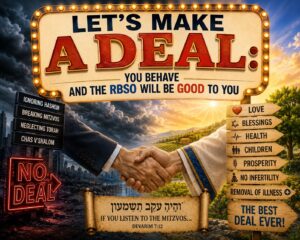
Welcome to Parshas Eikev, where Moishe is delivering what may be the greatest motivational speech in Jewish history. Today we’d call it incentive-based leadership. Ober, in order to chap what’s going on, let’s review the relevant words from Devorim 7 (2-15). “והיה עקב תשמעון…” If you listen to the mitzvis…then, the RBSO will keep His covenant with the Avos. Of course, there’s some debate as to what the word עקב means but for our purposes, let’s go with poshit pshat; it means that “if” you listen or “because” you will listen…Moishe’s bottom line message: You be good and the RBSO will be good to you! Fartig! Ober, let us segue….
Every generation believes it will be the one to conquer disease. The Egyptians had their healers. The Greeks had Hippocrates. The Romans built hospitals. Since 2025, we in the USA have Kenedy and his MAHA charge. Medieval physicians searched for miracle cures. Today we have MRI machines, robotic surgery, artificial intelligence, GLP-1 medications, gene editing and enough vitamins to fill an aisle at Costco. And if modern medicine doesn’t have the answer, not to worry. Instagram and TikTok certainly do. Open your phone and within thirty seconds you’ll meet someone who looks like they haven’t seen their own toes since the Clinton administration explaining how a $97 bottle of Himalayan yak-root extract, fermented sea moss, mushroom gummies, red-light therapy, cold plunges, hyperbaric oxygen, peptide injections and sleeping upside down will help you live to 137. Let’s also shout out stem cells, and exosomes to regrow hair. Gone yesterday, hair today! The one thing they all seem to have in common? Apparently, insurance carriers have yet to convinced. Ober, not to worry; somebody on YouTube swears it works. And yet…people still get sick, fat and bald. Despite all of mankind’s advances, and despite all the influencers hawking the latest miracle cure, we still haven’t accomplished what the Heylige Toirah promised more than 3,300 years ago. What was promised? It’s the one sentence in this week’s parsha that stopped the Ois cold: “והסיר ה’ ממך כל חלי.” “Hashem will remove from you every illness.” Hold on… Didn’t He already do that once? Let’s find out but first, let’s read the full set of medical and other rewards Moishe shares in the first few pisukim:
“ואהבך וברכך והרבך.” He will love you. He will bless you. Your children will flourish. Your fields will produce. Your grain, your wine, your oil, your cattle and your sheep will all be blessed. Then comes another incredible promise: “לא יהיה בך עקר ועקרה.” No infertility. Not among your people and not even among your animals. That’s big; givaldig! Moishe is painting a picture so idyllic that were real estate developers over in Yerusholayim, Beit Shemesh and even over in Natanya where buildings are sprouting faster than mushrooms, to print these great amenities in their glossy brochures, or pitch them on Instagram, we’d all be asking where to sign. As it is, Mamdani, Calrson, and others of their ilk, are doing amazing things for the Israeli Real Estate markets. Shoin, that too for another day.
The promises include healthy families, prosperous farms, growing businesses and healthy livestock. No infertility. What could possibly top that? Then comes one of the heylige Toirah’s most breathtaking promises. “וְהֵסִיר ה’ מִמְּךָ כָּל חֹלִי.” “The RBSO will remove from you every illness.“ Mamish beautiful words. Comforting words. Words every one of us would love to hear. But also, words that should stop us in our tracks; let’s read those five words again. The RBSO will remove every illness. Sounds wonderful. Mamish amazing! But wait! There’s even more. The very next words are not merely, “I will remove illness.” The posik continues: “וכל מדוי מצרים הרעים אשר ידעת…” “…and all the evil diseases of Egypt that you knew.” Shoin! Now the questions begin.
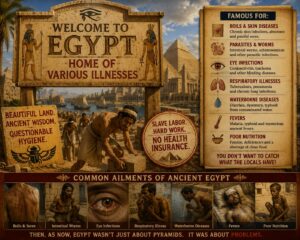
Why bring Mitzrayim into the conversation at all? Why not simply promise good health? Why specifically mention the diseases of Egypt? What diseases did they suffer from in Mitzrayim? Did we read anywhere that the slaves suffered from various illnesses? The Toirah never tells us. Rashi simply says they were the illnesses that afflicted Mitzrayim. Very helpful. Thanks, Rashi. But what were they? Ver veyst? The truth is, nobody knows for certain. Were they the boils of Sh’chin? The epidemic of Dever? The other makos? Or was Egypt simply notorious throughout the ancient world for disease? It so happens that modern archaeologists and Egyptologists who have examined Egyptian mummies have found evidence of tuberculosis, parasitic infections from the Nile, chronic eye diseases that caused blindness, severe dental disease, arthritis and a host of skin disorders. Yikes! Who knew? Apparently, people living three thousand years ago suffered from many of the same ailments we complain about today. So much for modern medicine. If Moishe merely wanted to promise good health, why not simply say: “והסיר ה’ ממך כל חלי.” Why continue with: “וכל מדוי מצרים הרעים…” Why mention Egypt at all? Could pshat be that Mitzrayim wasn’t merely a place? Perhaps it represented an entire way of life? Think about it. Every major plague struck something the Egyptians worshipped. The Nile. The sun. Animals. Power. Nature itself. Maybe the “diseases of Egypt” weren’t just medical conditions. Maybe they represented the physical consequences of a civilization that believed man and not the RBSO was in charge.
Let’s go veyter. And here’s where the Ois really began scratching his head. What illnesses was Moishe -representing the RBSO- promising to remove? Who was sick? Because if you’ve been following the narrative of the heylige Toirah from Har Sinai until now, this promise seems strangely out of place. Didn’t The RBSO already remove every illness? Don’t our Sages paint an extraordinary picture of the moments before Matan Toirah? Indeed, they do, let’s check it out because the medrish brings it to life. Says the medrish (Pesikta de-Rav Kahana, BaChoidesh 12; see also Midrash Tanchuma, Yisroy 8) that before Matan Toirah, the RBSO looked at the Yiddin and said, in effect: “How can I give My Toirah while some are blind, others are deaf and still others are lame?” What did He do? The Midrash answers:
“מה עשה הקב”ה? ריפא אותם ואחר כך נתן להם את התורה.”
“What did the Holy One, blessed be He, do? He healed them, and only afterward did He give them the heylige Toirah.” Mamish incredible! Not a handful of isolated miracles. A national healing. Every Yid stood before the RBSO physically whole. Ober, notice something astonishing. The medrish doesn’t say that the RBSO healed them at Matan Toirah. It says: “ריפא אותם ואחר כך נתן להם את התורה.” First, He healed them. Then He gave them the Toirah. The healing wasn’t a side effect of Revelation. It was a prerequisite for Revelation. Why did the RBSO chose to heal them before Matan Toirah? Why couldn’t a blind Jew receive the heylige Toirah? Why couldn’t a lame Jew stand at Har Sinai? Why was physical perfection a prerequisite for spiritual perfection? Ver veyst? That seemingly innocent question may be the key to everything ober the Ois has another question. Actually, several. How long did that miraculous healing last? A day? A week? Forty years? Forever? Apparently, it didn’t last forever. But when exactly did it end? And guess what, raboyseyee…and ladies. The heylige Toirah never tells us. In fact, what makes the question even more perplexing is that the wording in our parsha sounds as though this miracle has yet to occur. It’s to come. Moishe promises that the generation about to enter that: “והסיר ה’ ממך כל חלי” “I will remove every illness from your midst.” Again? But weren’t they already living with that blessing? If not… what happened at Revelation? When did sickness return? Was it after the Eygel? After the Meraglim? After the mass orgy at Baal Peor? So many choices. Was the healing at Har Sinai only temporary? Ver veyst? The heylige Toirah is strangely silent and if this were the only place the Toirah discussed illness, we’d probably shrug our shoulders and move on. But then another parsha came along and ruined everything. Let’s harken back just a few parshas to Mishpotim. There, in the middle of the laws governing one person injuring another, the heylige Toirah commands that the assailant pays the victim’s medical expenses. From the seemingly simple words, “וְרַפֹּא יְרַפֵּא,” our Sages derive one of the most fundamental principles in all of Jewish law: that a physician has not only the right, but ultimately the obligation, to heal.
Confused? You’re not alone! Only a short time earlier -according to Chazal- all the sick and otherwise infirm, had been miraculously healed before Matan Toirah. Yet almost immediately afterward -mamish one parsha later, the Toirah is already speaking about doctors, medical treatment and paying physicians? Who needed a doctor? And if doctors were already part of the RBSO’s plan, what exactly are we to make of the breathtaking promise in our parsha that the RBSO will remove every illness? Shoin! Houston, we have a problem. In one corner stands Parshas Eikev, promising a nation free of disease. In the other, Parshas Mishpotim, preparing us to pay many thousands for insurance, deductibles and co-pays to doctors and hospitals. What’s pshat? Are these concepts not mutually exclusive? What to do when both are the word of the living G-d? Could both be true? At the same time? How do we reconcile those two parshas? Do we fully understand the heylige Toirah’s view of illness, healing, medicine, or the remarkable promise that lies hidden in this week’s parsha? The bottom line: We have ourselves a bona fide contradiction. Eikev promises a world without illness but before that, Chazal tell us that every Jew was miraculously healed before Matan Toirah. Yet almost immediately afterward, the Toirah is already discussing doctors and medical treatment. Nu… How do our Sages understand all of this? Shoin! The first place we have to look is in the heylige Gemora (Buba Kamma 85a), which when commenting on the words “וְרַפֹּא יְרַפֵּא,” derives one of the most famous statements in all of Yiddishkeit:
“מכאן שניתנה רשות לרופא לרפאות.”
“From here we learn that permission was given to the physician to heal.”
At first glance, that Gemora almost sounds unnecessary. Permission? Of course, doctors should heal. If someone is sick, why would anyone think otherwise? Ahh…but perhaps that’s exactly the point. The Gemora isn’t merely telling us what doctors may do. It’s revealing what someone might have thought had the Toirah remained silent. After all, if sickness ultimately comes from the RBSO, perhaps one could argue that man has no right to interfere. If the RBSO made a person ill, who are we to undo His decree? The heylige Gemora answers that question emphatically. No! The Toirah itself authorizes the physician to heal. In fact, halocho ultimately understands this not merely as permission, but as an obligation. A doctor who has the ability to heal may not stand idly by. In fact, the Rambam, whose resume lists myriad Toirah writings, was also a very noted and famous physician. His important medical writings include these:
- Regimen of Health (הנהגת הבריאות) – diet, exercise, sleep, emotional health.
- Medical Aphorisms (פרקי משה ברפואה) – hundreds of medical observations.
- Treatise on Asthma.
- Treatise on Hemorrhoids.
- Treatise on Poisons and Their Antidotes.
He prescribed all sorts of treatments, including: herbs, diet modifications, exercise, fresh air, baths, massage, proper sleep, moderation in eating, and various medications available in the medieval world. Many of his remedies came from the best Greek and Arabic medicine of his day. Wonderful.
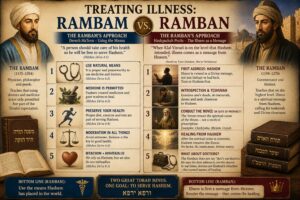
Problem solved? Not even close. Because just when I thought the Gemora had settled the matter, and after the Rambam became a doctor, along came the Ramban (Nachmanides) and turned the entire discussion upside down. He writes (Toiras HoOdom) something that should make every one of us stop and think. When the Yiddin live on the spiritual level that the RBSO intended, they are not supposed to relate to illness the way the rest of the world does. Their first address is not the physician’s office. Their first address is the RBSO. In that world, a Jew who becomes ill should examine his deeds, seek closeness to the RBSO and, in the days when prophecy existed, turn to the Novee. Not because medicine is forbidden, but because a nation living under direct Divine providence experiences illness differently than the rest of mankind. Exactly what that means, ver veyst? As best as my farshtupta kup can chap what the Ramban is saying, it goes something like this:
When the Yiddin are on their best behavior living as the RBSO intended as given over by Moishe, then sickness itself becomes a spiritual message, and not merely a biological event. What happens when one gets sick nonetheless? The illness is not viewed primarily as “bad luck,” germs, or nature; it’s viewed as a communication from the RBSO. It’s time for a change in behavior. The person should introspect, examine his deeds, do teshuvah, daven, and seek closeness to the RBSO. In the era of prophecy, he would go see the Novee. Why? Not because the Novee was a doctor. Because the Novee could identify the spiritual cause of the illness. In our times, many seek the advice of a mikubal who kimat always will tell the male clientele to go to the mikveh because they you have been spilling seed needlessly, or in the wrong places, if you chap. Yikes!
Did the Novee properly diagnose? There are seemingly examples of when this worked. Let’s check out a few for what they might have in common: In the Novee (Melachim II 38:30) Chizkiyahu becomes deathly ill. Who comes to diagnose? Not a doctor. The Novee Yeshayahu who tells him why he is ill. According to Chazal, he took ill because he did not marry and have children. Another seed issue? Ver veyst? When the Plishtim (The Philistines) captured the Aron, they were struck with tumors. Nobody called doctors; they called priests and diviners. They recognized that “this is from the G-d of Israel.” When King Avimelech took Soro to his boudoir, the RBSO closed all the wombs. No doctor. Avrohom davened; they were healed. There are many other examples.
The bottom line: The Novee does not prescribe herbs. Nor does the individual get any medication. The cure comes through Divine mercy after the spiritual defect is corrected. And the doctors? Is there a role for them? The Ramban does not say: Don’t use doctors. He says that in the ideal world where people are mamish connected to the RBSO, the first address is not the doctor; it’s at the RBSO. That said, once the Yiddin no longer lived on that level, they entered the ordinary course of nature, where doctors became the normal means through which the RBSO heals. They are His mediums.
But excuse me! Didn’t the Gemora just tell us that doctors have permission to heal? Didn’t the Toirah itself tell us to pay the doctor’s bill? How can the Ramban seemingly move doctors off center stage? The bottom line: The Ramban appears to place the emphasis on bitochon (faith and belief), direct reliance upon RBSO whereas Dr. Rambam places enormous importance on preserving one’s health. Caring for the body is itself an act of Avoidas Hashem (serving the RBSO). A physician who uses his knowledge to heal another human being is performing a great mitzvah. Shoin, the lines are drawn and the Ois is confused. The heylige Gemora tells the doctor to heal. The Rambam applauds the doctor for healing. The Ramban seems to say that the highest spiritual level is one in which a Jew’s first instinct is not to seek the doctor at all. Who’s right?
At this point, I went looking for the source that tells us exactly when that miraculous healing ended. Was it after the Eigel? After the Meraglim? Forty days later? Forty years later? After some digging, I found a medrish, of course I did! Says Rebbe Shimon bar Yochai (Vayikra Rabbah 18:4) that at Sinai there was no one blind, lame, deaf, or otherwise afflicted. Then it continues:
“וכיון שחטאו לא עברו ימים קלים עד שנמצאו בהן זבין ומצורעים…”
“Once they sinned, not even a short time passed before there were those with discharges and those with tzora’as among them.” Them discharges always came back to haunt, if you chap. And then comes an even more striking opinion: “ורבנן אמרי מן העגל…” “The Rabbis say: It was from the Golden Calf…” They connect the return of affliction specifically to the sin of the Eigel. In other words: Sinai taka brought complete healing. The Eigel brought the return of human frailty, and Moishe, in our parsha, offers the possibility of returning to that covenantal ideal. At some point, sickness returned. It had to. Otherwise, why would the Toirah discuss doctors? Why would Parshas Eikev promise to remove illness in the future? Why would later generations struggle with disease at all?
The bottom line: Perhaps the heylige Toirah isn’t trying to teach us chronology. Perhaps it’s trying to teach us theology. For one breathtaking moment in history, the Yiddin stood exactly where the RBSO wanted them to stand. Spiritually. Physically. Nationally. There was no blindness. No deafness. No lameness. The nation stood before the RBSO complete. Then history resumed. Life went back to normal to what was then and will always be normative behavior. That includes human behavior: we are designed and built to sin. Life became messy again. Various Illnesses, doctors, and medicines once again became part of the human condition.
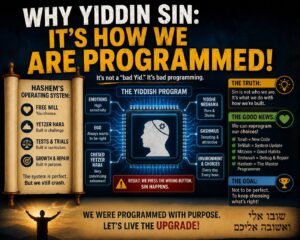
The final bottom line: none of this mattered. The Yiddin sinned before crossing the Jordan River, after crossing, and continue ad hayoim hazeh; all that changed was the location. It’s how we were programmed. Shoin!
A gittin Shabbis!
The Heylige Oisvorfer Ruv
Yitz Grossman
Source URL: https://oisvorfer.com/eikev-2026-the-illness-that-came-back/