Chaya Soro 2026: A Severance Package – Biblical Style
by devadmin | November 5, 2026 7:48 pm
Raboyseyee and Ladies,
Givaldig: We have the pleasure of beginning with a mazel tov by good friends. A big mazel tov to Bonnie and Heshie Schertz upon the birth last week and bris this past Monday morning of their newest grandson -keyn yirbu- born to their children, Dani and Sam Schertz. Mazel tov to Dani’s parents, Michelle and Eli Salig, and welcome to the world Binyomin Yosef Schertz! May you be a source of much and only nachas and joy to all.
A SEVERANCE PACKAGE — BIBLICAL STYLE
This past Shabbos, I listened to a lecture in which this question was posed: Must we consider our holy Ovos (forefathers) to have been perfect? Mamish flawless? More on that below, but let’s begin here.

The expression severance package is a relatively modern one. In America, formal employer severance plans began appearing in the early twentieth century, with the practice expanding during the Great Depression as companies laid off long-serving employees. The idea was simple enough: when the relationship ends, the departing employee should not necessarily walk out with nothing. A payment, calculated according to years of service, might help him survive until he found his next position. That said, the concept of sending someone away with something in his pocket is considerably older. The heylige Toirah (Parshas Re’eh), addresses the release of a Hebrew servant after six years of service. The Toirah is emphatic: “Lo seshalchenu reikam” — you shall not send him away empty-handed. In fact, the master is commanded to provide him generously from his flock, his threshing floor, and his winepress. Apparently, even in biblical times, the HR department understood that a departing employee should receive more than a farewell card and a box of personal belongings. And that said, the heylige Ois will argue that the first recorded severance package can be found mamish in this week’s parsha which features two deaths, two marriages, and the introduction of six additional sons whose names we hear once every year and about whom we know virtually nothing. Welcome to Parsha Chaya Soro; it’s quite the family affair! Soro dies, Yitzchok marries Rivka, Avrohom, apparently unwilling to let retirement interfere with his family plans, takes another wife and fathers six additional sons. Not too shabby a performance for a man of at least 137! Avrohom dies at the age of 175.
What’s on the Ois’s mind this week? It’s the family arrangements, particularly those made toward the end of Avrohom’s life, that deserve a closer look. From what the heylige Toirah tells us bifeirush (explicitly), Avrohom Ovenu was not merely a great patriarch, a baal chesed, and the father of the Jewish people, he was also something of an estate planner. And his approach to succession planning was, shall we say, rather decisive. The heylige Toirah tells us that Avrohom gave everything he owned to Yitzchok. Everything. No equal distribution, no family meeting, no lengthy negotiations with the siblings, no lawyers sitting around a conference table arguing over who gets the house in Chevron and who gets the camels. Yitzchok gets the inheritance. Fartig and period.
וַיִּתֵּן אַבְרָהָם אֶת כָּל אֲשֶׁר לוֹ לְיִצְחָק
But what about the other children? The heylige Toirah continues (Bereishis 25:5–6):
:
וְלִבְנֵי הַפִּילַגְשִׁים אֲשֶׁר לְאַבְרָהָם נָתַן אַבְרָהָם מַתָּנֹת וַיְשַׁלְּחֵם מֵעַל יִצְחָק בְּנוֹ בְּעוֹדֶנּוּ חַי קֵדְמָה אֶל אֶרֶץ קֶדֶם.
“Avrohom gave all that he had to Yitzchok. And to the sons of the concubines who were Avrohom’s, Avrohom gave gifts, and he sent them away from Yitzchok his son, while he was still alive, eastward, to the land of the East.”
Stop the presses! Concubines? How many? When did this go down? The heylige Toirah does not say le-ben hapilegesh — to the son of the concubine. It says “ulivnei hapilagshim” — to the sons of the concubines. Plural. Sons and concubines. More than one? How many concubines did Avrohom have? Who were they? We know about Hogor, and we know that in this week’s parsha the Heylige Toirah introduces Keturah. Rashi, tells us that Keturah and Hogor were one and the same woman. Ok! But even accepting Rashi’s identification, we are left with a grammatical question: why does the Heylige Toirah use the plural pilagshim? Did Avrohom have other concubines whose names and stories never made it into the script? Were there other children? Were these six sons the only ones? The text does not tell us. Rashi’s identification of Keturah with Hogor may answer who Keturah was, but it does not, by itself, explain why the Heylige Toirah chose the plural. Perhaps the plural refers collectively to the sons of the concubines, without requiring us to conclude that there were several women, ver veyst? Perhaps there is another explanation, also, ver veyst, but the larger point remains: we are busy discussing the six sons of Keturah, their gifts, and their eastbound relocation package. Yet the heylige Toirah’s wording seems to leave open the possibility that there were other concubines and perhaps other children about whom we know absolutely nothing.
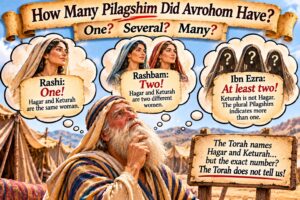
Interestingly, Ibn Ezra takes the word ‘pilagshim’ in the plural very seriously. Unlike Rashi, who identifies Keturah with Hogor, Ibn Ezra says explicitly that Keturah was not Hogor. Why? It’s simple: Because the Toirah uses the plural pilagshim. If Keturah and Hogor were one and the same woman, he argues, the Toirah should have used the singular. Mamish poshit! According to Ibn Ezra, then, Avrohom had more than one concubine. And suddenly our original question becomes even more interesting. Rashi gives us one woman who returns after being sent away. Ibn Ezra gives us a different woman, and apparently more than one concubine. Two very different family histories!”
The bottom line: Avrohom’s family tree may have been considerably more complicated than the version we learned in kindergarten. And the heylige Toirah, as usual, manages to say a great deal with very few words — while leaving the Ois with enough questions to fill another six pages. Well, blow me down! Another bottom line: Whether he had one concubine or many, we know this: he had six more kinderlach sometime after his 137th birthday and maybe even much later; good on him! And we also know this: the man who first enjoyed fatherhood at the age of 86, and waited another fourteen years before Yitzchok was born, now sends six more sons packing?! Expelled mamish! What’s pshat? Avrohom gives Yitzchok everything. The other children receive gifts. And then they are sent away. Not merely out of the house, not to another room, not even to another neighborhood. They are dispatched eastward, away from Yitzchok. By the way, what’s pshat eastward? Where did they go? The heylige Toirah says kedemah el eretz kedem — eastward, to the Land of the East. Avrohom was associated with Chevron, so the natural reference point would be the southern Judean hills. Moving east would take them across the Jordan and toward the territories of the East, eventually reaching the Arabian and Mesopotamian regions. But the heylige Toirah gives us no precise destination. No address, no country, no travel itinerary. Avrohom apparently wasn’t required to disclose the relocation arrangements.

And all that said, might we then not argue that Avrohom invented the severance package long before the corporate world discovered the concept? A parting gift, a new geographical opportunity, and an unmistakable message: your services are no longer required. Have a safe journey. Who were these unfortunate recipients of Avrohom’s generosity? The pisukim have just introduced us to Keturah, whom Rashi identifies as Hogor. She bore Avrohom six sons: Zimran, Yokshan, Medan, Midian, Yishbak, and Shuach. Six boys. Six names. And, for all practical purposes, six people who disappear from the heylige Toirah almost as soon as they arrive.

What did these boys do to deserve this treatment? That is the first question. The heylige Toirah does not tell us that they were wicked, that they rebelled against their father, that they challenged Yitzchok, or that they had any objection to Yitzchok inheriting the family fortune. There is no Soro demanding that they be expelled, no complaint recorded, and no divine instruction telling Avrohom to send them packing. One can imagine that their mother -or mothers- were not very thrilled with this development. The Heylige Toirah simply reports that Avrohom gave them gifts and sent them away. This is particularly interesting when we remember who Avrohom was. We are speaking about the man who opened his tent to strangers, who ran to welcome guests, who pleaded with RBSO to spare the people of Sedoim, and who was prepared to argue with the RBSO Himself on behalf of complete strangers. Yet when it came to his own sons, six of them were given gifts and sent east? Shocking and quite the contrast. Let’s not forget what he did to Yishmoel.
Says Rashi that Avrohom wanted to prevent the sons of the concubines from coming forward after his death and making claims against Yitzchok’s inheritance. In other words, this was not simply a matter of distributing gifts. It was about making sure that Yitzchok’s position as sole heir would not be challenged. Avrohom took care of the matter while he was still alive. Ober the heylige Ois finds that pshat somewhat unsatisfying. Rashi tells us that Avrohom wanted to protect Yitzchok’s inheritance and prevent the other sons from making claims after his death. Fair enough. But why did that require sending six sons away from their father and their half-brother? And their mother or mothers? Couldn’t Avrohom have given them their gifts, made the inheritance arrangements perfectly clear, and allowed them to remain part of the family? Were these six boys making trouble? Had they threatened to challenge Yitzchok? The Heylige Toirah tells us none of this. Then again, this was not the first time Avrohom expelled a child and cut him out. Mamish in last week’s parsha, we read how Avrohom expelled Yishmoel — a child, together with his mother. And now, all these years later, the same? Is there a pattern here? As an aside, if Keturah was taka Hogor, as Rashi tells us, we have an entirely different set of questions. And frankly, I find this question almost impossible to ignore. Why on earth would Hogor return to Avrohom and have six more children with him after the way she and her first son were treated? Was she overstricken or meshuga? Let’s review. Hogor had been given to Avrohom by Soro. She bore him Yishmoel. There was friction between the two women, Hogor fled, and eventually Soro demanded that she and Yishmoel be sent away. Avrohom, following the RBSO’s instruction, sent them into the wilderness with bread and a container of water. According to Rashi, he did not even provide them with silver and gold. And now, years later, this same woman supposedly returns to Avrohom, marries him, and bears him six additional sons? What am I missing? Did Avrohom go looking for her? Did he apologize? Did he promise that this time things would be different? Did Hogor willingly return to the man who had once sent her and her son away? And what did Yishmoel think about his mother returning to the household from which they had both been expelled? Rashi actually makes the question more intriguing. He explains that Hogor was called Keturah because she remained attached to Avrohom and had not been with another man since their separation. So here we have a woman who apparently remained loyal to the man who had sent her away. Quite a story! But the heylige Toirah tells us nothing about the reunion, the reconciliation, or the circumstances that brought them back together. It simply introduces Keturah and gives us six names. The bottom line: if the RBSO didn’t tell us, maybe it’s none of our business.
Perhaps Soro’s death changed the circumstances. Perhaps Avrohom sought Hogor out and brought her back. Perhaps there was a reconciliation that the Toirah chose not to record. Or perhaps there is an entirely different story here. But if Keturah was indeed Hogor, we are entitled to wonder: what happened between the wilderness and the wedding? We should remember, of course, that the identification of Keturah with Hogor is Rashi’s interpretation; the posik itself does not explicitly tell us that they were the same woman. But once we accept Rashi’s identification, we inherit all these questions along with it.
Shoin, let’s compare the two episodes. When Yishmoel was sent away, the heylige Toirah gives us the entire backstory. Soro demanded it, Avrohom was distressed, and the RBSO instructed him to listen to Soro. We know what precipitated the expulsion. With the six sons of Keturah, we are given no such explanation. No demand from Soro, no recorded misconduct, no divine instruction, and no account of Avrohom’s emotional state. Just gifts, followed by a departure eastward. But there is another rather uncomfortable detail. Not all of Avrohom’s departing children received the same severance package. Yitzchok gets everything. The six sons of Keturah receive matonos, gifts, whatever those gifts may have been.

But what about Yishmoel, the original firstborn, who had been sent packing years earlier together with his mother? What did he receive? The heylige Toirah tells us that Avrohom arose early in the morning, took bread and a container of water, placed them on Hogor’s shoulder, and sent her away. That’s the package! No mention of gold, silver, camels, or a generous relocation allowance. Bread and water. Fartig. Says Rashi on the words lechem vecheimas mayim, this: veloi kesef vezahav — no silver and gold. He explains that Avrohom deliberately withheld money because he was angry with Yishmoel over his behavior. Quite a difference from the six younger sons, who would eventually receive gifts before being sent east. May we conclude that Avrohom was not the warmest father? Is there another view?
Ober the Ibn Ezra, on the very posik describing Hogor’s departure, raises the possibility that Avrohom gave her additional silver and gold, although the heylige Toirah does not mention it. More importantly, Ibn Ezra tells us that after Soro’s death, Avrohom gave gifts to Bnei Yishmoel — the sons of Yishmoel, meaning his grandchildren. Not Yishmoel himself, but his children! Ibn Ezra explains that while Soro was alive, Avrohom was obligated to follow her wishes, as instructed by the RBSO. After her death, he was free to show concern for Yishmoel’s family. So perhaps the original departure package was not the whole story. Avrohom may have given Hogor money when she left, and later provided for Yishmoel’s children. What really happened, ver veyst? At least -according to Ibn Ezra- the family was not necessarily forgotten after the expulsion. But this certainly changes the picture. The boy who left with bread and water may not have been left empty-handed after all. Perhaps Yishmoel’s severance package was not denied; it may have skipped a generation. What really happened, ver veyst? Who says that we’re entitled to know every detail? The RBSO decided what to share and not! Veyter.
And then comes another detail that caught the Ois’s eye. When Avrohom dies, who shows up? Yishmoel! The very son who had been sent away with his mother, carrying little more than bread and a container of water, returns to participate in his father’s burial. The heylige Toirah tells us (Bereishis 25:9) explicitly: וַיִּקְבְּרוּ אֹתוֹ יִצְחָק וְיִשְׁמָעֵאל בָּנָיו
“And Yitzchok and Yishmoel, his sons, buried him.”
Notice the order. Yitzchok is mentioned first, although Yishmoel was the older son. Says Rashi azoy: this teaches us that Yishmoel had done teshuvah and gave precedence to his younger brother. The son who had once been the firstborn now recognized Yitzchok’s position. One wonders what happened between the expulsion and the burial. Did Avrohom and Yishmoel reconcile? Did they maintain contact? Did Yishmoel visit his father? Did Avrohom visit him? Did Yitzchok ever develop a relationship with his older brother? We are given the final scene but almost none of the backstory. The heylige Toirah does not tell us whether the brothers had become close, whether the reconciliation happened years earlier, or whether this was simply a final act of respect for their father. Not to worry, many a medrish fills in the backstory and the Ois has written on them over the past 16 years.
Shoin, let’s review the family benefits plan. Yitzchok gets the entire estate. The six sons of Keturah get gifts and a relocation package. Yishmoel gets bread and water, at least initially, and is sent into the wilderness. Yet Yishmoel returns to bury his father, and according to Rashi, does so with humility and recognition of Yitzchok’s rightful place. The original severance package was apparently not the final word in that relationship. Which brings us back to the question that started this whole discussion. How are we supposed to read these episodes? Are we permitted to look at the conduct of Avrohom Ovenu and ask whether every decision he made was necessarily perfect? Can we wonder whether Yishmoel was treated fairly? Can we question why six additional sons, about whom the heylige Toirah records no wrongdoing, were sent away from their father and their half-brother?
As mentioned, the speaker this past shabbis referred to a public statement by Rav Aharon Kotler zt”l, published in Warsaw in 1935, in which Rav Aharon vigorously protested the degradation of the Avos and Imahos. He described them as the loftiest and purest of personalities, the holiest of creatures, and warned against portraying them as ordinary people with ordinary human weaknesses. In other words: The Ovos were perfect, and that their conduct was not to be judged by ordinary human standards. Rav Aharon was famously uncompromising in his defense of the extraordinary stature of our forefathers. That said, the heylige Toirah itself gives us these stories. It tells us that Yishmoel was sent away, that Avrohom was distressed, that the RBSO instructed him to listen to Soro, and that six more sons were subsequently given gifts and sent east. Why does the Toirah tell us all these details if we are not meant to examine them? Are we to assume that every question has an answer, even when the answer is not supplied? Or is the struggle to understand the conduct of our forefather’s itself part of learning Toirah? As you all well know, the questions only get bigger, and at times, even stronger as we read about actions taken and decisions made by Yitzchok and Yaakov, and especially his sons, the holy shvotim. There is plenty to discuss and question. Avada, the Ois does not seek to diminish Avrohom by asking these questions; it’s all part of the heylige Toirah the RBSO decided to share with us. Nor should we presume to judge him. But neither should we pretend that the questions do not exist. The man who argued with the RBSO to save the people of Sedoim also made decisions about his own children that leave us scratching our heads. Especially so in our times. Especially so in times when kimat all rabbis -from every spectrum of the observant world- agree that we are to love and hold onto wayward children, and not -under any circumstances- send them away. Are we supposed to emulate Avrohom’s ways with wayward children? Are we supposed to have favorites? Are we supposed to have pilagshim? How many? Only when the wife passes away or before?
Let’s close with this: We have been so busy celebrating the fact that Yitzchok inherited everything that we have overlooked the other side of the arrangement. What did it mean to be the chosen son, if being chosen, also meant being separated from your siblings? His older brother was sent away when he was a toddler. His six younger half-brothers were sent away when he was an adult. He inherited the fortune, the covenant, and the family business. But what sort of family did he inherit? The heylige Toirah does not tell us whether Yitzchok was lonely, whether he missed his brothers, or whether he ever questioned his father’s decisions. He had Rivka, and eventually he had Yaakov and Eisav. We cannot (though medrish can and often does) manufacture feelings that the pisukim do not record. But we can ask whether there was a price attached to being the chosen son.
And that brings us to another curious feature of Yitzchok. Compared with Avrohom and Yaakov, he is a remarkably quiet figure. He speaks relatively little, and much of what we know about him comes through the words and actions of others. Is that simply his personality? Is it part of the way the Heylige Toirah presents him? Or is there room to wonder whether a life in which siblings repeatedly disappeared from the family circle might have shaped the man he became?
Perhaps being the chosen son meant inheriting everything. Perhaps it also meant being left with considerably fewer people to share it with.
A gittin Shabbis!
The Heylige Oisvorfer Ruv
Yitz Grossman
Source URL: https://oisvorfer.com/chaya-soro-2026-a-severance-package-biblical-style/