Bereishis 2026: Nothing Went According to Plan
by devadmin | October 8, 2026 8:31 pm
Raboyseyee and Ladies,
Nothing Went According to Plan
One Rule, One Murder, Two Wives and a Whole Lot of Excuses
For seventeen years the Heylige Ois has been opening the Chumash to Parshas Bereishis, digging through the pisukim, the Rashi, the heylige Gemora and avada the Medrish, trying to find something that hasn’t already been beaten to death by every rabbi, rebbe, pontificator and blogger. Every year, the heylige Toirah begins with the same words: “In the beginning.” Ober, this year, I will begin by asking a slightly different question. What exactly happened after the beginning? Because if you read Bereishis carefully, the answer is pretty funny and sad: almost nothing went according to plan! Let’s begin.
Hashem creates the heavens and the earth. He creates light, darkness, water, dry land, vegetation, the sun, the moon, the stars, the fish, the birds and the animals. And then He creates man. Everything is orderly. Everything has its place. The heylige Toirah repeatedly tells us that Hashem saw what He had made and it was good. Finally, man was placed in Gan Eden. He had food. He had shelter. He had companionship. He had some work to do. He had an entire garden to enjoy. And he had exactly one rule. One. Not 613. Not a thousand. Not even ten. One little rule: Do not eat from that particular tree. That’s it. There was no Shulchan Aruch. There was no Mishnah Berurah. There was no Daf Yomi. There was no rabbi standing behind him saying, “Nu, Odom, let’s learn this over one more time before you do something stupid.” Odom (Adam) had one commandment from the Almighty Himself, and somehow even that proved to be too much.

And perhaps that is where the heylige Toirah’s story of humanity really begins. Not with perfection, but with failure. Not with a human being who gets everything right, but with a human being who gets one simple thing wrong and then immediately discovers another very human characteristic: the inability to accept responsibility. Shoin, I said it! The RBSO asks Odom why he ate from the tree, and Odom essentially answered, “The woman You gave me.” Not “I made a mistake.” Not “I was weak.” Not even “I screwed up.” No. The woman You gave me. Chava got her turn and explained that the serpent, the nochosh, deceived her. The serpent, unfortunately, had nobody left to blame. Guilty as charged, all of them! And there it is. The first family argument. The first excuse. The first attempt to shift responsibility somewhere else. Before there were lawyers, public-relations consultants, crisis managers, political spokespeople or anybody saying, “I want to be clear,” Odom had already discovered the oldest defense strategy in human history: it wasn’t my fault. Shoin!

This is where the Heylige Ois has to ask a rather uncomfortable and efsher a shtikel irreverent question. Did the RBSO really expect Odom to know how to behave? He was the first human being. There were no parents to teach him. No grandparents to tell him what they had learned from their mistakes. No rabbi or rebbe. No Instagram or TikTok reels with advice. No heylige Toirah. No Sinai. No Jewish mother screaming from another room, “Nu, I told you not to touch that!” No AI. And the kasha is this: So what exactly was Odom supposed to have inside him?
Ober, let’s read this. Our Sages give us a fascinating answer when they discuss the yetzer horo, the little devil in us, the evil inclination. What’s he doing here? To chap, we must look at the famous words “and behold, it was very good.” What was very good? To chap, the Heylige Ois has to take a shtikel detour back to Day Three, because something very interesting happens there. On Day Three, the heylige Toirah says “ki tov” twice. First, in Bereishis 1:10, we read וַיַּרְא אֱלֹהִים כִּי־טוֹב — “and G-d saw that it was good.” Then again in 1:12: וַיַּרְא אֱלֹהִים כִּי־טוֹב — “and G-d saw that it was good.” What’s pshat? Day Two doesn’t get a “good?” Why not? Not because it was bad; because it wasn’t finished. The work involving the waters was still a work in progress. Day Three comes along and finishes what Day Two started — and suddenly we get “ki tov” twice. Once for the completion of yesterday’s unfinished business, and once for today’s new creation. Raboyseyee, already on Day Three we learn something about the RBSO’s creation process: not everything gets finished on schedule. Sometimes yesterday’s mess carries over into today. Sometimes the thing that wasn’t “good” yesterday becomes “good” once the work is completed. Sound familiar?
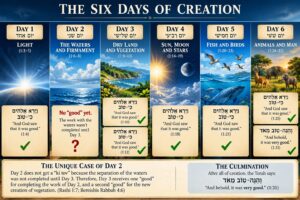
And then, at the very end, after Odom, Chava, Kayin, Hevel and the rest of the human experiment have entered the picture, the Toirah doesn’t merely say “ki tov.” It says: וְהִנֵּה־טוֹב מְאֹד — “and behold, it was very good.” Very good? And as you well know, over the years those words caught the attention of many an exegete, and they ask what changed from merely “good” to “very good.” Among the myriad answers offered by the medrish, is the idea that “good” refers to the yetzer tov, while “very good” includes the yetzer horo. It was very good that the RBSO created and gave us the evil inclination? Really? The Medrish explains that without the yetzer horo, a person would not build a house, marry, have children, conduct business or accomplish many of the things that make human civilization possible. In other words, the yetzer horo is not simply the little devil sitting on somebody’s shoulder whispering, “Do it, Yom Kippur is just around the corner,” along with many other much worse devilish ideas. It is also ambition, desire, competition, appetite, drive and the human urge to possess, create and accomplish. I needn’t tell you about his powers of persuasion; he’s big, mighty and powerful. The same force that can make a person greedy can also make him ambitious. The same desire that can get a person into trouble can also create a family, build a business and produce something that did not previously exist. Who knew how many positive attributes he mamish comes with? Givaldig!
And if that’s pshat, maybe the problem was never that Odom had a yetzer horo. Maybe the problem was that Odom had free will. And free will is a rather dangerous gift. The RBSO could have created human beings who automatically obeyed. That would have been easy. Create a creature, program it to follow the rules, and nobody has to worry about what happens next. No temptation, no rebellion, no jealousy, no murder and no need for the Mabul or many other calamities. But that would not really be humanity. It would be something closer to a very sophisticated appliance. We would all have behaved as instructed and shoin! We’d all be like Teslas in self-driving mode. Instead, the RBSO created human beings with the ability to choose. And immediately, they chose badly. The end? Not, and let’s go veyter in the parsha.

Then comes Kayin. Kayin brings an offering. The RBSO does not accept it in the way Kayin expected. Kayin becomes angry. His face falls. The RBSO warns him with one of the most extraordinary lines in the entire opening of the heylige Toirah: “Sin crouches at the door, and its desire is toward you, but you can rule over it.” Wow! Think about what the RBSO told Kayin. He doesn’t say that temptation doesn’t exist. He doesn’t tell Kayin that he should never feel anger or jealousy. He doesn’t say that having the impulse is itself the sin. He tells him that the impulse is there — and that he is capable of mastering it. The yetzer is crouching at the door. The question is who opens it. Kayin doesn’t listen. Hevel dies. And humanity takes another step away from the idyllic beginning. Now we have jealousy and murder! We’re not even midday into the parsha yet! But the heylige Toirah doesn’t stop there. Kayin has descendants. Civilization begins to develop. People build, invent, create music, work with metal and establish families. Human beings are not merely surviving anymore; they are creating a civilization.
And then we meet a man by the name of Lemech. Now, the heylige Toirah introduces Lemech almost casually. “And Lemech took for himself two wives.” The posik gives us their names: Adah and Zillah. That’s all the heylige Toirah itself tells us at first. But, as the Heylige Ois has been known to say for seventeen years now, when the heylige Toirah gives you one sentence and Chazal give you a whole backstory, you don’t exactly put the Medrish back on the shelf. Rashi on 4:19 wastes no time and quotes the Medrish explaining that Adah and Zillah were not simply two women who happened to be married to the same man. Let’s get real: they represented two different purposes. One was associated with bearing children; the other was maintained for pleasure. Mamish azoy? Indeed, the Medrish describes one wife for פריה ורביה — procreation, and one for תשמיש — sexual relations and pleasure. There’s more: the latter was given a potion to prevent pregnancy; she was dressed and fed like a bride, while the other was effectively neglected and treated like a widow. The first sex toy? Ver veyst?

The Medrish describes a society in which a woman could effectively be assigned a function: one for producing heirs and another for beauty and sexual gratification. And that, raboyseyee, is mamish how Lemech is introduced. Apparently, humanity had not been on the planet for very long before somebody invented the concept of a separate department for reproduction and another for pleasure. Were the two mutually exclusive? And this is where the Heylige Ois has, in the past, repeated one gevaldige line. The heylige Toirah calls him Lemech. But the Ois has always wondered whether perhaps we should have called him Melech, meaning a king. Not because the words are actually the same — they are not: Lemech = למך; Melech = מלך. But they contain the same three Hebrew letters — מ, ל, ך — just rearranged. Lemech was apparently already rearranging the rules. Lemech was already behaving like royalty. Two wives. Children. Status. Technology. Music. Power. And, apparently, the confidence that comes from believing that the rules apply differently to you. He wasn’t wearing a crown, but he certainly seems to have been acting like he owned the kingdom. He certainly used his scepter! Let’s avada give a shout-out to Shlomo Hamelech, King Solomon, who apparently decided that when it came to women, 1,000 was the magic number. For better service, take a number!

And this is where the story gets even stranger, because Lemech is not merely introduced as a man with two wives. He then delivers one of the most cryptic speeches in the early Toirah, a speech involving Kayin, vengeance, sevenfold punishment and seventy-sevenfold vengeance. And this is precisely where the Medrish opens another window and says, essentially, “You think you understand what happened? Nu. Let’s talk.” According to one tradition brought by Rashi, Lemech was blind and his son Tuval-Kayin served as his guide while they went hunting. One day, Tuval-Kayin spotted what he thought was an animal and directed his father where to shoot. Lemech pulled back the bow and killed the creature. Only afterward did Tuval-Kayin realize that the dead “animal” was actually a human being — and not just any human being, but Kayin, Lemech’s ancestor. The same Kayin who generations earlier had killed his own brother, Hevel.
Lemech, horrified by what he had done, struck his hands together in anguish and, in the process, accidentally killed Tuval-Kayin as well. So now, according to this version of events, Lemech had somehow managed to kill both Kayin and his own son, albeit unintentionally. Karma? Es farshteyt zich — it’s easily understood — that his wives wanted nothing more to do with him. He was dangerous and apparently possessed. Lemech tried convincing them to come back. No more sex and no more children!? What could be worse? Yikes! Rashi actually brings this as the explanation for his opening words: “Adah and Tzillah, hear my voice.”
But, raboyseyee, that’s not the only version of what went down. Another Medrish, Bereishis Rabbah, gives us a different — and, if you ask the Heylige Ois, an even more entertaining — explanation. In that version or tradition, Lemech hadn’t killed anybody. His wives had separated from him because they were afraid of the decree against Kayin’s descendants. Kayin had murdered Hevel, and Chazal understood that his punishment had been delayed until the seventh generation. Lemech was the seventh generation, and his wives were essentially saying, “What’s the point of having more children if the whole family is about to be wiped out by the Mabul?”
Lemech then argues that if Kayin, who actually committed murder, was given seven generations before the punishment arrived, surely he, who hadn’t killed anybody, should be given many more — seventy-seven, in fact. And now we finally chap what the hell Lemech meant when he said, “If Kayin is avenged sevenfold, then Lemech seventy-sevenfold.” He wasn’t saying that Kayin received seven generations to atone and that Lemech needed seventy-seven generations to atone. He was making a legal argument. Kayin committed the original murder and still received a seven-generation reprieve; Lemech was arguing that since he hadn’t committed Kayin’s crime, he deserved an even longer reprieve. And the Heylige Ois has to admit: as a legal argument, that’s a pretty creative shtikel kal-vachomer — the classic “how much more so” argument. Unfortunately for Lemech, we’re not sure the RBSO’s heavenly court was accepting briefs. If everybody could use that logic to escape the consequences of what came before them, the RBSO would never collect a debt and never fulfill His word. And raboyseyee and ladies avada, this is mamish the kind of thing the Heylige Ois loves about the Medrish. The Toirah gives us a few cryptic lines and leaves us scratching our heads. Chazal come along and say, “Nu, let’s reconstruct the scene.” Suddenly we’re not merely reading a speech about seventy-sevenfold vengeance. We’re sitting in Lemech’s house listening to a man explain to his two wives why, despite everything that has gone wrong around him, he should somehow be exempt from the consequences.
Apparently, the first generations of humanity had already discovered what every lawyer, politician and successful gonif eventually discovers: if you can’t win on the facts, try a different interpretation of the rules. The heylige Toirah gives us the headline; our Sages give us the police report. And sometimes the police report is a hell of a lot more interesting than the headline.
And now something even more interesting happens. The problem is no longer just individuals doing bad things. The whole system became bad. The heylige Toirah tells us: וַתִּמָּלֵא הָאָרֶץ חָמָס — the earth became filled with chamas: violence, theft and corruption. What chamas has become over the years is for another day. The heylige Gemora and Medrish tell us that the generation of the Mabul had become so corrupt that their final sentence was sealed specifically because of gezel, robbery. Ober, what kind of stealing were they doing? Says the Medrish that they would steal less than a perutah from each other. One guy takes a little. Another guy takes a little. Nobody takes enough for the victim to have a legal claim against any one person. But put it all together? The whole basket is gone. Givaldig. They had figured out how to steal while remaining technically innocent. They didn’t eliminate the law. They learned how to game it.
And suddenly Bereishis sounds very familiar. Odom says, “The woman You gave me.” Kayin says, “Am I my brother’s keeper?” Lemech gives us his own explanation of why things aren’t really his fault. And now an entire society is saying, “I didn’t technically do anything wrong.” Nu, what could possibly go wrong? That’s the yetzer horo at its most sophisticated. It doesn’t always tell you, “Go do something terrible.” Sometimes it whispers, “It’s not really stealing.” A little here, a little there. Everybody does it. It’s under the threshold. Technically, you’re allowed. And before you know it, the whole basket is gone. The yetzer horo has graduated. It was no longer simply saying, “Take it.” Now it was saying, “Find a way to take it without getting caught.” And that, raboyseyee, is the progression of Bereishis. Odom sinned and blamed someone else. Kayin killed. Lemech rationalized. And eventually, an entire generation institutionalized the rationalization. The yetzer horo had gone from an individual temptation to a business model. Not one bad apple, raboyseyee. The whole damn orchard.
And before you call for my excommunication into some cheyrim, don’t forget that the facts on the ground, as they appear mamish in the heylige Toirah, do support the Ois’s theories. That said, raboyseyee, there is one more kasha we cannot simply walk away from. If the RBSO knew that Odom would sin, that Kayin would kill Hevel, that Lemech and his generation would continue down the wrong path, and that eventually the entire world would become corrupted, then what exactly does the heylige Toirah mean when it tells us that the RBSO “regretted” having made man? The posik says:
וַיִּנָּחֶם ה׳ כִּי עָשָׂה אֶת הָאָדָם בָּאָרֶץ –The RBSO regretted that He had made man on the earth.
That sounds mamish like buyer’s remorse. The RBSO made the purchase, watched the thing go south, and was now wondering whether He should have kept the receipt?! Of course, the heylige Medrish doesn’t let us get away with such a simple understanding. In Bereishis Rabbah 27:4, our Sages wrestle with this very problem. Rabbi Yehuda understands the posik as expressing regret: had the RBSO created man in the heavens, perhaps man would not have rebelled. Rabbi Nechemya reads the very same idea in the opposite direction and finds consolation in the fact that man was created on earth, because had humanity been created in the heavens, perhaps we would have corrupted the heavens as well. And then Rabbi Aivu gives us an absolutely gevaldike interpretation for the Heylige Ois: perhaps the regret was connected specifically to the creation of the yetzer horo. Had there been no yetzer horo, perhaps man would not have rebelled in the first place.
So, what are we supposed to do with that? The same yetzer horo that the Medrish earlier described as part of “very good” — because without it people would not build houses, marry, have children, conduct business and accomplish things — is now being mentioned in connection with the RBSO’s regret. Might that be the ultimate irony of the human condition? The very thing that makes us capable of greatness is also the thing that makes us capable of spectacular stupidity. Desire can build a family or destroy one. Ambition can build a business or turn a person into a gonif. Pride can motivate a person to accomplish something extraordinary or convince him that the rules apply only to everybody else.
The problem isn’t necessarily that the RBSO put something defective into Odom. Perhaps the problem is that He put something extraordinarily powerful into him and then gave him the freedom to decide what to do with it. And perhaps that is why the heylige Toirah doesn’t end our parsha with the Mabul. Farkert! The Mabul belongs to next week’s parsha. Bereishis ends us right at the moment when the RBSO looks down at the world and sees that the human project has gone terribly wrong. The wickedness of man was great upon the earth. The world was filled with chamas. And the posik tells us that every inclination of the thoughts of his heart was only evil all day long. OMG!
And then comes that extraordinary statement: the RBSO regrets having made man and His heart is saddened. But even there, the Medrish gives us something remarkable. Rashi, quoting Chazal, explains that the sadness is not evidence that the RBSO was somehow surprised by what happened. A person can know intellectually that a child will someday die and still rejoice when that child is born; when there is joy, there is joy, and when there is mourning, there is mourning. Chazal use that human experience to explain how we can understand the RBSO’s grief over His creation even though the future was already known.
And Rashi makes the point even stronger: despite knowing what would eventually happen, the RBSO did not refrain from creating humanity because of the righteous people who would eventually emerge from them. And maybe, just maybe, that is the answer to this week’s title: Maybe nothing went according to plan. Maybe Odom was never supposed to be perfect. Maybe Kayin was never supposed to get everything right. Maybe the existence of the yetzer horo, the ability to choose, the capacity to screw up, the ability to rationalize, and even the possibility of teshuvah were all part of the package called “being human.”
The RBSO could have created a world populated by creatures that never disobeyed, never sinned, never argued and never made a mistake. But that world would also have had no courage, no ambition, no creativity, no teshuvah, no growth and no human achievement.
It would have been a world of appliances, not a world of people. And so, after seventeen years of reading Parshas Bereishis, perhaps the Heylige Ois has finally figured out what happened after “In the beginning.”
The RBSO created the world, gave Odom almost everything he could possibly want, handed him one rule, gave him free will, and watched humanity immediately begin testing the limits. Odom blamed Chava. Chava blamed the nochosh. Kayin killed Hevel. Lemech apparently decided that two wives were better than one and that he could live by a set of rules somewhat different from everybody else. Generation after generation became more sophisticated, more ambitious and, unfortunately, more creative at finding excuses for their behavior.
And yet the RBSO kept going. Not that humanity got it right. We didn’t. Not even close. The miracle is that after every screw-up, every failure, every excuse, every act of jealousy, every murder and every spectacularly bad decision, the story continued. The RBSO didn’t abandon the project. He didn’t say, “Fine, this was a bad idea. Let’s start over with angels.” Farkert! He continued with imperfect human beings. Over and again. And maybe that’s the great message of Bereishis. The RBSO could have abandoned the project the first-time mankind screwed it up. Had He done that, there would be no Avrohom, no Moishe, no Jewish people, no heylige Toirah, no Yerusholayim, no Shabbis, no Yom Tov, no kiddush, no cholent — and, most importantly, no Heylige Ois sitting here seventeen years later trying to figure out what the hell Lemech was up to.
Perhaps man was never designed to succeed every time. Perhaps man was designed to fall, decide whether to blame somebody else or accept responsibility, and then get his sorry ass back up. Maybe that’s Bereishis. In the beginning, there was a plan. Then humanity happened.
A gittin Shabbis!
The Heylige Oisvorfer Ruv
Yitz Grossman
Source URL: https://oisvorfer.com/bereishis-2026-nothing-went-according-to-plan/